
Guest post by NANDINI RAO
Picture credits: Rakesh and Alana

“I want to break free…”. The Freddy Mercury anthem rang out in the cold winter night, in the middle of a busy marketplace in Delhi. One by one, a group of women appeared out of the crowd and started dancing to its compulsive beat. People gathered around, cheering them on and some women from the audience joined in too. Synchronising steps, the dancers swayed to the medley of music as it moved on to Hindi songs, a snatch of Spanish and finally, the compelling Punjabi phrase “Sadda haq, aithey rak!”. This was officially the first flash mob (or “mob dance”, as we call it) of the members of the Citizens’ Collective against Sexual Assault (CCSA).
The Citizens’ Collective against Sexual Assault (CCSA) is a Delhi/NCR-based group of organisations, individuals and activists from women’s movements and progressive movements. It works towards addressing issues of sexual violence against women, girls and transgender people. It raises awareness among the public, media, administration and the police on issues of gender rights. It works collectively to build an environment of safety in Delhi, Noida and Gurgaon.
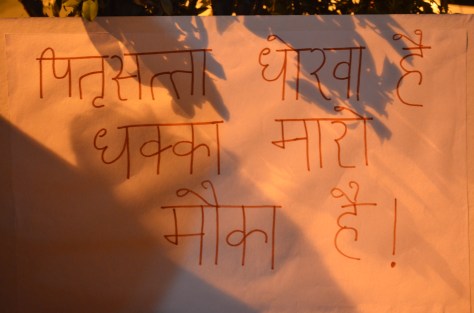 The Collective organised its first Take Back the Night (TBTN) campaign on December 31, 2012, as a way to claim back the streets on New Year’s Eve, a night when people are in a mood to eat, drink, dance and be merry. This was a moment when we – and other Delhiites – were very emotional about the brutal assault of Jyoti and her friend, and her subsequent death a few days earlier. The campaign was held in a crowded marketplace, where the participants from women’s, students’ and progressive groups were joined by a huge group of onlookers. Many of the latter had left the bars, restaurants and dhabas, where they were ringing in the New Year, to join the ragtag group on the street singing about lighting candles to overcome the surrounding darkness. We expressed our sorrow at losing sisters across the country to patriarchal violence (in homes, workplaces and by state forces). We also remembered those who were still struggling and inspiring us all. That evening, the march that started at the market went on for about half a kilometer, with hundreds joining in. It was a moment to rejoice in this solidarity. CCSA decided to once again reiterate messages of struggle and solidarity and reclaiming consent in a New Year’s Eve campaign on December 31, 2013.
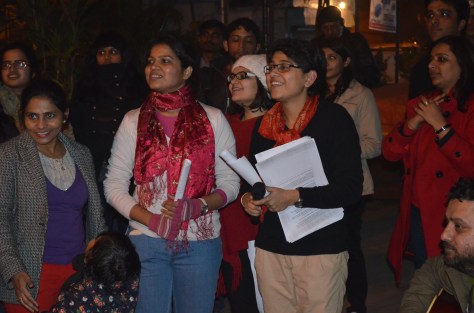 A week before, a collective maelstrom took place (“brainstorm” does not cover the extent of the discussions). Ideas were shared, argued, debated over, some agreed upon, others discarded and finally, the work of putting it all together began. The group decided to do a “mob dance”, to sing, march, leaflet and engage with the public on the streets. We were not sure what would come out of it (apart from us shivering on one of the coldest winter nights in the season). But we were certain that we wanted to send out messages of reclaiming consent at the end of a year of lows and highs.
The past year has witnessed lows and highs. Tragedies like Muzaffarnagar took place under the nose of an indifferent state; the battles of people who were attacked there continue in the biting cold. The endless struggles of victims of the Gujarat carnage go on. Section 377 was re-imposed by the Supreme Court, and effectively condemned by the public, sexuality rights’ and human rights’ groups from across the world. Domestic workers’ rights (here, as well as in diplomatic circles) and sexual harassment in the workplace formed part of several “mainstream” discussions. In an amazing display of collective power, a gram sabha in a small village in Orissa, voted against the might of a mining giant. Political discourse was changing right in front of our eyes as people asserted their choice of parties and political leadership.
It was time to once more stake our claim to consent over socio-cultural, political and economic spaces. Taking back the night seems more necessary today than ever before.
 Being part of movements working on issues of rights, we always worry about how to effectively reach out to the public. How can we share our passion about “doing the ‘rights’ thing”, yet, be inclusive and not put up people’s backs while discussing difficult issues? How can we share complex messages of gender violence, patriarchy and empowerment in ways that are compelling and yet, will resonate with the ordinary person on the street? We spend endless hours debating among ourselves about this place versus that one, this date or that, seminars against workshops, marches versus media interactions, singing versus dancing. As if choosing one necessarily precludes the other. How about … can we march, sing, dance, sloganeer and reach out to ordinary people on the streets? Either the threads unravel or they weave to form a perfect tapestry. December 31, 2013 was one such moment when the Take Back the Night campaign organised by the CCSA fell in place with a satisfactory click.
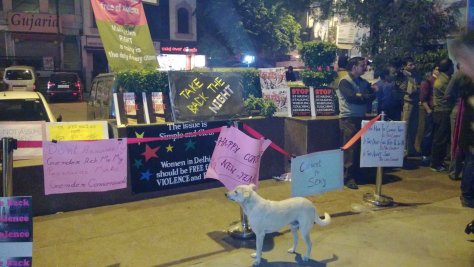 Yet, here too, patriarchal forces kept trying to shoulder their way into the peaceful TBTN campaign. Almost from the word go, the group got badgered by the Delhi Police. First they tried to push us out of the area that we had placed placards and banners and where we were dancing and singing. Seizing the chance, we marched towards a place full of bars and restaurants, buzzing with well-heeled Delhiites. That made the police scramble about some more! The Deputy Commissioner of Police (DCP) himself tried to intervene by talking about the violation of laws (clearly, drunken revelry by the rich does not fall into the same domain). Two police vans hovered, waiting to pick up the marchers, as black-scarfed commandoes of the Delhi Police ran behind us holding machine guns in their hands! What the Delhi Police officials did not understand that night was that they were displaying the negative might of the state, by aggressively focussing on the peaceful campaigners of CCSA. Over three hours that the group was on the road, the police tried to convince, bully, coerce and finally, threaten a group that had essentially gathered to peacefully discuss issues of rights. Group members explained, argued, demanded, ignored and finally, simply refused to engage with officialdom.
Over the coming year, CCSA plans to organise many more such TBTN campaigns and resolves to reclaim all the spaces that are rightfully ours. The Collective stands with women and girls across the country (from small towns & villages to the big cities) fighting violence of all kinds: economic violence, state-sponsored torture, domestic violence against women & girls, sexual harassment at workplaces & public places. It stands with domestic workers struggling for economic justice and social security, as well as with sex workers demanding a dignified living and work environment, the Dalit movement fighting caste atrocities, as well as with victims of draconian laws like the AFSPA in the Northeast and Kashmir.
CCSA resolves to relentlessly reclaim consent and rights in the coming months of 2014 and beyond!
CCSA Members can be contacted at ccsaindia@gmail.com and www.facebook.com/groups/sbandolan.
 KAFILA - COLLECTIVE EXPLORATIONS SINCE 2006