All posts by Aditya Nigam

Wastelands of Rajasthan: Aman Dedhia

Guest post by AMAN DEDHIA

It has been a while since my time in Rajasthan. It took a while to collate and make sense of everything I saw, understood and documented during my time there. I have tried to write down the major parts of it in this not-so-short document. To set some context, in the two weeks I was there, I met the people from the Oran padh yatra, people from KRAPAVIS and other organisations and, most importantly, stayed in a few villages in Jaisalmer where the people were kind enough to show me around. What started with an urge to understand orans, conservation and their problems with solar projects, took me on a journey that at its core was about understanding wastelands and autonomy.

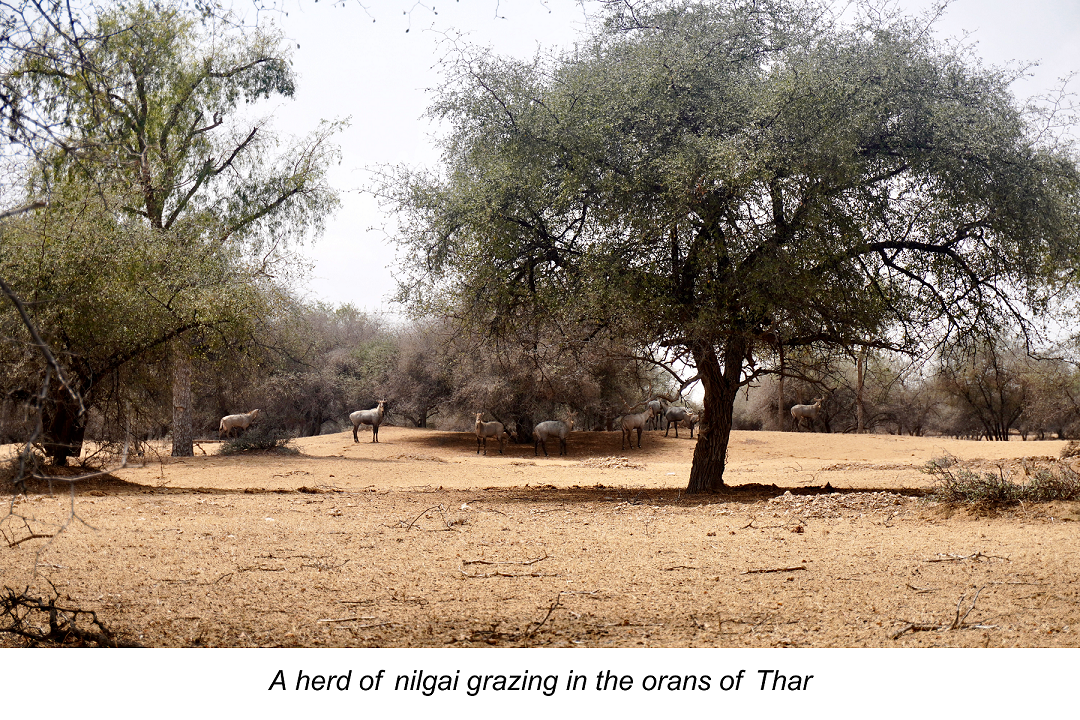
Nilgais grazing

Orans

I’d like to begin by shedding some more light on what orans (also known as deobani or rundhs) are, since they’ve been at the centre in the attempts to protect the region. Orans are sacred groves that belong to the temples of the villages and are protected ecosystems spread out across Rajasthan in every village you go. They’re basically community conserved desert forests holding a significant religious value. I came across herds of neelgai, peacocks, gazelles, huge herds of cows and goats, all grazing in these orans. They are protected in the sense, they are not used for agriculture and are mostly community conserved, being used as grazing grounds and for non-timber forest products. That is not to say that there are no encroachments on these lands. Many villagers have encroached on the boundaries of these orans for farming, borewells, shops and other establishments. A lot of people, especially in western Rajasthan do depend on these orans for livelihood. Regions that are mostly dry and on the fringes, which is a huge part of Jaisalmer, only have seasonal farmlands, if any, dependent on the short monsoon rains. A decent amount of people here are primarily dependent on pastoralism. Orans are a major part of the grazing lands supporting their pastoralism and in turn, their livelihood. There are roughly 25,000 orans across Rajasthan, accounting for roughly 6 lakh hectares of land.[1] Another important thing to note is that all of these orans have some sort of water body, mostly made and maintained by the people, that plays a key role in making the ecosystem thrive, providing an oasis for the fauna and flora of the region. Continue reading Wastelands of Rajasthan: Aman Dedhia

The Missing Link – How the Great Democracy Robbery Was Conducted

A fundamental mistake is being made by many well-meaning people with respect to the West Bengal election results, For instance, many people are comparing the votes deleted in the farcical “SIR” exercise with the loss of roughly that same amount of votes in TMC’s “final” tally. The closeness of these two figures  – 27 lakhs in the case of deletions (under the logical discrepancy category, though the actual figure should be much higher), and the decrease in TMCs vote  – still falls far short of the BJPs 2.92 crores or so. If one goes by the “final figures” provided by the ECI, the TMC got only 2.60 crores in comparison suggesting that the BJP would have won hands down, even without “SIR”.
Of course all those trying to normalize the big fraud that elections have progressively become since 2019, intentionally or innocently,  also routine resort to such so-called “final figures”. The Godi Media is the biggest player in this heist of the public mind and it has been ably playing this role this time too.

Continue reading The Missing Link – How the Great Democracy Robbery Was Conducted

Heat in the Indian Cities – A Reality More Complex than Tree Cover: Soumya Dutta 

Guest Post by SOUMYA DUTTA

Delhi, my current ‘home town’ for over 30 years, increasingly looks like a City that is learning to sweat, as  it slowly descends into a  Humid Heat environment, from a largely dry and hot summer.
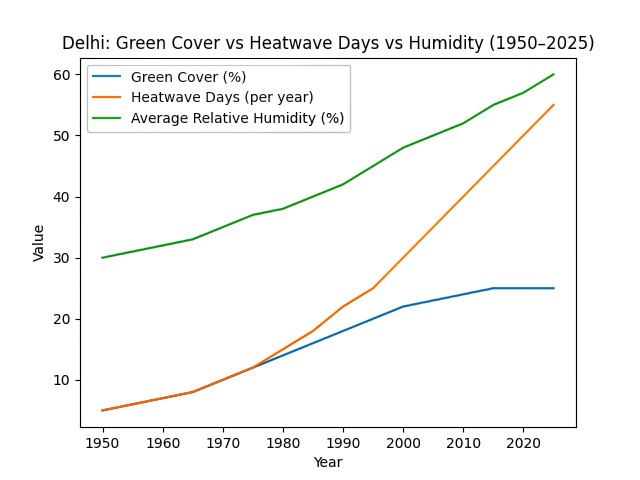
Delhi Green cover Heatwave Days and Humidity
For a tad over three decades, I have lived through Delhi’s summers. I distinctly remember a time when heat here had a certain clarity – harsh, yes, but mostly dry. Except the occasional breaks by a storm or ‘aandhi’,  which brought the temperatures down, but left it mostly dry.  The afternoons scorched, the loo winds burned your skin, and yet early mornings and  evenings offered a measurable  respite from the high temperatures. Sweat quickly evaporated in the dry air, allowing our bodies to naturally cool down by the loss of heat of evaporation. Nights cooled, at least enough to sleep – because the dry rocky surface quickly re-radiated heat back to space. And that heat had a much clearer escape route, as the atmospheric  air had much lower moisture, a powerful heat trapping green house gas .

Continue reading Heat in the Indian Cities – A Reality More Complex than Tree Cover: Soumya Dutta 

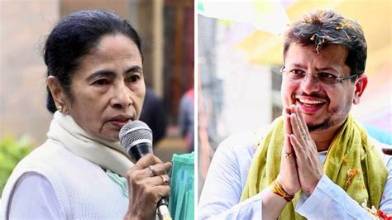
Statement in Protest of the Violent Meme targeting Mamata Banerjee and the Muslim Community

Following is a statement signed by 1815 people protesting against the violent anti-Muslim and misogynist meme that had been circulating, targeting West Bengal Chief Minister Mamata Banerjee.

We, the undersigned people from different walks of life, express our deep revulsion and anger at the vicious meme, targeting the Chief Minister of West Bengal, Mamata Banerjee, which has been circulating in social media on this day April 27, 2026. We are attaching with this statement, a blurred image of the meme, along with the profile of the person who circulated it – they call themselves a “Rightwing Nationalist” based in Bhadohi, Uttar Pradesh – so that our compatriots know what we are protesting against.

The meme is not only violent and misogynistic, it is also viciously anti-Muslim. It depicts the Muslim – perhaps the “Bangladeshi Muslim” – as passing through Mamata Banerjee’s open legs and is titled “This is Momta Culture” – while of course, giving us a splendid view of the meme creator’s own sanskari culture.

Through this statement we want to appeal to the people of this country, our compatriots, and to those in the judiciary, and elsewhere in the system, who still stand in defence of minimum standards of probity in public life. We want to underline that this is a challenge to our justice system that such hate speech against an entire community and a woman politician can be aired and shared with complete impunity.

We also want to underline that it is the culture of rape and misogyny that has been encouraged by the ruling party at the centre that has led to this situation that anybody can air whatever comes to their hate-filled minds. We have not forgotten the release of the rapists of Bilqis Bano, the killing of the Hathras rape victim, the destruction of the entire family of the Unnao rape victim; nor have we forgotten the Kathua rape or the killing of Ankita Bhandari for failing to provide “special service” to a senior leader of the ruling party or giving an election ticket to sexual harassment accused former chief of the Wrestling Federation of India. In all these cases, we have witnessed complete silence from the top leaders of the ruling party including the prime minister and home minister.

We do not want to address the creators of the meme for we know that they are products of this frightful hate machine that “Rightwing Nationalism” (their appropriate self-description) is. Rather, we are interested that our institutions of democracy and justice play the role that they should be playing in order to ensure minimum standards of probity in public life. Continue reading Statement in Protest of the Violent Meme targeting Mamata Banerjee and the Muslim Community

The Indian Nation State and Its Discontents: Ravindra K. Jain

Guest post by RAVINDRA K. JAIN

ABSTRACT

The nation-state that is the Indian Union comprises a diversity of socio-cultural minorities and a ruling majority. The decoupling of nation and state highlights a contradiction rather than the integration of socio-cultural diversities and political functions of governance. This contradiction is marked by a double deficit of democracy, namely, authoritarianism and citizenship. A potted history of three phases of modern India explores the roots, symptoms and provenance of this democratic deficit in the present conjuncture.

Keywords Apologetic patriotism; nation state and state-nation; late colonial, early post colonial and Hindutva phases; nationalism and social polity; caste, class and power.

I analyse the Indian State sociologically in three phases of continuous chronological succession: A. The Late Colonial, B. The Paternal post-colonial and C. The current Hindutva. Each phase is characterized by a dual deficit: authoritarianism and citizenship. In order to elucidate the origin and perpetuation of this dual deficit, I would delve into the potted history of each phase. Continue reading The Indian Nation State and Its Discontents: Ravindra K. Jain

‘Our wages were stolen and we forced a correction’ – NOIDA workers: Anumeha Yadav

Guest post by ANUMEHA YADAV

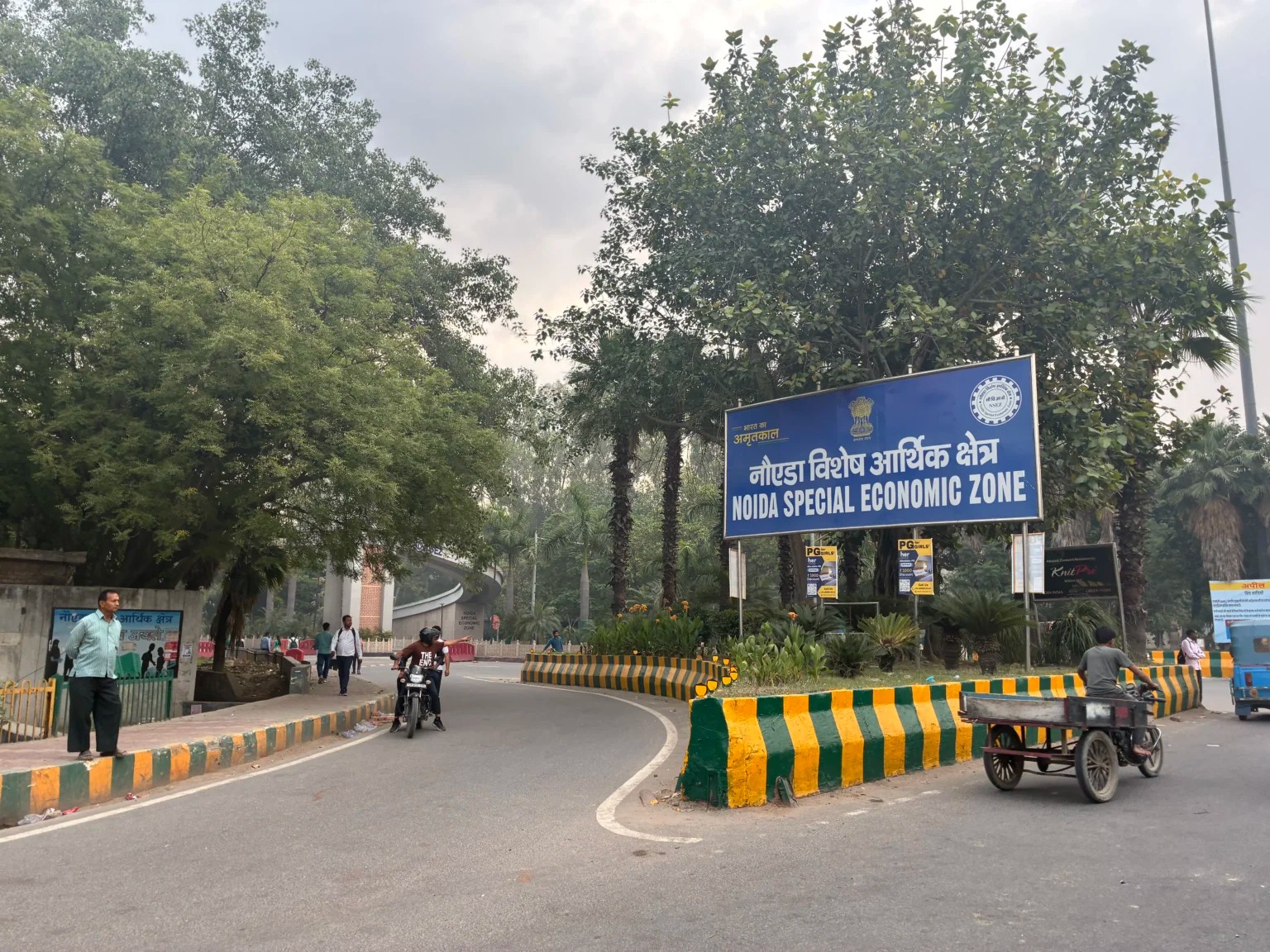
NOIDA, Uttar Pradesh: At 8 am, an hour before factories would start work. Maina Devi* waited for her company bus on the sidewalk next to a large warehouse in Phase 2 of Noida’s industrial area.

Way to NOIDA SEZ, image Anumeha Yadav/The Migration Story

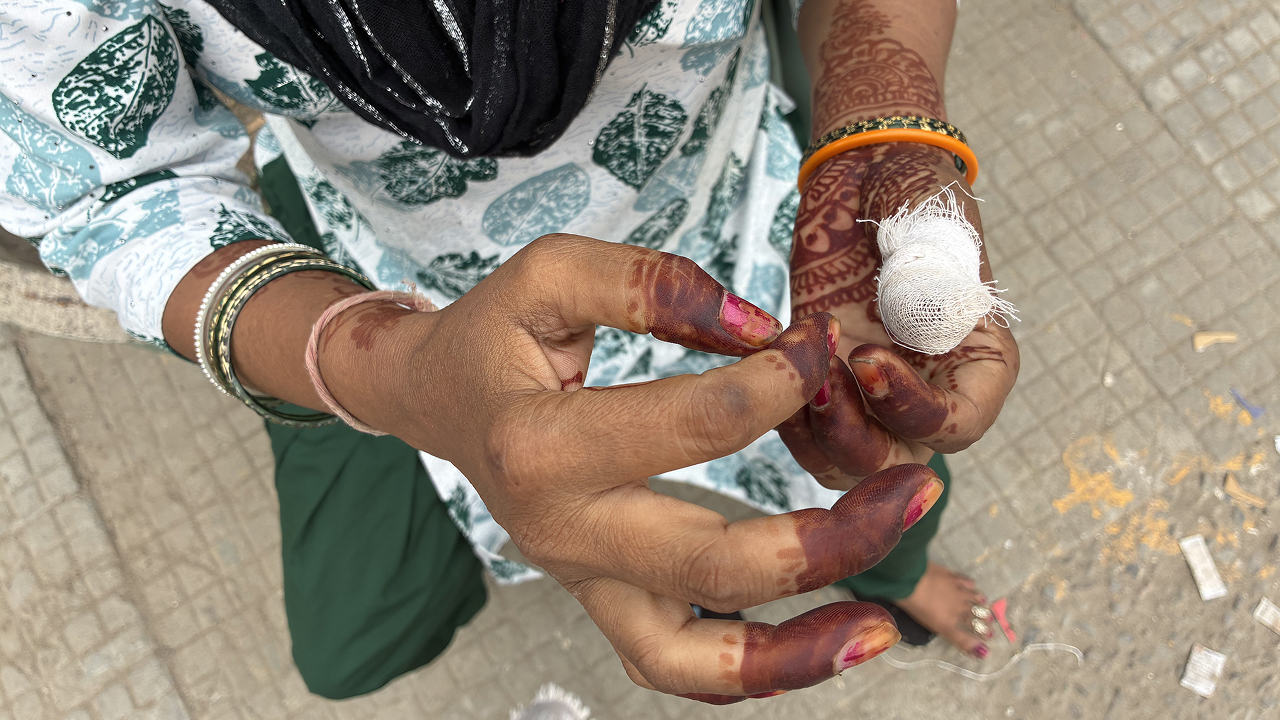
It had been a week since she and hundreds of workers from multiple factories on the borders of Delhi stopped work for four days protesting low wages and difficult work conditions. Several factories still had visible damages. Amid the continued police presence, fresh notices on factory gates reassuring workers of revised wages, Devi was heading to work, her thumb in a fresh bandage.

Maina Devi before rushing off to work, image Anumeha Yadav/ The Migration Story

Continue reading ‘Our wages were stolen and we forced a correction’ – NOIDA workers: Anumeha Yadav

Theory After Gaza: Decolonizing the Political

[The essay below is based on a presentation at a recent workshop on Theory from the Global South and a part of a longer work. Some of its claims are therefore, necessarily tentative. – AN]

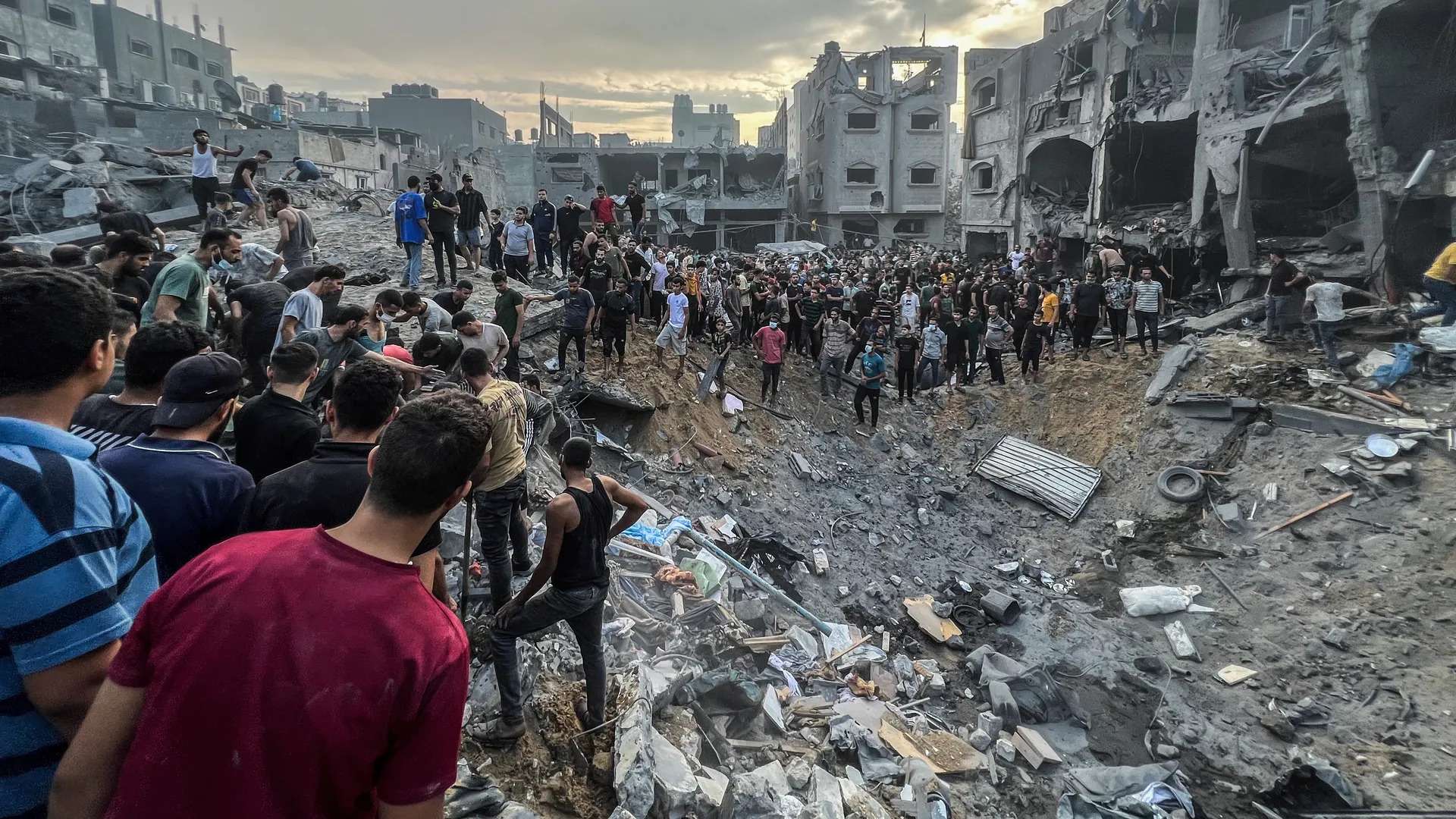
Gaza, December 2024, Courtesy Euro-Med Human Rights Monitor

What is happening to Gaza/Palestine today is a horrible genocide, the likes of which has rarely been seen. Yet, it must be asserted that not exceptional or unique – but entirely of a piece with the history of the colonial expansion of the West over five centuries. Gaza reveals, in a flash, the long-erased histories of settler colonialism and genocides; it reminds us that that history is very much part of our living present. Gaza strips the mask of “civilization” donned by the “enlightened West” that has long portrayed us in the global South as lesser, uncivilized beings worthy of being enslaved, used as cannon fodder and ultimately, exterminated. That was what we saw in the unrepentant colonizer’s speech by US Secretary of State, Marco Rubio at the Munich Security Conference. But in stripping off the masks of “civilization” from their faces, Gaza shows up how repeatedly, over and over again, the same script has been played, regardless who was in power in the Axis of Evil countries of Europe, UK and the US.

But more importantly, Gaza forces us to retell the whole story of the past five centuries by setting aside the received mythologies of “the political” and of “Enlightenment”. Gaza demands that we put at the centre of our narrative, not states and nations but those millions of dispossessed by settler colonialism, driven to death in imperialist wars and thrown around from one part of the world to another as “stateless” people, “refugees” and “minorities”.  Even though, in the interim, Palestine must have its own sovereign state to survive in this world of armed state, Gaza/Palestine demands a complete overturning of the very possibility of a repetition of another Gaza/Palestine ever again. It demands of us that we dismantle the entire theoretical edifice undergirding dominant narratives; it demands that we start telling the story from the vantage point of the people at the receiving end of that hallowed thing called “modernity” – that most people in the global South experienced as coloniality and what has been called “war capitalism” by historian Sven Beckert – which I will discuss below. Continue reading Theory After Gaza: Decolonizing the Political

Bangladesh in Transition – Understanding Election in the Aftermath of the July Uprising : Sohul Ahmed

Guest post by SOHUL AHMED

[We bring for our readers, this essay by Sohul Ahmed, which details the context and background of the recently held Bangladesh election. Though a cacophony of voices from the Right to the Left in India had already pronounced their  shared judgement of an “Islamic takeover” of Bangladesh via the July Uprising, what this essay details the extremely significant political process through which the July Charter was formulated, signed on to by 33 parties, and how the most orderly and peaceful election was held in the country just two weeks ago.  This article rebuts the general impression created by this Right-Left propaganda in India that supreme chaos reigns in Bangladesh. Since this article was written, a new government has been formed with a Hindu  and a Chakma-Buddhist face each, in the cabinet. The main Islamic party has been trounced in the elections. So much for all the doomsday prophesies about post-July Bangladesh. That does not mean everything is fine – and Ahmed explains the complications that still exist. – AN]

Bangladesh elections, representational image, courtesy Reuters/ BBC

Bangladesh stands at a crucial juncture in its political transition following the July Uprising. The country witnessed its national election almost one and a half years after the ousting of Sheikh Hasina’s autocratic regime – an election widely regarded as one of the most consequential moments in the country’s political history. Our characterization of this election as “crucial” or even “historic” has deep roots in Bangladesh’s recent electoral experience. Continue reading Bangladesh in Transition – Understanding Election in the Aftermath of the July Uprising : Sohul Ahmed

वीबीग्रामजी रद्द करो,  मनरेगा बहाल करो : कार्यकर्ताओं और संगठनों की मांग

[निम्नलिखित बयान साठ से ज़्यादा ऐसे संगठनों और कार्यकर्ताओं की तरफ़ से 15 फरवरी को जारी किया गया है  जिनका मनरेगा  के कार्यान्वयन से संबंध रहा है। ]

हम, नीचे दस्तखत करने वाले एक्टिविस्ट्स, जो भारत के कोने-कोने में मनरेगा मजदूरों के साथ काम करते हैं, महात्मा गांधी राष्ट्रीय ग्रामीण रोजगार गारंटी अधिनियम (मनरेगा) को खत्म करने की कड़ी निंदा करते हैं, जो माँग पर मिलने वाला काम के अधिकारका प्रोग्राम था।

हमारा मानना है कि:

– मनरेगा महाराष्ट्र की रोजगार गारंटी योजना से सीख लेकर भारी समर्थन और बातचीत के बाद शुरू किया गया था।


पहली बार हर परिवार को 100 दिन का काम मिलना पक्का किया गया था। Continue reading वीबीग्रामजी रद्द करो,  मनरेगा बहाल करो : कार्यकर्ताओं और संगठनों की मांग

Bangladesh Beyond the Ballot – The Struggle Begins Now: Sohul Ahmed

We are reproducing an article written by SOHUL AHMED on the eve of the Bangladesh elections, earlier published in Bengali in Prothom Alo, Dhaka. The English version was published in Ahmed’s Substack, yesterday, 12 February. A researcher on genocide and democratic politics, Sohul Ahmed is already familiar to Kafila readers. We publish this piece here because it helps us understand the current elections as but a moment in the larger process of transformation unleashed by the July Uprising of 2024.  An important reason for publishing this piece here is because Bangladesh’s difficult struggle for democratic transition holds significant lessons for us – in our struggles in the times to come. – AN

Image courtesy Mohammad Ponir Hossain/Reuters

After fifteen years of autocratic rule, Bangladesh is re-entering an electoral phase. This election is significant for two primary reasons: first, it reactivates a stagnant electoral process and initiates a transition toward a competitive system; and second, it seeks to establish a sustainable political settlement that institutionalizes this process.

The upcoming election serves as both a national vote and a referendum. Far more than a simple contest for power, it is a fight to reclaim the essential democratic entry points lost over the past fifteen years. By functioning as a referendum, this process seeks a mandate for the structural reforms and political settlements necessary to build a truly democratic foundation for the country. Continue reading Bangladesh Beyond the Ballot – The Struggle Begins Now: Sohul Ahmed

Support the Rojava Revolution, Condemn Syrian Interim Government’s and IS Offensive: Kurdish Women’s Foreign Relations Office

We are publishing this statement by the KURDISH WOMEN’S FOREIGN RELATIONS OFFICE in support of the valiant struggle of the Rojava Revolution to defend itself.

Rojava Revolutionaries, image courtesy ‘Women Defend Rojava’ (womendefendrojava.net)

The Syrian Interim Government under interim president al-Shaara, has declared war on the Democratic Autonomous Administration of North and East Syria and its achievements for women. Since 6 January, the situation in the region has been escalating. After militias of the so-called Syrian Interim Government launched a military attack on predominantly Kurdish neighbourhoods in Aleppo, forcing hundreds of thousands of residents to flee and committing brutal massacres, they turned their attacks towards northern and eastern Syria, surrounding them on all sides. Through a genocidal campaign of destruction against the Kurdish people – especially women – the Democratic Autonomous Administration of North and East Syria, a democratic project based on women’s liberation, grassroots democracy, ecology, and pluralism, is now under threat of destruction.

These attacks represent a massive escalation of systematic violence against women and their hard-won rights. Jihadist groups driven by a deeply misogynistic and patriarchal mindset are targeting, killing, kidnapping and subjecting women to sexual violence. In doing so, they are terrorising women as a means of destroying entire communities. In recent days, we have received horrific videos and reports from the region showing women’s bodies being deliberately desecrated by being thrown from houses and mutilated. Continue reading Support the Rojava Revolution, Condemn Syrian Interim Government’s and IS Offensive: Kurdish Women’s Foreign Relations Office

Deal With the Problem, Not the Activists; Control Polluters, Not Those Demanding Accountability! – NACEJ

The National Alliance for Climate and Environmental Justice (NACEJ) strongly condemns the raids, searches, and intimidation of climate activists Harjeet Singh and Sanjay Vashisht by Indian enforcement agencies.

Recent actions by the Enforcement Directorate (ED) and allied agencies—reportedly based on alleged violations of foreign exchange regulations, vague claims of threats to “energy security,” and unsubstantiated intelligence inputs—have been carried out without transparency or disclosure of credible evidence. Public reporting indicates reliance on anonymous official briefings, rumoured intelligence reports, and speculative allegations, with officials unwilling to come on record. Continue reading Deal With the Problem, Not the Activists; Control Polluters, Not Those Demanding Accountability! – NACEJ

“SIR” Is a Process of Mass Disenfranchisement

The Solution

After the uprising of the 17th June Election of 2024

The Secretary of the Writers Union Prime Minister’s Office

Had leaflets distributed in the Stalinallee the message sent out via Nagpur

Stating that the people

Had forfeited the confidence of the government

And could win it back only

By redoubled efforts. Would it not be easier

In that case for the government

To dissolve the people

And elect another? – [Courtesy Bertolt Brecht]

The way things are going with the SIR, we are heading for the regime “electing its people” – with the full participation of the Opposition parties, who despite the knowledge of the process, have become unwilling participants. Not knowing how to respond, they seem to be running around like headless chickens. “Vote Chori” and the so-called “Special Intensive Revision” (SIR) are closely tied together and though Rahul Gandhi seems to have got the import of what this means, reports suggest that RSS “sleeper cells” within and outside the Congress Party are hyperactive now, trying to undermine the campaign against vote chori. Some INDIA bloc parties have even openly distanced themselves from it. Continue reading “SIR” Is a Process of Mass Disenfranchisement

Beware of Aadhaar – A Warning on India’s Biometric Identity Model: Statement by Organizations and Concerned Individuals

Following is a statement issued on 10 December 2025, by over 50 organizations and 200 plus individuals on the reported adoption of the “Aadhar model” by some other countries.

We, concerned Indian citizens and organisations, are alarmed to note that efforts are being made to promote biometric identity systems similar to Aadhaar in other countries.

Aadhaar is India’s unique identity number, linked with a person’s biometrics (fingerprints, iris and photograph as of now). The number was rolled out with fanfare from 2009 onwards. The use of this number, and of Aadhaar-based biometric authentication (ABBA), was promoted to the hilt by the Indian government in close collaboration with the IT industry. Aadhaar was supposed to be voluntary, but it quickly became clear that living without it would be very difficult for most. Today, it is as good as compulsory. Most social benefits are out of reach without Aadhaar.

Aadhaar was rolled out in an explicitly “evangelistic” mode from day one. In recent years, it has been projected as a grand success by its promoters. Their friends in high places (like Davos, the World Bank, and the B&M Gates Foundation) are on board. There is an attempt, partly successful already, to project Aadhaar as a model and “export” it to other countries. Continue reading Beware of Aadhaar – A Warning on India’s Biometric Identity Model: Statement by Organizations and Concerned Individuals

Wildlife-Human Conflict – Non-intervention is No Longer a Choice: Sandeep Menon

Guest post by SANDEEP MENON

[Earlier this year, Kerala government sought the permission of the central government to kill wild animals that “post a threat to life and property”, declaring human-wildlife conflict a state-specific disaster.  As wildlife-human conflicts rage with a new intensity across different parts of India, the author underlines the need to go beyond knee-jerk reactions and put in place proper policy measures. The issue itself is highly controversial and even emotive and we present this essay here to put things in perspective and proposes some measures that are currently being debated among wildlife enthusiasts. – AN]

Photo courtesy Biplab Hazra and Think Wildlife Foundation

On the 24th of Nov 2025, a 70-year-old Adivasi woman was tending her goats on revenue lands near Masinagudi in Tamil Nadu, when she was killed and dragged into the bushes by a Tiger. It paid little heed to the shouts of witnesses who saw it moving the body to a nearby waterhole. Between late October and November, multiple attacks on people and livestock were reported from the Nugu region near Nagarhole in Karnataka, leaving 3 farmers dead and one critically injured. Including one farmer who had just recovered from a broken hip bone caused by an earlier elephant attack. In response to intense public pressure, over 23 tigers (including many cubs) have been captured from non-forest areas in a span of one month. A huge number for a small rural landscape around two sanctuaries. In many cases, operations were hindered by mobs, who screamed and pelted stones upon sighting the animal, leading to heightened aggression. One of the tigers was found to have a festering snare wound, while another was the mother of 5 healthy cubs. Things took an interesting turn, when experts found it hard to match one of the Tigresses to existing wildlife databases. Raising the possibility that she might have been completely raised outside protected areas. Nor were they all transitionary, weak or infirm animals. Some of them were found to be healthy individuals, simply finding new spaces to eke out a living. It is unclear what the department intends to do with all the captured tigers and cubs. If they end up in captivity, that would be a tragic outcome that serves neither the individual animal nor the species. Continue reading Wildlife-Human Conflict – Non-intervention is No Longer a Choice: Sandeep Menon

The Day the Colloquium Fell Silent – Bureaucratic Diktat and the Fate of Thought: S. M. Faizan Ahmed

Guest post by S. M.  FAIZAN AHMED

Image courtesy The India Forum

The resignation of Professor Nandini Sundar from the convenorship of the seminar colloquium at the Department of Sociology, Delhi School of Economics, has left an emptiness that language struggles to fill and words can barely cover. The seminar she was to host, titled Land, Property and Democratic Rights, was to be delivered by Dr. Namita Wahi, a senior fellow at the Centre for Policy Research and one of India’s most thoughtful legal scholars on land rights.

The event formed part of the department’s long-standing Friday Colloquium series—among the oldest and most cherished intellectual traditions in Indian academia. Over the decades, nearly every major figure in the social sciences has presented a paper here at least once. More than a seminar, it has been a ritual of conversation—one that has weathered political shifts, personal rifts, intellectual disagreements, and institutional flux, sustaining across generations a living legacy of thought, dialogue, and learning. Continue reading The Day the Colloquium Fell Silent – Bureaucratic Diktat and the Fate of Thought: S. M. Faizan Ahmed

A Shadowed Present and the Onus of Thought – Remarks, Non-Polemical or Otherwise: Sasheej Hegde

[This concluding essay of the series in Kafila titled Decolonial Imaginations. Links to the previous essays are given at the end.

The terms ‘decolonization’ or ‘decolonial’ have become quite critical now, given that the impulse of justice lies at the core of these concepts. Neither postcolonial nor decolonial perspectives are compatible with right-wing ideologies but the fact that Hindutva ideologues in India and the rightwing globally are now trying to appropriate that language makes it seem to some that the very idea of the postcolonial or decolonial is suspect. We believe that this demonizing of decolonial theory from a position defensive of the European Enlightenment needs to be unpacked in the interests of a mutually productive debate. Kafila has been publishing a series of interventions on what the idea of the decolonial imagination involves, locating decolonial theory as speaking from the margins, drawing attention to identities which the orthodox Left subsumed under ‘class’ and which the rightwing in India seeks to assimilate into Brahminism. Additionally the orthodox Left’s rejection of spiritual beliefs and inability to engage with them is also a factor that may have produced the space for right wing appropriations of a field marked “religion”. 

We hope that these interventions will clear the ground for productive conversations on the Left rather than polarised and accusatory claims that mark some spurious claims to ‘correctness’.]

Register

In a superbly crafted, and provocative, essay titled ‘In Defense of Presentism,’ the historian David Armitage (2023) has tried to re-present the prospects of ‘presentism’ for historians particularly (even though the essay has its lessons for various practitioners across domains, critical or otherwise).  As he notes: ‘Historians are trained to reject presentism: we are likely to argue that our duty is to the past and its inhabitants – and not to the present and certainly not to the future.’  But, as he shows with great analytical acuity and detail, historians are deploying the word ‘presentism’ in a variety of ways, which he then goes on to unravel, while making a case for what historians ought to be opposing and what about the present they can comfortably be accepting.  My brief is surely not to detail the intricacies of Armitage’s argument for my readers here – although I would urge them to read and absorb the essay themselves (even as my moves here have been made possible by it).  Rather, my effort is to quickly address some critical aspects of the ‘presentism’ that underwrites contemporary scholarship in India (and elsewhere) – although, again, for the purposes of this formulation, I shall limit myself to Meera Nanda (2025) and the terms of her critique of postcolonial and decolonial theory (henceforth PDT).  My own relationship with PDT has been an ambivalent one – and, hopefully, a recent contribution will clarify that (Hegde 2025) – and there are also aspects of the critique mounted by Meera Nanda that I agree with.  But this is not the ground that I will be traversing here in this short note. Continue reading A Shadowed Present and the Onus of Thought – Remarks, Non-Polemical or Otherwise: Sasheej Hegde

Left, Right, Left – Notes on Radical Post/De-Coloniality: Gita Chadha

[This post is the ninth – and penultimate – essay of the series in Kafila titled Decolonial Imaginations. Links to the previous essays are given at the end.

The terms ‘decolonization’ or ‘decolonial’ have become quite critical now, given that the impulse of justice lies at the core of these concepts. Neither postcolonial nor decolonial perspectives are compatible with right-wing ideologies but the fact that Hindutva ideologues in India and the rightwing globally are now trying to appropriate that language makes it seem to some that the very idea of the postcolonial or decolonial is suspect. We believe that this demonizing of decolonial theory from a position defensive of the European Enlightenment needs to be unpacked in the interests of a mutually productive debate. Kafila has been publishing a series of interventions on what the idea of the decolonial imagination involves, locating decolonial theory as speaking from the margins, drawing attention to identities which the orthodox Left subsumed under ‘class’ and which the rightwing in India seeks to assimilate into Brahminism. Additionally the orthodox Left’s rejection of spiritual beliefs and inability to engage with them is also a factor that may have produced the space for right wing appropriations of a field marked “religion”. 

We hope that these interventions will clear the ground for productive conversations on the Left rather than polarised and accusatory claims that mark some spurious claims to ‘correctness’.]

Much has already been said in this set of essays on the difference between two kinds of Indian responses to colonial western modernity. These responses can be classified as the left leaning post(de)-colonial theories and the right-wing responses that may also be classified, by some, as post(de)-colonial theory. This set of essays are in conversations around the allegation that the former feeds into the latter. It is evident to many of us doing post(de)-colonial theory on the left that the difference between the two is unmistakable. Yet, this is missed by many on the left, leading to much misrepresentation; and by many on the right, leading to much appropriation. We also know that the responses to modernity from post(de)-colonial theories on the left are fractured on multiple axes, religion and faith being a major one. Due to the common worlds we inhabit, it is indeed possible for much confusion to occur. I think the act of demarcating the players, the fields, and the actions of the oeuvres, the right and the left is important, especially for a pedagogic purpose.  Each generation seeks clarification in the classroom on several of these confusions and debates. While demarcating the difference regularly and rigorously is an important intellectual exercise for everyone in the discourse, doing this is also an ethical responsibility, particularly for those who do not wish to be either misrepresented or appropriated, which is basically those who are not bedfellows with the orthodox left and definitely not with the orthodox right. The demarcation is required to be done in multiple domains of theory as well as practice. This set of essays seeks to precisely do that. Continue reading Left, Right, Left – Notes on Radical Post/De-Coloniality: Gita Chadha

When Decolonisation turns Inward – On the Dangers of Methodological Nationalism: Sabah Siddiqui

[This post is the eighth essay of the series in Kafila titled Decolonial Imaginations. Links to the previous essays are given at the end.

The terms ‘decolonization’ or ‘decolonial’ have become quite critical now, given that the impulse of justice lies at the core of these concepts. Neither postcolonial nor decolonial perspectives are compatible with right-wing ideologies but the fact that Hindutva ideologues in India and the rightwing globally are now trying to appropriate that language makes it seem to some that the very idea of the postcolonial or decolonial is suspect. We believe that this demonizing of decolonial theory from a position defensive of the European Enlightenment needs to be unpacked in the interests of a mutually productive debate. Kafila has been publishing a series of interventions on what the idea of the decolonial imagination involves, locating decolonial theory as speaking from the margins, drawing attention to identities which the orthodox Left subsumed under ‘class’ and which the rightwing in India seeks to assimilate into Brahminism. Additionally the orthodox Left’s rejection of spiritual beliefs and inability to engage with them is also a factor that may have produced the space for right wing appropriations of a field marked “religion”. 

We hope that these interventions will clear the ground for productive conversations on the Left rather than polarised and accusatory claims that mark some spurious claims to ‘correctness’.]

When I first encountered postcolonial theory as a young scholar, it felt like an opening into a new way of understanding the world. Much of my introduction came through Indian thinkers, some of whom were not located in India, yet their work spoke powerfully to questions of colonial legacies, subjectivity, and the politics of knowledge. These early engagements helped me grasp the goals of postcolonial scholarship: to make visible the structures of power that colonialism left behind and to explore the ways in which it continues to shape our systems of knowledge and self-representation. Over time, however, I noticed a subtle shift; the language of postcolonial studies seems to have receded somewhat, while the term decolonial has gained prominence as a way to address questions of knowledge and authority in the present moment. Other contributors to this blog series have traced the rise and relative decline of postcolonial thinking in South Asia. I still resonate with postcolonial analysis, and have used it within my own work, but for the purposes of reflecting on the current politics of knowledge in Indian universities, I am choosing to engage now with the decolonial project.

Continue reading When Decolonisation turns Inward – On the Dangers of Methodological Nationalism: Sabah Siddiqui

Colonialism, Modernity and Science: K. Sridhar

[This post is the seventh essay of the series in Kafila titled Decolonial Imaginations. Links to the previous essays are given at the end.

The terms ‘decolonization’ or ‘decolonial’ have become quite critical now, given that the impulse of justice lies at the core of these concepts. Neither postcolonial nor decolonial perspectives are compatible with right-wing ideologies but the fact that Hindutva ideologues in India and the rightwing globally are now trying to appropriate that language makes it seem to some that the very idea of the postcolonial or decolonial is suspect. We believe that this demonizing of decolonial theory from a position defensive of the European Enlightenment needs to be unpacked in the interests of a mutually productive debate. Kafila will be publishing a series of interventions on what the idea of the decolonial imagination involves, locating decolonial theory as speaking from the margins, drawing attention to identities which the orthodox Left subsumed under ‘class’ and which the rightwing in India seeks to assimilate into Brahminism. Additionally the orthodox left’s rejection of spiritual beliefs and inability to engage with them is also a factor that may have produced the space for right wing appropriations of a field marked “religion”. 

We hope that these interventions will clear the ground for productive conversations on the left rather than polarised and accusatory claims.]

It is impossible to think of modernity and colonialism, without thinking of their third sibling – science. They are not just siblings, in fact, but a set of triplets which took birth within the same western context and period – and hence, the adjectives ‘modern’ and ‘western’ are used to qualify science, often by the colonizers themselves. Just as the notion of ‘savage native’ was a part of colonial construction, so was the idea of ‘modern science’. Not only did the colonial powers conquer people and knowledge systems across the world, but they also established hegemony within their own societies, colonizing them from within. This was done using complex mechanisms of power, control and appropriation. Continue reading Colonialism, Modernity and Science: K. Sridhar

Javed Akhtar, Bollywood and Urdu’s Ghostly Existence – Rashid Ali

Guest post by RASHID ALI

Image courtesy The Hindu

Javed Akhtar’s recent ‘exile’ from the West Bengal Urdu Academy event did more than generate headlines. It dwarfed a bigger debate about Urdu in Hindi cinema, which was the event’s main theme. The media precipitately reduced the whole issue to the conflict between the lyricist and the Urdu Academy. The controversy carried a tinge of ‘Muslim fundamentalism,’ reflecting today’s cultural and political ideologemes. However, the discussion on Bollywood’s uneven relationship with Urdu was lost in the sound and fury of cultural climate of the country. Et tu, Brutus?’ finds a new stage – ‘Et tu, Bollywood?’ You speak against the very world that gives you voice. Continue reading Javed Akhtar, Bollywood and Urdu’s Ghostly Existence – Rashid Ali