
Guest Post by SAJAN VENNIYOOR
What is the purpose of a political ad?
The page-killer print ad, the giant hoarding, the radio jingle and the TV spot do not serve to inform or educate the public, but only to impress them. These are peacock tails, gambling on the handicap principle that reliable signals must be costly to the signaler, and cannot be afforded by those with less worth. They are public displays of political virility, the media equivalent of a baboon’s red butt which signals the animal’s potency not just to the female but to the entire tribe.

Last month, DNA newspaper reported that the Congress is ‘buying endless radio air time in Mumbai promoting the Rajiv Awaas Yojana, the UPA’s flagship housing scheme.’
“I was told by a frustrated journalist friend,” says the correspondent, “that this was a classic example of ignorant, senseless media planners and buyers in the industry. The Rajiv Awaas Yojana, she told me, was not even applicable in Mumbai.” Obviously, this rookie journo, like the EC, doesn’t get the point. These ads are not meant for the beneficiaries, any more than full page MNREGA ads in the Times of India, Delhi edition, were meant to be read by unemployed, landless peasants.
The information content in most political ads can be written on the margins of a bus ticket, with enough room left over for the Hanuman Chalisa. For his 1952 presidential campaign, Adlai Stevenson had bought half-hour commercials on TV, but the pundits of Madison Avenue were already beginning to package candidates like Fruit Loops. (Stevenson actually did say, “The idea that you can merchandise candidates for high office like breakfast cereal is the ultimate indignity to the democratic process.”)
Political ads don’t appeal to the human intellect. They play on our hopes and fears, and seldom rise above the level of dim-witted symbolism that supposedly cost Rajiv Gandhi the 1989 elections, or the Rs. 700 crore India Shining campaign dreamt up by the whiz kids of Grey Worldwide in cahoots with NDA’s finance minister Jaswant Singh, that doomed the BJP in 2004.
“‘India Shining’ is all about pride,” said Pratap Suthan, who coined the memorable slogan. “It gives us brown-skinned Indians a huge sense of achievement,” he said, shortly before being struck by an iceberg and sinking without a trace.
Kabab and sharab
Channeling campaign funds through political ads on radio and TV, rather than directly to voters in cash and kind, is little more than a switch from illegal corruption to legal corruption.
The media’s laid backness about political advertisements, its own bread and butter, is in stark contrast to its moral indignation about liquor distribution to the poor. Come the elections, the media erupts in a rash of reports on the ‘illicit flow of liquor and money’ in ‘Expenditure Sensitive Pockets” (read: slums) where, one is led to believe, no illicit liquor flows otherwise. Daily sales and stock positions of over 10,000 liquor shops are being closely monitored in Goa, the press informs us with grim satisfaction. (10,000 liquor shops in a state the size of a pool table? Holy cow).
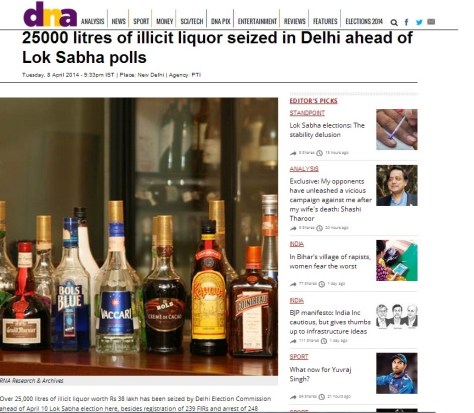
There were three consecutive dry days during poll week in Delhi this month and it’s not surprising that enterprising bootleggers stocked up in anticipation of demand. Still, the headlines scream, “25000 litres of illicit liquor seized in Delhi ahead of Lok Sabha polls”, helpfully illustrated with pictures of Grand Marnier, Kahlua and Cointreau bottles implying that Delhi voters, while susceptible of inducement, are men of refinement and excellent taste.
 “Un plus bouteille de Chartreuse, camarade, s’il vous plaît”
This Brahminical abhorrence of free alcohol should be contrasted with the intellectual pleasure derived from contemplating 80 foot hoardings of Dr. J Jayalalithaaa or watching the Modi Rap on TV. Ranging from dire predictions that “democracy will vanish if bribing voters becomes standard practice” (Prabhu Chawla) to incoherent noises indicative of disapproval (Arnab Goswami), the thought of voters being bribed with alcohol and cash gets the knickers of news anchors and op-ed writers in a twist.
Perhaps it wouldn’t be so bad if poor voters were given the Collected Works of Vivekananda or bottles of gangajal.
Just days before the Lok Sabha elections kicked off, I read with dismay in the newspapers that quantities of IMFL were seized in excise raids across the Andaman & Nicobar Islands. “Police strongly believes that such large numbers of liquor bottles were kept for using the same before and during elections by political parties,” said one news report. Though “no link with any political party has been found yet”, such large quantities of liquor, opined Andaman Sheekha darkly, raises many questions.
Having spent a few blissful years in Port Blair, I have fond memories my friendly neighbourhood bootlegger. Karupiah, as I’ll call him, had a modest but steady business, and he prudently stocked a crate or two of IMFL in anticipation of dry days, like polling dates.
On any given day, raids across the Andaman & Nicobar Islands would produce illicit IMFL bottles by the score.
On any given day, especially a dry day, raids across India would produce illicit liquor bottles by the thousands. Yet the media, the Election Commission, the excise department and various other uniformed organs of the state prefer to ignore this minor fact of life in the moral panic that sets in shortly before elections.
The media is obsessed with liquor bottles. They have a particular loathing of the half and quarter bottle, as popularized by Keshto Mukherjee in 1970s movies, symbolic of the sottish habits of the underclass. In aspirational India, many respondents cheerfully admit they’d sell their votes for cash, mobile phones and TV sets, but cheap liquor seldom figures on their wish-list. Yet, of all the gifts – sarees, cricket sets, mobile phones, mixer-grinders, TV sets and laptops, to name but a few – by which the upstanding Indian citizen is induced to part with his vote, the one that’s guaranteed to send a frisson of horror riding up the spines of TV anchors is alcohol.
The Representation of People Act 1951 is, of course, pretty anal about the “receipt of, or agreement to receive, any gratification, whether as a motive or a reward” by voters. Nishkama karma is the watchword. Former Chief Election Commissioner Dr. SY Quraishi is particularly scathing about feasts thrown by rich candidates for their poor constituents, especially the lavish helpings of “biryanis, kababs and sharaab” that mark pre-poll festivities.
The notion that a tot of IMFL or an extra helping of galouti kabab might unduly influence voters comes naturally to the former CEC (though the suggestion that an endless stream of government propaganda masquerading as ‘awareness programmes’ might also unduly influence the voter would be pooh-poohed by the former Director General of Doordarshan, Dr. SY Quraishi).
The Advertising Code of the Cable TV Networks (Regulations) Act is pretty clear that “no advertisement shall be permitted, the objects whereof, are wholly or mainly of a religious or political nature; advertisements must not be directed towards any religious or political end”. This code also applies to radio, but you wouldn’t think so if you were to switch on a TV set or radio these days, where there’s probably more political ads than programming.
When TV channels, outraged at seeing cash and alcohol flow into the grubby hands of voters instead of their own, petitioned the Andhra High Court to strike down the ban on political ads, the government argued that the “prohibition on ads of political nature on cable networks is to prevent well-funded and resourceful individuals or organisations from using money power and the power of TV advertising to distort the balance of political debate and the electoral process”.
Nevertheless, the Andhra HC lifted the ban in 2004, saying that the law against political ads on TV was “violative of the right to freedom of trade and business”. Spending crores of rupees on political ads and infantile jingles is evidently more virtuous than giving away saris to poor women, especially if you own a TV channel.
The Advertising Code for broadcasters still prohibits political ads, but, with the blessings of the Supreme Court and the Election Commission, TV channels earn millions from election campaign ads. Estimates put the total advertisement and publicity budget across political parties at Rs. 4,000-5,000 crore.
(Having won the right to carry political ads, TV channels are now engaged in a bitter fight to stop the regulator from enforcing a 12 minute cap on TV ads. As Amarchand & Mangaldas – the law firm of choice for many media companies – admits, TV networks have “reluctantly agreed […] to confine advertising to less than 30 minutes”, which confirms what we have always suspected, that advertisements routinely exceed programming on many TV channels).
Giving back to the giver
The concept of the media as an impartial and virtuous intermediary between political parties and the voter is of fairly recent vintage. The need for a righteous intermediary to intercede with janata janardhan is, as far as I can tell, a Brahminical construct. “In the mythic introduction to the ancestral offerings, Apastamba says: tatra pitaro devata brahmanas tv ahavaniyarthe (In this (ritual) the Pitrs are the divinity, but the Brahmins stand in for the offertorial fire).”
And not just any old Brahmins, but ones in good standing in society, with high TRPs.
Also, if you please, navavaran bhojayed ayujah (feed an uneven number of Brahmins – but at least nine) srothriyan vagrupavayahsilasampannan (or as many as you can afford) which, as we know, is the fundamental principle behind media planning and buying.
Elections in India are no longer the riotous celebration of democracy they once were. They have become sterile, bureaucratic exercises run by media planners – and the Vogons of Nirvachan Bhavan – who have taken all the joy out of street-level campaigning. It is not surprising that the party best known for taking the battle to the streets – a few slaps notwithstanding – is the Aam Admi Party, which is also the only one that says government should pay for equal advertising for all political parties. According to the AAP manifesto, “Political parties [are] to be provided equitable access to information and media space. Distortions of the media such as paid news, unlimited media advertisement and misuse of public money for advertising the ruling party to be regulated.”
This is not entirely an original idea. The equitable sharing of airtime on TV and other electronic media during elections is already in the Representation of the People Act (Section 39A). The possibility that rich parties and candidates could, inequitably, buy loads of air-time on radio & TV is not recognized either by the Representation of the People Act or the Cable TV Networks Act.
Invested as they are in media ad campaigns, the Election Commission fails to understand the meaning of gift-giving. Like the Canadian government that banned potlatches, the EC condemns the ancient tradition of the gift-giving feast as ‘bribery’, and considers it unproductive, illegal and contrary to civilized values.
By the way, the Kwakwaka’wakw responded creatively to the anti-potlatch law passed by the Canadian government:
Sometimes, they held potlatches around Christmas time, arguing that they were following the Christian tradition of distributing presents. At other times they gave away sacks of flour and sugar as well as boxes of pilot biscuits, arguing that they were giving their hungry relatives food. Photographs of such potlatches show stacks of these commodities, piled high in a manner reminiscent of Hudson’s Bay blankets. A container holding a commercially-produced foodstuff, although ostensibly a source of nutrition for hungry relatives, was now an ingenious indicator of resistance.
‘Sensible Objects. Colonialism, Museums and Material Culture’, Elizabeth Edwards et al.
Ceremonial gift-giving has never been about bribery; it’s about demonstrating wealth and prominence, presumably useful qualities in a leader.
The unstated advantage of channeling corporate campaign funds into political ads, instead of kababs and sharaab, is that the money eventually comes back to the giver. Between them, the Ambani brothers own substantial chunks of Indian media, with Mukesh Ambani controlling some 30 TV channels, including English and regional language news channels, while Anil Ambani owns internet and mobile portals as well as India’s largest private FM radio network. In a laudable display of value chain management, a goodly portion of campaign expenditure flows back into the Ambani coffers through political ads placed on their media outlets,
The mainstream media is understandably coy about discussing this conflict of interest.
Meanwhile, Jaswant Singh of India Shining fame, for whom India didn’t shine a whole lot since 2004, fortunately didn’t lose touch with his inner thakur. By the next elections – presumably having no access to government funds for expensively banal ad campaigns – Singh took the direct marketing route and distributed cash to voters during election meetings in Barmer. “It is my duty to help the poor,” he mumbled unintelligibly. “If Congress thinks helping poor is a crime, I cannot help it; I’ll continue to help poor people.”
It’s an old Rajputana tradition.
 KAFILA - COLLECTIVE EXPLORATIONS SINCE 2006
It was disgusting to have Narendra Modi staring right at me in the beautiful mornings the past few weeks!The ads in ToI looked as though the paper was owned by him. In Nagaland Morung was the one paper that refused to carry any party ads in the front page and thus denied the opportunity to earn some money!!
LikeLike
Hard hitting and witty.
LikeLike
It is so rarely we get something to laugh at while appreciating the double standards of media…..usually we’re grinding our teeth and wondering how the people of India are going to cope with this huge malfeasance of the media….
LikeLike
Both the Congress and BJP will lose. BSP’s Mayawati is a silent Integrator of all societies that will balance for Sarvajan Hitaye Sarvajan Sukhaye i.e., for the welfare and happiness of all societies.
Stealth Cult RSS is a monkey that steals the butter and Modi is just a goat where the monkey smears the butter on the goats mouth to escape getting caught.
LikeLike
Bribing The Voters
Retired Chief Election Commissioner , S Y Quraishi , is all set to release his book ,
” The Undocumented Wonder : The Making of the Great Indian Election ”
Talking to DNA ( 15 April 2014 ) he listed some 40 different ways in which , Political Parties try to bribe voters
Some of these are :
> Cash
> Depositing money in voter’s bank account
> Liquor Bottles
> LPG Cylinders
> Free Rice / Food Packets
> Payments of Electricity / Water Bills
> Mass Feasts
> Screening of films
> Laptops / Tablets
> Bicycles
> Mangal Sutras
> Gold Coins
> Buffalos
> Colour TV
> Mixer – Grinder
> Unemployment Allowance
> Waiver of loans
> Free Houses ……etc
Political Parties are happy that Mr Quarishi , being an honest / straight forward person , could imagine only 10 % of the ways of bribing voters !
And who cares that the EC has managed to seize a meager Rs 300 crores worth of cash so far during the current season , when all of the Rs 40,000 Crores worth of black money ( @ Rs 5 crores per candidate * 8,000 candidates ) , has escaped un-noticed ( looking other way ? ) by ,
> Income Tax Department
> Enforcement Directorate
> CAG / CVC
> Election Commission…..etc
Even the almighty Supreme Court seemed helpless , when it held recently :
” Although promises of distribution of freebies may not technically constitute corrupt practice , under the Representation of People Act , they vitiate the electoral process by influencing voters and disturbing the level playing between contesting parties ”
And since there is no difference of opinion between the political parties when it comes to exploiting the poverty of 400 million BPL ( Below the Poverty Line ) voters , I would not be surprised if the next government at the Centre , introduces a ,
” Bribe ( given ) Politically ( is ) Legal Bill ” ( for BPL people ! )
in the very first session of 16th Lok Sabha !
Expect it to be passed unanimously – and without a debate !
Political parties are firm believer of what Kaushik Basu ( onetime advisor to PM ) once said ( – although in a different context ) ,
” Giving bribe must not be treated as crime
Ordinary citizens are forced to give bribes when they are denied , service that is legitimately due to them
If they are held innocent , they will come forward and report all instances when they were forced to bribe bureaucrats
Only bribe-takers must be punished ”
* hemen parekh ( 28 April 2014 / Mumbai )
LikeLike