
Guest Post by KAVITA PANJABI
Kavita Panjabi honours the memory of a South Asian feminist from Pakistan who effortlessly produced an ” ‘us’ across generations, contexts and movements”, an ‘us’ across “Kolkata, Dhaka and Delhi, Lahore, Peshawar and Karachi.”
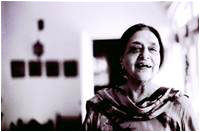
Just read about Tahira Mazhar Ali passing away, feeling really sad, hence this short piece.
I met her only thrice, and it was like I carried her within me all these years.
The first time was in 2001 at a seminar organized by ASR in Lahore on the 30th anniversary of the genocide in Bangladesh. She came up to chat after my presentation on the Mahila Atma Raksha Samity (MARS) and the Tebhaga women’s movement, excited. It had taken her on a nostalgia trip, and she said she remembered the MARS on a collection drive for the Bengal Famine in Lahore too; many, including she, had taken off the gold bangles they were wearing and contributed on the spot.
The next time was a couple of years later on the way back from the Karachi conference of the Pakistan-India Peoples’ Forum for Peace and Democracy (PIPFPD – Nighat had generously opened up the ASR office to the whole Bengal contingent, and it was like a shaadi baari when we arrived there, late in the night – mattresses had been hired and laid out last minute, to accommodate the extra people who had suddenly called up to say they too were coming, steaming hot degchis of food were put out for us in the kitchen. And Tahira Apa invited all of us to lunch the next day – for we were from Bengal and she wanted to meet us. I remember one of the most serene Buddhas I have ever seen, sitting to the right of her doorway, close to a glass cupboard full of the latest finds from digs in Baluchistan, “Of course its ….,” she grinned, “But if I didn’t buy them, they would have gone out of the country. People are such thieves you know – all this would have gone out of the country…..”
As unforgettable as her robust welcome, that made us feel so wanted in a stranger’s house, was the amazing Punjabi meal, which included various meats, naans and rotis of course, but also some of the finest baigan ka bartha and shalgam ka bartha we had ever had.
I instinctively took to her, wanted to record a proper conversation with her. She met me early the very next day – for we were leaving soon after that. I remember sitting with her in the morning light – in an open courtyard, maybe in a garden, with the sun and shadows flickering across her face that had such character. She talked about her younger days, Nehru and her deep admiration for him as well as major differences, Jinnah, the Communist Party being sent underground, her work with peasants, the National Workers Party and the Democratic Women’s Association.
Especially striking was the completely natural way in which she talked about ‘us’ across generations, contexts and movements. Included in that ‘us’ was I, a woman from across the border, and all the women whom I had protested with, walked the streets with, and sung with, completely off key, but lustily nevertheless, in Kolkata, Dhaka and Delhi, Lahore, Peshawar and Karachi. She had a no-nonsense, down to earth way of articulating that ‘us’ with such ease and confidence – it sounded so natural because, one realized the moment one heard it, it was natural.
Kavita Panjabi is Professor at Jadavpur University, Kolkata.
 KAFILA - COLLECTIVE EXPLORATIONS SINCE 2006
Sincere thanks for sharing a thoughtful post.
:))
LikeLike
Kavita Panjabi sends this link to an interview with Tahira Mazhar Ali.
http://www.livectv.com/begum-tahira-mazhar-ali-khan-interview-in-jugno-24th-march-2015/
LikeLike
Reblogged this on oshriradhekrishnabole.
LikeLike
Reblogged this on loudmoments and commented:
A small memoir on ‘us’ from Kafila! A perspective on a different perspective!
LikeLike
Lovely, simple but still very comprehensive comments for a very liberal, secular and humane lady of subcontinent.
LikeLike