
We are reproducing an article written by SOHUL AHMED on the eve of the Bangladesh elections, earlier published in Bengali in Prothom Alo, Dhaka. The English version was published in Ahmed’s Substack, yesterday, 12 February. A researcher on genocide and democratic politics, Sohul Ahmed is already familiar to Kafila readers. We publish this piece here because it helps us understand the current elections as but a moment in the larger process of transformation unleashed by the July Uprising of 2024. An important reason for publishing this piece here is because Bangladesh’s difficult struggle for democratic transition holds significant lessons for us – in our struggles in the times to come. – AN
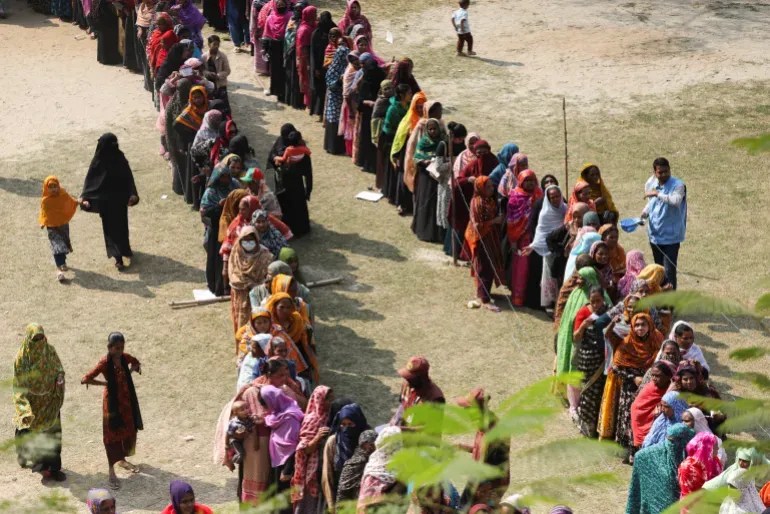
After fifteen years of autocratic rule, Bangladesh is re-entering an electoral phase. This election is significant for two primary reasons: first, it reactivates a stagnant electoral process and initiates a transition toward a competitive system; and second, it seeks to establish a sustainable political settlement that institutionalizes this process.
The upcoming election serves as both a national vote and a referendum. Far more than a simple contest for power, it is a fight to reclaim the essential democratic entry points lost over the past fifteen years. By functioning as a referendum, this process seeks a mandate for the structural reforms and political settlements necessary to build a truly democratic foundation for the country.
The most tragic chapter of our political history is that a fundamental right—the right to vote—has become a rarity. To this day, we have failed to establish a recognized mechanism for the peaceful transfer of power. Consequently, those who ascend to power exploit legal loopholes and machinations to entrench themselves so deeply that their removal is often achieved only through force or by staining the streets with the blood of citizens. The old political settlement rendered peaceful transitions nearly impossible.
This cycle is precisely what the post-July Uprising process aims to break. Through reform commissions and the National Consensus Commission, an effort is underway to chart a path for democratic transformation. This attempt to facilitate peaceful power transfer has created an exemplary situation where political society prioritizes dialogue and constant negotiation. This shift symbolizes growing political maturity; however, this process is merely a step in the journey—not the final destination.
The ‘Anti-Election’ rhetoric
An ‘anti-election’ rhetoric is highly prevalent within Bangladesh’s civil society, often voiced under the guise of seeking ‘true democracy.’ This discourse typically emerges from two distinct camps. One camp maintains that elections are futile rituals that fail to alter the material fate of the people or bring true liberation. They dismiss parliament as a ‘pigsty’—a corrupt institution incapable of reform. The second camp argues that elections alone cannot sustain a democracy. They prioritize the establishment of ‘strong institutions’ and the rule of law as prerequisites, suggesting that holding a vote in a vacuum of institutional integrity is meaningless.
Both sides utilize standard critiques of ‘liberal democracy’ to justify their anti-election stance. While their theoretical arguments are understandable, in a country where the electoral process has been systematically dismantled, such rhetoric is frequently weaponized by autocracy.
We witnessed the frequent manipulation of these arguments during the fifteen-year tenure of the Awami League. Following the electoral farces of 2014, 2018, and 2024, the regime often posed the cynical question: ‘Is an election the only component of democracy?’ This logic was used to diminish the importance of the ballot and render the fundamental right to vote irrelevant. During those ‘dreadful electoral games,’ the true intent behind these philosophical arguments—to provide intellectual cover for disenfranchisement—was clear.
Even if we acknowledge the cynical truth that an election may change nothing but the face of the ruler, we must insist: we need the election. It is the indispensable gateway to democracy. When this door is slammed shut, it paves the way for systemic state violence and long-term political instability. Thus, despite a thousand limitations, we must maintain that the process itself is vital. Even if the immediate results lead some to claim that ‘nothing has changed,’ the electoral mechanism must be kept alive to preserve the possibility of future transformation.
The Post-Election Challenges
This election marks only the inception of our democratic journey. Following the vote, two formidable challenges will emerge. First is the implementation of the July Charter. Despite its significance, a consensus among political parties on several critical provisions remains elusive. For the past eighteen months, a ‘neutral’ interim government acted as a mediator to facilitate dialogue; however, once the election concludes, the newly elected government will become a direct stakeholder.
Consequently, the path toward constitutional compromise will be fraught with difficulty. The struggle over the Charter’s reform is likely to spill over from Parliament into the streets. While the opposition may allege Charter violations, the government will likely pivot to its ‘popular mandate’ to justify its stance. This 180-day implementation period will be the litmus test: it will determine whether our transition is seamless or if we slide back into a cycle of conflict. We must remember that globally, democratic transitions following mass uprisings are notoriously difficult; history is replete with examples where such movements were stalled or reversed.
The second challenge is the profound vacuum within our civil society and the obsolescence of our political language. Bangladesh’s traditional civil society has largely withered; the ‘old guard’ organizations either became polarized or fell dormant during the previous regime. Meanwhile, the vibrant new generation of activists—the architects of the uprising—has largely been absorbed into the interim government or the various political parties. To ensure democratic accountability, we must now rebuild an independent civil society from the ground up, one that remains separate from the machinery of the state.
Crucially, we must also reinvent our political vocabulary. My generation came of age under an autocracy; as a result, our entire political lexicon is rooted in resistance, confrontation, and survival. While that language served us well on the barricades, it is fundamentally ill-suited for a functioning democratic regime. We face a crossroads: do we remain trapped in the exclusionary rhetoric of us vs. them, or can we cultivate a language fit for pluralism, negotiation, and compromise? Our choice of language will ultimately determine whether we build a democracy or merely a different version of the past.
The Struggle Begins After the Vote
We are entering a pivotal new phase—a struggle not just for the ballot, but for the very soul of our democratic process. While we must secure our right to a peaceful transfer of power every five years, the deeper work lies in the long-term activism required to turn political rhetoric into tangible reform.
In this context, we should look to the historian Howard Zinn. When asked about his voting habits, Zinn remarked that he supported a candidate for only the single minute he spent inside the voting booth; his “real work” of organizing began the moment he stepped out. For Zinn, the strength of a social movement matters far more than the individual occupying the office.
We must embrace this urgency of post-election activism. The election is not the finish line; it is merely the entrance—a gateway to a broader transition. To ensure a smooth journey toward true democracy, we must maintain continuous civic engagement. Our real struggle does not end at the ballot box; it begins the moment we leave it.
 KAFILA - COLLECTIVE EXPLORATIONS SINCE 2006