At Jantar Mantar
As I was leaving the protest site of the Cockroach Janta Party at Jantar Mantar where I had gone to express solidarity – on July 5th, the sixteenth day of the struggle – a young man who had also just stepped out, approached me to ask the way to the nearest Metro station. I was not sure myself, so I suggested he feed it into the map on his phone, which he was holding. He laughed and said “hum gaanv se hain, lagta hai ki kisi se poochna hi achha hai.” (I’m from the village, I always feel it’s better to ask someone)
I replied “main toh ek alag hi peedhi se hoon, mujhe bhi kisi se poochna behtar lagta hai” (I am from a different generation altogether, I too prefer to ask someone).
United in our spatio-temporal dislocation, we then got directions from some other passerby, and walked together for a bit till I reached my car. Was he a student, I asked. He turned out to be from Ayodhya, running a small business in Faridabad. He had decided to come to Jantar Mantar and meet the “bacche” (although he was not much more than a baccha himself) because he wanted to be there to show support for their struggle. He couldn’t study much himself, and although he was happy running his small business, he said kabhi kabhi lagta hai ki zyaada padh paata toh business hi aur achhi tareeke se kar paata. Mujhe padhna achha lagta tha…” (Sometimes I feel if I could have studied a bit more I could have even run my business better. I used to enjoy studying).
He had come all the way from Faridabad, when he could spare some time on a Sunday, to meet these other young people who had captured his imagination with their guts and determination. As for this easy, fleeting camaraderie between two strangers of different generations and genders and class locations in a city like Delhi – what was it? Where did it come from? It was not entirely unfamiliar. It was the kind of connection sparked by the magic of collective struggle against injustice – it is a sense of safety, and inexplicable familiarity, of home and hope. We all felt this magic in the encampments against the CAA – at Shaheen Bagh, Khajoori and many other sites, and in other cities and towns.
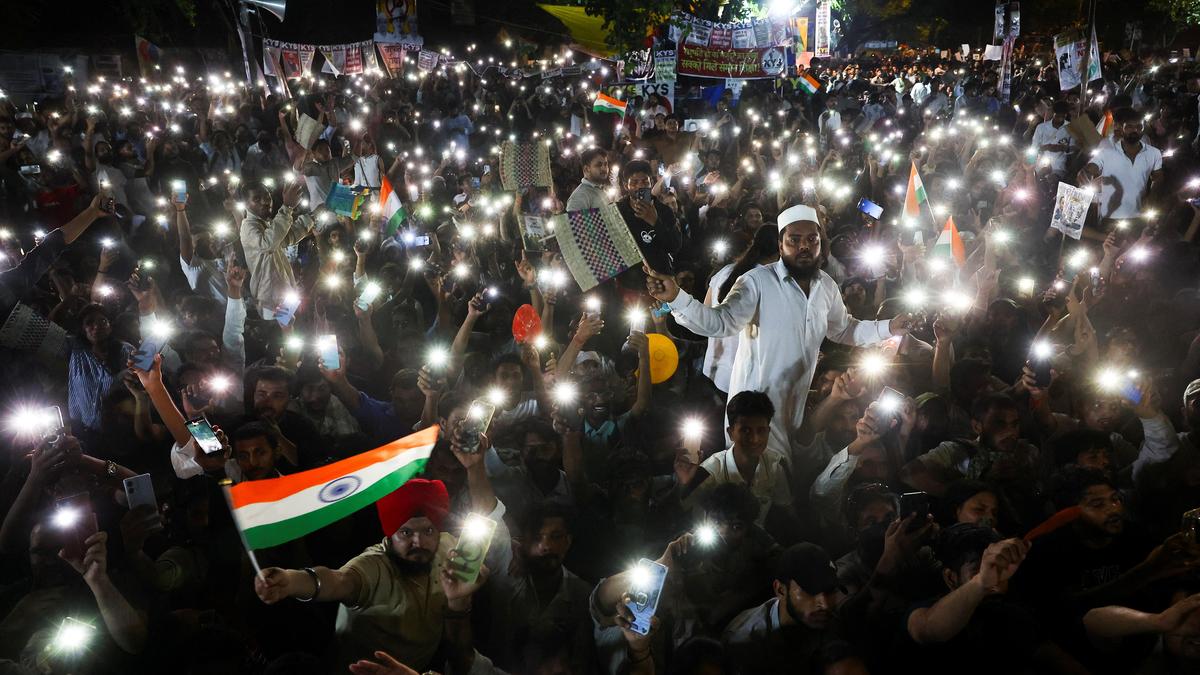
And you feel it at Jantar Mantar where The Cockroach Janta Party is starting its twentieth day of protest today, demanding the resignation of the Education Minister for the large scale collapse of the entrance exam system nation-wide. Sonam Wangchuk has now been on hunger strike for the twelfth day today, as have some 18 to 20 students from different student organisations (mostly from AISA), from different universities in Delhi, and from different states. They have come from Tamil Nadu, and Madhya Pradesh and Rajasthan, and they are on the hunger strike too. Some of the students have had to be hospitalized since the the tenth day or so, but others have since joined in. The young hunger strikers look wan and pinched, but beam broadly, their faces glowing with purpose. They make jokes, they make you laugh, and they fill your heart with hope and pride.
Hundreds of others are milling about, and some of them are parents. One young woman whose child was only in middle school had been there every day, she told me. “They are fighting for the future of our children, no?”
It is now the stuff of legend – how a relatively unknown young man, Abhijeet Dipke, in a moment of anger at the massive corruption in the entrance exam system, set up a funny meme satirically taking on proudly the insulting name given to young people who question the government, by the Chief Justice of India. Because Dipke called it a “party” to mirror the acronym of the BJP, it sparked enormous excitement among the younger generation, the responses online were overwhelming, he decided to come back from the USA to protest at Jantar Mantar, and called on all young people to join him there.
An older Left oriented generation watched in some bewilderment and suspicion (there was the usual cynicism about AAP, with which Dipke had been associated; suspicion about Wangchuk – why was he released from prison so quickly, is this the BJP’s B team?). But the protest took off on the ground with thousands of students and young people on the first few days; the CJP was joined from the first day by the ecological warrior from Ladakh, Sonam Wangchuk, and by Left student organisations. Soon, leaders of the CPI(M), CPI (ML) and Trinamool and of the farmers’ movement, were seen at Jantar Mantar publicly expressing solidarity, as were many other individuals and organizations known by their political activism and their writing, to be opposed to the Hindutva corporate regime. This regime has now acquired the kind of suffocating, monopolistic, systemic power unimaginable in the democracy that was India; power directed in the last instance by the shadowy, wealthy, Brahminical organization with no accountability whatsoever to any authority or to the people of India – the RSS.
The issue – education
The financial corruption at every level in the BJP-RSS ecosystem (manifest even in the Ram Temple), has been suspected in the education sector very clearly for over a decade. Substantial rumours abound of faculty appointments in public universities through cash payments (it is not sufficient to be an actual RSS activist – that is only the minimum requirement). Selection of security agencies is also said to involve money changing hands (and the budget allocation for security is now triple what is spent on libraries in public universities.) I speak of rumours, because there has not been the kind of full exposure that we see with the Ram Temple, but the blatant daylight robbery at the temple suggest that the stories circulating about lesser institutions (mere universities as opposed to the house of god) must be true.
A young school student Sarthak Sidhant was able to track online, the ways in which CBSE modified its criteria for tenders to favour a blacklisted edutech company that handled the On Screen Marking System, which turned out to be a complete disaster. The role of edutech companies by the way, is explicitly fostered by the NEP to set exams, conduct evaluations, and run online courses. These are private, profit making organizations, which are now to take on many of the key functions of publicly funded universities.
If the venerable CBSE has shown itself to be rotten to the core, there is no doubt that the opaque National Testing Agency (NTA) – set up in 2017 as a centralized institution to replace all other forms of evaluation that educational boards and institutions have set up over time – is completely compromised too. It is not a government institution (unlike UGC and CBSE) but a “registered society”, an autonomous body under the Ministry of Education. Teachers and teachers’ associations have predicted from the very moment of the setting up of NTA , and the rolling out of the National Education Policy in 2020 (NEP 2020), the very outcomes we see today.
The JNU Teachers’ Association issued a statement in June 2026, analysing the rot since the NTA was set up and NEP rolled out. Titled “Over-centralization in Indian education system – the warning was ignored and the crisis is here”, it concluded by demanding that
the NEP 2020 must be immediately rolled back to protect the future of India’s students, the NTA must be immediately scrapped to save the autonomy of public universities and the Union Minister of Education, Mr Dharmendra Pradhan must immediately resign to save the integrity of education system in India.
The NTA since its inception has an unbroken record of exam leaks, manipulations and cancellations. There have been more than 40 paper leaks in the last five years, an unprecedented number. Each leak has put money in pockets, and each leak has resulted in suicides of young students.
Those of us who have participated in exam paper setting at NTA have often remarked that despite the flourishes of security protocols (searches, passwords, leaving phones outside etc), how easy it would be for NTA employees to gain control of the papers. Initially many of us boycotted the process as we wanted to continue with the entrance exam the way JNU faculty have conducted it since 1970. All India exam centres, exams to be written in any of the official Indian languages, not a single leak in all these decades. Essay type questions where candidates were assessed not for “flowery English” as a NITI Ayog member said, (defending Multiple Choice Questions as testing intelligence, not “mugging”), but for showing interest in the discipline and expressing whatever their views were on an issue, in their own ways. Eventually we ended the boycott because we didn’t want to push ourselves out of the entrance exam process. And discovered that the process of MCQ paper setting has its own logic.
MCQs require multiple sets of question papers of 100s of questions to be set supposedly to ensure that nobody knows which paper will actually be used, but what this means is that even a sincere paper setter trying to test thought rather than information, runs out of creative questions, and is reduced to setting questions that are simply about dates and places. However, since the NTA also compensated us for our time with substantial fees for paper setting (which was part of our normal duties when we did it at the university), not every paper setter, to put it mildly, has been sincere. (Many of these were the eager new faculty appointments whose trajectory we mentioned earlier). So MCQs at their best, as seen in the CUET, are precisely about mugging. And evidently, the NTA exam setters now resort directly to getting AI to do the job, as happened with the UGC NET Sociology paper. Remember, these paper setters are faculty from universities, who are paid an extra fee over and above their salaries to do this work.
(This morning we learn in addition that this paper was leaked. The leaked pdf document matches the internal template used at NTA for preparing question banks.)
The rampant impunity at every level has now reached levels of absurdity.
Teachers argued that the NEP was a blueprint for saffronized and corporatized education. Its plan to merge schools with lower numbers of students was intended to shut down schools. And indeed this policy of “rationalization” led to the shutting down of 93,000 schools all over India in the decade 2014 to 2025.
There has been drastic transformation of curricula across universities partly driven by the kind of semi literate common sense that governs India today, and partly by design, intended to end any critical thinking whatsoever.
For teachers’ critiques of
NTA see The National Testing Agency is a scam – shut it down now! Ayesha Kidwai
NEP, see NEP 2020 – elitist and corporatized education under Hindu Rashtra: Nivedita Menon
MCQs see Does the MCQ Format Work For Social Sciences and Humanities Entrance Examinations? Ayesha Kidwai and Nivedita Menon
In short, this regime wants to end access to publicly funded education, to end critical thinking, and to produce our young people as a cheap labour pool for the rapacious global economy. The NEP says proudly that we will train young people to hold three or four jobs in a lifetime – an education policy that celebrates precarity!
Back to Jantar Mantar
There is a crack, a crack in everything -, that’s how the light gets in…
Leonard Cohen’s words come to mind. What we see at Jantar Mantar is a crack in the darkness that has descended on us, ever more heavily, over the past decade.
The Cockroach Janta Party has tapped into the anger and resentment and despair of young people over exam leaks, but that’s not all this is. The young people we see at Jantar Mantar and all over the country (NSUI has apparently independently of CJP, been conducting militant demonstrations in many cities), are using the leaks to speak about democracy and secularism and social justice. Jai Bhim and Inquilab Zindabad and Hindu Muslim ki Rajneeti Nahin Chalegi. And Meri Life Meri Marzi, slogans about sexuality but also Bharat Mata ki Jai – all of these ring out at the protests.
These young people have grown up in this regime, they have come to adulthood in a dispensation that normalises hate and dispossession of the poor and powerless, and yet they are not normalised, not disciplined into this regime. The universities have been the centre of protests over issues ranging from fee hikes, to sexual violence, library facilities, reconstructions of syllabi along Hindutva lines, ecological questions to do with the campus and beyond. No wonder the NEP is structured to end all of this unrest forever.
The CJP is by no means a homogeneous platform, it is a coalition that has come together over one issue – education. There are internal differences on other issues, but those need not be raised here, at this time, and they are not. This is the form of successful non-party mobilisation we saw in the late 1990s to early 21st century – citizens coming together over Hindu right-wing violence or workers’ rights, or in opposition to nuclear energy and the nuclear bomb – broad platforms of individuals and organizations that did not agree on everything, but worked on that one issue and marched together for a while.
As a young student activist Puranjai wrote earlier, when the CJP was conducting protests but the Jantar Mantar sit-in had not yet begun:
If one is able to imagine the protest site as something other than that of a unilinear flow of information, if one is able to design a setup other than the stage and the road, one might be able to move towards more just alternatives. By rallying around the cause of a more inclusive India, one can build solidarities that might not have been possible before. This present moment holds promise and one need not sit away from it.
Everything is not joyous and celebratory and militant all the time at Jantar Mantar. A parent, a sibling of one of the students on hunger strike arrived the day I was there, they try to keep up a brave front. There is an overlying sadness about the students who committed suicide. Since the mainstream media studiously avoids any reference to this extraordinary protest, most of our information is from social media. We see some of the grief stricken parents arrive, they meet Abhijeet, they cry. We see Abhijeet’s eyes fill with tears, he struggles to control himself. We cannot forget how young they are, these heroes of our democracy, who remind us what it is to be principled, determined and undaunted – but also vulnerable and human.
A local dog has joined the protest, he feels at home in that community. I am reminded of the massive anti fee hike student marches of 2019, about which I have earlier written. In one of these, starting from JNU, a dog from Ganga Dhaba had decided to accompany her friends, passing through barricades, running along with them, she marched with them all the way to Jor Bagh. It was a carnival we found there, when some faculty arrived to express solidarity, Music and singing and energizing chants. Suddenly the street lights were switched off, and everyone knew in that moment of darkness that the lathi charge was about to begin. The two students I was chatting with, moved of one accord. They dashed off to find the dog, and as I stepped to the side, my heart pounding at the knowledge of what was to come, protected from it by my age and status as faculty (though the lathis did fall on two of our male colleagues), I saw the two women emerge from the crowd, carrying their friend, running, stumbling, the dog safely in their arms.
They carried her back to campus.
Our young people know and practice the truth of vasudhaiva kutumbakam, the slogan made meaningless by RSS functionaries, including the Prime Minister and Home Minister.
On the day I was at Jantar Mantar, I met Sonam Wangchuk too, briefly. He was reading something, and looked up courteously as I introduced myself as a teacher. It was the 8th day of his fast, he was clear-eyed and smiling. What do you teach, he asked me.
Political Theory, I said.
He raised his fist and smiled teasingly – ” We are doing the practice”.
Every single force in our country that resists corporatized Hindu Rashtra needs to see this moment as one that breaks the hopeless pall of doom that we have been experiencing. As the BJP breaks up party after party to gain the majority in parliament that the people did not give it in 2024; as the ongoing SIR disenfranchises large numbers of Indians; as election after election is managed for the BJP by the ECI; and the courts fail us time after time, falling in line with the government – militant and peaceful civil disobedience might be the only weapon against a regime that has swallowed every institution, ending up more powerful, more vicious and unethical, than the colonial government ever was.
The CJP at this time has one single powerful demand – the resignation of Education Minister Dharmendra Pradhan. The arrogance and lack of accountability of this regime is such that Pradhan dismissed the CJP protest as “a B Team of disruptive elements”.
Can these audacious young people take back India for us?
Not by themselves perhaps, but what if every single oppositional force is part of the push? And as more and more sections join in, perhaps another demand can be added – the dissolution of the current Election Commission of India; the repeal of amendments that gave the government complete control over appointment of the Chief Election Commissioner, and immunity to election commissioners from legal proceedings for decisions made in their official capacity; in short, the restoration of the previous autonomous – and accountable – status of the ECI.
Can a larger mass campaign endorse the CJP’s demand for the resignation of the Education Minister but also go beyond, to the fundamental issue of elections managed by the ECI for the current regime?