
Hobbling on the beach
I was born next to Elliot’s beach in Besant nagar in Chennai where I spent a large amount of my childhood and adolescence A small caveat about this area: Besant Nagar is considered one of the posh areas in Chennai. However, like many such places the combination of communities the class composition of this area is far more complex; large bungalows of film stars and the like co-exist with the Uroor slum. By co-exist of course, I don’t mean for a moment that they peacefully co-exist. They are next to one another (sort of) and there are many who are out there to change that. The slum has been destroyed by humans (more often) and natural disasters many a times. The latest being a bid by the government to build an elevated highway next to the ocean displacing the entire slum (again!). But that’s another story. (http://letsrob.org/home/)
The beach itself is an interesting space in my city, it is one of the few remaining public spaces that people can come and relax in without paying. But there are unsaid divisions within the beach. Having known this particular beach almost my whole life, I know that there are different unspoken, unmarked sections for the rich, the poor, the lovers, the lusters, the friends, the random teenagers who would have just met two minutes ago and aunty-uncle couples who have been married for time immemorial. Of course, the way these boundaries are drawn and where you find yourself changes according to a variety of factors.
After a fascinating flight journey (which will be another piece in the series), my first outing in Chennai few days after I reached home was to my beloved beach.
There it was the beach that I knew every inch of, or so I thought, which looked completely different that day. I took my walker (a four legged contraption to make up for my one broken leg, which I shall hold dear always!) and had the longest hobble I had done since I injured my leg and sat down on a chair with my leg up in its large cast, smiling victoriously. The process of healing and way you engage with one’s own body and the complete change in one’s priorities warrants its own reflection. Much of my days are spent focusing on how far back my ankle can move and the simple joy of that extra centimeter it moves every day. It’s a humbling experience in a world that forces us to imagine and think grand things on a daily basis and only then are you seen to be ‘productive’.
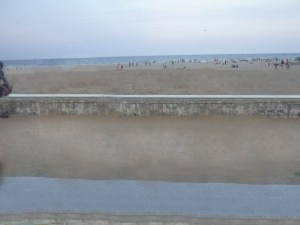
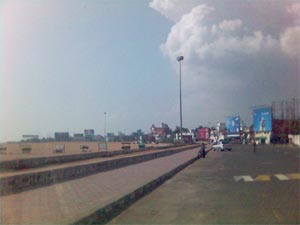
This beach has a long walkway next to the road that extends through the stretch of the beach. On the side of this walkway, on the beach is a little parapet for people to sit on. And if you are to get to the sand beyond this parapet you need to climb down steps! Steps! The only exceptions to this are the few points where the contractor who built this, ‘ran out’ of bricks or cement or water or all (due to rampant corruption, of course) and left a gap.
So when I went to my neighborhood beach, I had to almost be lifted up by people on and off the walkway. I don’t own a wheelchair, as it is not required for this kind of injury at all times, and so I hobbled with my walker to my chair. There was no option of me touching the sand with my unbroken foot because I couldn’t hobble far enough to find a gap in the parapet. Of course anybody without two functional legs or hands that can push them forward or a very fancy bike/car that can drive through the sand (or other ways of moving that I can’t think of right now):- touching the ocean is not an option.
The simple solutions to this rather basic question of planning the area in and around the beach to make it accessible to many more people are overwhelming. (http://www.ncpedp.org/access/acc-home.htm)
And yes, as the show must go on: there were the looks of passersby. People of all ages go for a walk on the beach, either in the mornings or evenings. That evening many a walkers passed by. I must admit, the most significant difference between the trip to the cinema and the beach was that with a cast, everybody seemed to assume (rightly so in my case) that this injury is temporary. Without the cast and in a wheel chair or a walker as the case maybe, it is not clear where you stand! This seemed to have informed their reactions to a large extent. Besides, my pink shorts would have taken the attention away and thrown many into a tizzy about the “lack of ‘shame’ and ‘culture’ among young women nowadays”! Or at least, I secretly hope it did. :)
Among the many who came along where an old aunty-uncle walking slowly along the walkway. The image of them which obviously involved mutual everyday care for god knows how many years, was rather charming I must admit. I also just got up to leave. Uncle asked ‘what happened?’. I explained it’s a multiple fracture. Then began a short ‘contest’ of sorts, an unintentional one, between aunty and me. She was walking slowly too due to age or any other complications she might have. We both ‘walked’ and she got to the edge of the walkway before me. We smiled at each other gracefully and went our separate ways. She reached the edge faster because she had been doing this for longer among other reasons I presume. Well, either way, it was just the kind of exchange that I needed. A reassurance of sorts and a quick glimpse into everyday resilience of many.
Just when we were about to get into the car, along came a group of aravanis (hijras). As someone who often works with and has a number of aravani friends, usually I bond with them. They blessed me more than usual and were hoping for a large sum of money. My usual bonding exercise didn’t work. It felt like, me and everyone around me was supposed to have an acute sense of the ‘misfortune that has hit me’ and give the aravanis a lot of money for their blessings. Didn’t work really. Yes, it’s painful and inconvenient on a daily basis. But then again, they of all people know that there isn’t one kind of body in the world. While life is difficult with one functional leg, it is difficult not by default but it is made difficult by all the circumstances around us. If not for all of this, this would be another kind of body. Not simple by any stretch but at least not inconvenient, because in the ideal world different would be good and access to public space and access to life and world would really be for ALL. Wishful thinking! This made me think about queer politics, the body and ability/disability and all the work/discussions/questions that need to be raised around this, among other things within our movement and within LGBTHKQI.. communities. This of course is yet another connected story. A story where we have a long way to go.
Any Chennai-ite will tell you how central all our beaches are to our city. While I always had a sense of their inaccessibility to people with a range of physical disabilities, it was quite another story to realize the magnitude of this. This is then a comment on the city itself, symbolically and practically.
This as we know is one example. We know of so many stories in India and elsewhere where making public spaces accessible to disabled persons is hardly ever a priority (http://media-dis-n-dat.blogspot.com/2010/07/city-in-india-grossly-violates.html; http://www.disabilityindia.com/html/newsdec.html#access). This, not just in recreational spaces, but in educational institutions and workplaces among others.
This then brings us to the larger question. Through this experience, the overwhelming way in which our spaces, minds, thoughts, practices and so on are based upon a default and normative notion of the body became clear. This understanding remains at the core of the lack of sensitivity to and prioritizing of the issues of access to public spaces for all. This lies at the core of our understanding of disability subjectively and thus as a broader political concern. To shake this up, as we know, is no easy task. Consciously watching, recording and sharing this experience one hopes is a small step towards initiating reflection and debate on the subject.
 KAFILA - COLLECTIVE EXPLORATIONS SINCE 2006
That is a great observation, and a much ignored subject in the Indian context. It’s only amazing how we, the physically-able people, only realise this discomfort when we have to somehow face it ourselves. The contractor might have been more careful, if only he knew what it meant to not be a part of the ‘public’ in public areas such as what you mentioned.
I realised this myself when I worked with the Accessibility Management team for the London Olympic Committee last year. It was only after closely working with people who were passionate about equality of rights to public access, that i even realised the lack of it.
While this was one of the top agendas in the London Olympic preperation, it is still missing in the Commonwealth Games preperation in Delhi. It is surprising how the other parts of the world are somehow more sympathetic towards other people and their needs than what we are. Is it because we don’t value life as much as we have abundance of it? I wonder what may be the reason, but whatever it may be, it needs greater visibility. We need to respect the rights to all humans equally despite any physical / economical / social / mental / psychological differences. And it will only be then that we would make inclusive spaces for our citizens. That’s the least a democratic country must do.
LikeLike
Ponni,
Both your posts in this series have been excellent. As someone who hopes to be in the business of planning India’s cities, I hear you and agree with your arguments for a more differently-abled-friendly design for public spaces (including privately owned buildings open to the public).
Most people commenting on your posts seem to be social scientists. Let me give you a planner’s perspective.
While agreeing on the need to ensure access for all, we need to understand the consequences. A common strategy to make footpaths accessible to people on wheelchairs is to provide a slope at intersections. Now, imagine what’ll happen if you do that on a congested Indian street. Two wheelers will be trying to get a little further by driving on the footpaths. A footpath with a two wheeler driving on it is no more accessible for a person on a wheel-chair than a footpath that is not designed for people on wheelchairs.
We must then ask, can appropriate design alone solve any given problem?
Some planners seem to think that is possible. They speak of ensuring compliance to traffic rules through design of footpaths. In my limited exposure to the design of footpaths, I can’t see how they can be designed such that they are both accessible and designed to protect pedestrians from errant motorcyclists.
The alternative is to approach the problem through all three directions – a) design, b) enforcing compliance through more active policing and c) a campaign to make people and motorists in particular more sensitive to the needs of the differently-abled (and pedestrians and cyclists too)
LikeLike
A further thought:
I erred by speaking of accessible design of public spaces almost purely in terms of accessibility for motor-challenged persons. I was later wondering how visually challenged people deal with public spaces differently.
One of my Professors at IIT Madras – the late Prof. D. Veeraraghavan (Dilip) – was visually challenged. I once asked him why he never took the elevator that had been installed in the Humanities building by the institute precisely with the view of making it accessible to all. He told me that he had been using the stairs for more than 20 years – they were more comfortable for him than a new elevator. (The irony was that 20-year old students with properly functioning legs had no objection to using it)
Now, I wouldn’t take his preferences to be representative of the preferences of all visually challenged persons. But even then, this seems to suggest to me that the needs of visually challenged people might conflict with the needs of motor-challenged people.
Some needs are common, of course. A level walking surface, free of potholes, makes walking less hazardous for everyone. But a visually challenged person might not find it easy to adjust to a street that keeps getting built and rebuilt.
LikeLike
Thanks a lot for this perspective Karthik. While I agree that planning is not an adequate solution, the political will to initiate inclusive planning of all kinds does not exist in our context and if that were to evolve, I would say it would be a significant beginning.
LikeLike
Vantage Point: – Experiential reality of being a mobility impaired woman since the age of two .I am now 52. A wheel chair user for the last ten years
I first of all want to say thank you to Ponni for highlighting the issues of access and disabling conditions. I read the first few comments and asked myself as to whose voice is being silenced or talked about? I am not sure whether Ponni has been able to interact with the disabled, as the idea of beach and movie is a planned endeavor. The very fact that Ponni engages with what is right now disabling and the hope is that it can be transformed. In this movement she touches many spots which many of us who wanted to go the beach, or could not have told a friend that the weather is so great that I need to go for a walk or watch a films (even though it is not worth) To me the problem with having discussions about disability issues is that disabled people are just not out there, on beach, in movies or in schools and colleges in the same way as the non-disabled are. I fractured my foot in midair in Bologna and went on to see Venice and Florence. How? It is because state has respected groups with diverse needs The understanding is that life with a disability is not worth living, and therefore the desire to enhance quality of life is not required. Despite the equal opportunities legislation, we know that as a society, only disabled seem to be placing high value on accessibility. Consequently, many of us prefer to stay at home and lose the opportunities to connect with the world of the able-bodied; even people with economic influence and power who have access to numerous tools and resources sometimes experience struggles such as going to the toilet It is through people like Ponni who I believe will in many ways contest the fact that disability is not a self-evident condition of physical inadequacy and private misfortune whose politics concern only the disabled people . As an activist, I do use the idea of the temporarily able bodied (TAB), which is s an indicator of the precariousness of human existence, and is extremely helpful in destabilizing the binaries of health/ill health, non-disabled/disabled. However the margins which divide us into categories are realistically wobbly, such that constant replication is needed to keep them in check. In a similar way as we perform our gendered/disabled/sexed/impaired identities, we also need to perform what is expected of a healthy body, so that it is not tainted with bodily breakdown. The negation of binary thought opens up the realm of continual negotiation, within which it might be possible to work towards a truly inclusive society. However, it will be vital to remember that this is not a one time attempt. It has to be conceptualised as a process so that an analytical stance can be generated. Like all catchphrases such as TAB, Ponni cautions us the oversimplification of the phrase . To me she has underscored parts of bodily difference and I hope that others will take a cue and understand the temporarily able bodied ness
LikeLike
Ponni,
You mistake me by suggesting that planning is not an adequate solution – I only said that design of public spaces is not sufficient.
I do not see planning as separated from making rules and enforcing them so as to make public spaces truly usable by differently abled people.
LikeLike
dear ponni,anita,
your posts were really quite thought provoking. i am an artist working in vadodara and this is a subject that has been of my concern for some time now. coming from the visual field, my approach to this has been largely at the level of looking at representation of ‘dis-ease'( the title of a series of my works) and disability( i really find your term TAB quite appropriate, anita!).
Thinking around this area led me to explore the visuals that modern medicine uses and the way these shape our perception of disease. I became interested in seeing how image making within the field of medicine controls our gaze as regards our bodies. As I explored this area, I realized that these visuals, circulated widely through the net, in hospitals and in medical journals are highly problematic. They literally cut the body up into pieces and make it available for public display and also strip us of our individual identity and turn us into specimens. They are either in the form of neutralized linear diagrams that project the body as an object of study and separate it from its emotional, social, and political existence or they are hyper realistic close ups of diseased body parts which invariably produce reactions of horror, disgust and fear. Having myself been a patient of severe eczema, and having scoured the net and all sorts of books, looking for cures, I realized how disturbing and reductive modern medical imagery is. How much it controls our ways of looking at disease.
Pursuing this thread I started exploring representations from the history of medicine. Had medical imagery always been like this? All over the world? It was then that I came across texts such as the Historia Monstrum and De Monstruorum Natura, the first scientific attempts during the Renaissance at enumerating and recording monstrous births and disability. These were modeled on earlier texts such as ‘Physiologus’ (Greek) and the medieval ‘bestiaries’ which were apparently more ‘fabulous’ than scientific in their approach and documented and classified various animals and birds and other curiosities. But then even the Renaissance texts had enough of the fabulous in them. So much so that the new races discovered in new lands were also illustrated and listed as monstrous curiosities alongside the monstrous births and disabilities.
Looking at these part fabulous part scientific representations which made monsters of ‘the other’, in comparison with today’s ‘true to life’, ‘factual’ (as the eye/scanner sees it) and ‘objective’ representations, I started wondering about how each of these work. I realized that despite their claims to ‘truth’ and ‘objectivity’, today’s representations (like the renaissance illustrations) still perpetuate the viewing of disease and difference as monstrous. While the Renaissance underlined this difference with crude labels such as Monstrum Bifrons and Monstrum Cepticeps , we use complex medical jargon which classifies one anyway as a deviant from the ‘norm’ and thus monstrous and in need of correction. No doubt modern medicine has come a long way and achieved a lot yet what struck me was that the ways of seeing it perpetuates remain as problematic as in the Renaissance texts. Interestingly some Chinese and Persian medical illustrations that I came across were much more sensitive in their approach. They looked at diseased bodies not just as objects of classification and study but also as belonging to thinking feeling individuals who experience pain, discomfort and alienation.
i realize more and more that representation is certainly another important area that needs to be re thought when approaching this subject, in order to bring about a change in our understanding of dis-ease and disability and that is the area around which i am trying to develop my own practice as an artist right now.
LikeLike