
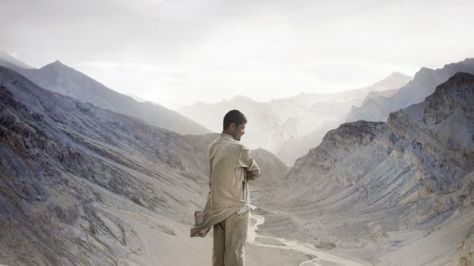
By SANJAY KAK
“Kashmir will haunt India the way Algeria haunts France.”
I remember that from ten years ago, on one of those early e-groups, the provocation almost buried in the dense threads that made up conversation there. “It will haunt Indian intellectuals”, the young Kashmiri correspondent had promised darkly, “in the way Algeria continues to haunt the French”. From its first pages, as the eponymous young narrator of The Collaborator walks us into the heart of his terrors, and introduces us to his hell, Mirza Waheed’s novel gives notice that the long overdue time of that haunting may be upon us.
The book is set somewhere in the mountains of Kashmir, but not the unchanging, pastoral idyll of Bollywood cinema, of Gulmarg’s meadow and Pahalgam’s river; nor the ordered beauty of the Mughal imagination, of Shalimar and Nishat bagh. Instead it’s located in the present, in its “militarized wilderness”, in Nowgam, a “new village” settled in the violent aftermath of 1947. The mortal cut of the partition of Kashmir between India and Pakistan put a sudden end to the nomadic life of this community of Gujjar pastoralists, and Nowgam has grown in the way scarred tissue forms over wounds. Almost half a century later, sandwiched between the belligerence of those two nations, in the shadow of Koh-i-gham, the mountain of sorrow, the sound of heavy artillery fire being exchanged across these rugged peaks has become routine.
Read the full review, published in Biblio, here (download .pdf).


Important review of a very important novel. I disagree with Sanjay Kak in his imagining that the cover is about casting Kashmir in the Af-Pak framework. I don’t think so. The picture might well be representative of parts of the Kashmir dilemma that most of us do not recognise and have indeed, refused to acknowledge. Since our perception of Kashmir is all about the valley and there are parts of the Kashmir topography that rise higher than the valley and involve people who have a different history to narrate. Leaving that aside, as one who has just finished reading Mirza Waheed’s book, I’m trying to find my own reference points in his narration, to the history of Kashmir that I know, beyond the official orthodoxy. Is there any such authentic reference point from which one can look upon this novel, and all of Kashmir’s recent history, with absolute objectivity? Certainly not. We are still trying to negotiate our way through the politics of nation-states and their mutual envies and still unable to hear the voice of the people as they remember and narrate their histories. Some fragments of these narrations have begun emerging in the media in Kashmir, though very hesitantly and with all the precautions that the media professional would adopt to ensure he’s not dead meat the day after his story appears. But the literary voice is emerging to give us its account of what has happened, is happening and will continue happening in Kashmir. Some of these voices have emerged through the Kashmir media, but just as soon been swamped by the commercial calculus of the media industry. Beyond these contingent restraints on the media, the literary voice, once it emerges — especially if it finds expression in a globally recognised linguistic idiom — is difficult to stop. I salute Mirza Waheed for his work. I see that Basharat Peer is one among the indispensable sources of support he’s acknowledged in bringing this work into the public gaze. IMHO, Basharat has made a difference to how Kashmir is viewed both in India and abroad and I send him too my thanks, for giving us a window into a reality that remains for the most part, obscure.
LikeLike