Maybe fighting moral policing is optional for you. But for us women, it is life and death.
We do not need swaddling clothes of modesty
For we are not corpses yet.
We are not lifeless chattels
To be put away in good order.
Nor are we shop-front mannequins
with folded palms and plastic smiles,
Saree-clad, or stripped naked.
We are not really women who have taken it lying down always. We are women who have constantly and stubbornly fought many, many forms of misogyny throughout our lives. If we are still standing up, if we are able to stride heads up and without fear, and with or without delegate passes, right into the fortress Adoor Gopalakrishnan and his chelas have secured in the name of the International Film Festival of Kerala, that’s because we have seen much, and even the youngest of us have already secured their scars-of-honour in the battle against patriarchy. In Kerala, where patriarchy is sly and silent and as insidious as the foul chemicals that pollute the air and corrode the lungs, we have survived this long. So we were neither nervous nor surprised at what we confronted there.
The protest today was over by around one-thirty. By the end of the small slice of time between eleven in the morning and one-thirty at noon, in the tiny little courtyard in front of the Kairali-Sree theatre complex, we encountered once again nearly every one of the all-too-familiar forms of misogyny we have long fought in Kerala. I was not surprised for instance, when long-time male friends tried to briskly walk past as if they did not see me. Nor was I shocked when a very familiar member of intellectual circles in Thiruvananthapuram worried if we were not, according to him, ‘feeding the Maoists’ (Why don’t you let us feed you, I retorted, all of you who claim to be anarchists-at-heart?). And when some bearded men (in Kerala, beards are often the most evident sign of intellectual eminence — by implication, the latter is a position to which women cannot aspire)protested to my young daughter and a fellow organizer of this protest that the poster they had put up was of a lesbian kiss, but what they wanted was the ‘normal’ kiss, it seemed almost like everyday talk! Damn their heterosexism, damn their shady, dirty minds! But then, we are not cowed down by them. Your beards will not protect you, we told them, when you are charged with sexual harassment. That, indeed, was like fire to pests. They disappeared, instantly.
And we were of course prepared for the howls and catcalls of the Hanuman Sena supporters when the protest actually began. Because we are not new to fighting to defend our claim to be fully human, we know that slogans – human speech — are always more powerful when infused with moral courage. The absence of language, in contrast, can either signify either a pain beyond human powers of expression, or violence that eschews language deliberately. Surely the catcalls and the howls that a bunch of rowdy young men emitted there belonged to the latter sort. And for that reason, they were easily vanquished by the power of words uttered with deep conviction. Of course their behaviour did not do honour to any religion or faith — I don’t know if the middle-finger gesture turns holy when the hand that makes it is mounted on a wrist that sports a saffron band. Maybe they have officially recognized it as holy, and it is precisely such new-age ‘holiness’ that we are determined to fight.
But what about the poor man pushed into the melee, fooled by the Hanuman Sena, that he would be kissed if he came into our midst? So pathetic, he almost represented the touch-starved, speech-deprived majority of Malayalis. We were of course hardly offended by him. We know virulent patriarchy when we see it; and we are generous enough — and generous precisely because we are powerful from within — to ignore patriarchy’s pathetic manifestations. That’s why we more or less forgave the representatives of the Malayalam film industry who wanted us to keep quiet so that the business they were transacting at the IFFK could go on uninterrupted. So wrapped up they are in their own tiny minds and petty interests, they hardly care for anything else (and still think they can make great cinema — how pathetic, indeed!).
Indeed, we even weathered the image-hungry platoon of media-persons. Just as we have known since many decades now, many media-persons seem to still think that our very existence on the face of this earth is due to their munificence. Indeed, when one of us pointed out horribly phallic their pointing instruments were, some of them erupted in anger. One of them even stepped towards the young woman who said this, waved his hand, and declared angrily that she ought to be grateful to him for his support! But did this upset us? No indeed, who doesn’t know that most media-persons are smugly feudal, that they have long forgotten their own indebtedness to democracy? Or maybe even more, why should we even deny them this teeny, if false, consolation? Who doesn’t know that most of them possess no voice at all, now that the media is no longer really committed to democracy but to the ugly predatory neoliberal order and the newest masters that run that show?
The police here were definitely more civilized than at Kochi or Kozhikode. Here they blended seamlessly, forming the very backbone of the lifeless militarised bastion the IFFK has become. The way they were deployed here, it was almost as if some structural levels of state power had become suddenly manifest. One could not help noticing how they formed the broader patriarchal framework that spanned the tiny space of the theatre complex, within which both protection and punishment unfolded alike.
But last of all, there were male friends, comrades, ostensibly, who surfaced at the exact moment when the protest ended. Of course I will forgive them, if only because I know closely the kind of pathetic shuttling they identify as ‘life’ — between ultra-conservative homes, passivizing workplaces, and mildly-anarchic spaces of homosocial interaction that shape their illusion of ‘being free’. How can one expect them to be brave? Of course it hurt when a dear friend, of many years, told me that I could kiss him, maybe, but ‘should not perform for the media’. That’s what they all think, despite their progressive posturing. We are clearly ahead of these men. It will take years, it is clear, before they come anywhere near us. And so I feel no anger, only pain and sadness, maybe a certain numbness. Maybe these men are the worst victims of patriarchy, and truly pathetic because they do not, or do not care to, know it.
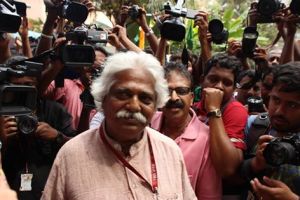


[J Devika was one of the organizers of the Kiss Against Fascism protest at the IFFK. This is her necessarily partial account of the protest.]
 KAFILA - COLLECTIVE EXPLORATIONS SINCE 2006
I am amused and fascinated by the kiss protest in Kerala and the energy associated with it. As I do not currently live in kerala, my impressions are based on the information from web.
I am curious about the impact the protest will have for women and men interested in interacting freely in the public space in Kerala. The real challenge for those associated with the protest will begin only after the hype and novelty of the protest has died down. They have opened up a bit of clear space in the jungle of hypocricy, orthodoxy, mysogyny , patriarchy(list is long…) in the Kerala psyche.As long as this space is open to all women and men, I am sure this will grow and evolve into something beautiful.
On a lighter note, I would like to bring your attention to the protest against changes in pornography regulations that took place outside English parliament last week. Their mode of expression of protest was creative and funny and got the attention that it deserved.
LikeLike
Great work, happy for this success. The struggle would have to continue until all the skeptical minds are convinced about the need of this cause.
LikeLike
Devika – lots of protests required in India, but do we really “fight for the cause” or for the sake of the cause? while kiss of protest is right to demand freedom of expression, did the protest serve the purpose unless the purpose was to get attention? If our right to PDA was the one to achieve and considering the retrograde people we have around, it will be great if we can foster this as a long term cultural change – we had a generation of parents who did not even explicitly say “love you” to their spouses in front of their own family, we have a generation of teachers who “sat” boys and girls differently, our movies showed actors either roling down the slope in a park (who would do that in real?) or two sunflowers shivering on the screen..the change you are asking for is a long term change, i think a protest like this only defeats the purpose because it polarises the opinion rather than foster acceptance. unfortunately, i am neither the intelligensia (dont have a beard):) nor the protester kind. But I wish we can do this with a conviction for the cause rather than to get noticed.
LikeLike