
Interview with SARWAR TUSHER, writer and activist in Dhaka. Sarwar is one of the leading critical intellectuals associated with the important journal of political thought in Bangladesh, Rashtrochinta Journal and is also member of its editorial panel. In this detailed interview Sarwar explains not just the movement but also the larger politics of Bangladesh. The interview was taken by Aditya Nigam over email.

[After a round of massive repression and killings, the details of which the reader will find below, the movement is now back with renewed strength. This time it is not just the students and youth demanding an end to quotas but rather huge popular movement that is demanding nothing less than resignation of the Sheikh Hasina government and radical reform of the state. The conception behind this demand for “radical reform of the state” has been spelt out by Sarwar Tusher in detail below and the reader can see how it has grown in conjunction with mass movements of the past. Critical political thinking in tandem with the experience of mass movements has now led to the demand also of a new Constituent Assembly and the drafting of a fresh Constitution. It is also significant that “July” is no longer the name of a month but the name of the struggle itself as it reappears with greater vigour. I should add one more point here, which as to do with some misgivings in India about the quota and reservation question. Though Sarwar deals with it at greater length in different part of the interview, my own sense on reading his responses as well as following the discussions over the past one month, is that the situation is more akin to what might have been (and still is) in countries of state-socialism where the communist party certification was crucial in getting jobs and rising in the bureaucracy and other state institutions. The party certified whether you were “revolutionary” (muktijoddha) or “counter-revolutionary” (razakar) and it is not difficult to see why those regimes became so seriously unpopular (to put it mildly) in their own countries. AN]
Q1. My first question to you is about the background to the anti-quota movement – in terms of the actual issue of the quota and its status after the 2018 movement. What does the High court order of 5 June say and why? What happens to the affirmative action quotas? I ask this last question because in India, quota only refers to reservations for Dalits and Adivasis and so people have generally been suspicious of the category of ‘merit’.
ST. Thank you very much. Actually there is no similarity between the Indian reservation system for Dalits and Adivasis and Bangladesh’s quota system. That is why it is best to discuss them separately, each in its own context. According to Bangladesh’s quota system 56 percent of government/ public employment had been reserved by quotas and the remaining 44 percent was available for selections through open selection via merit. From this statistic itself it is clear that the Bangladesh quota system was unjust and illogical. There is actually no debate about the need to give special facilities, incentives for the advance of weaker sections of society. This is absolutely necessary and just. It is incumbent on any democratic state that it should pay special attention to the advancement of sections that have been victims of historical as well as contemporary systemic discriminations. However, the reality of Bangladesh’s quota system is different. Instead of removing discrimination, it has created new discriminations. That is why the forum created by the students for conducting this struggle has been named Students Movement against Discrimination. It is evident from the figures I mentioned earlier themselves that the existing quotas are discriminatory.
But there is another very serious side to this issue. In Bangladesh state institutions cannot function as independent institutions; here constitutionally the structure of power has been so concentrated in the hands of one individual that all institutions dance to the tune of the leader of the party in power. As a result all state institutions are partisan and subservient to the top person in power. In order to run and administer such a state structure, the government in Bangladesh generally try to pack the administration with their own party people. The Awami League government has taken that tendency to unprecedented, virulent levels. They have consolidated their power by packing all state institutions with their party people.
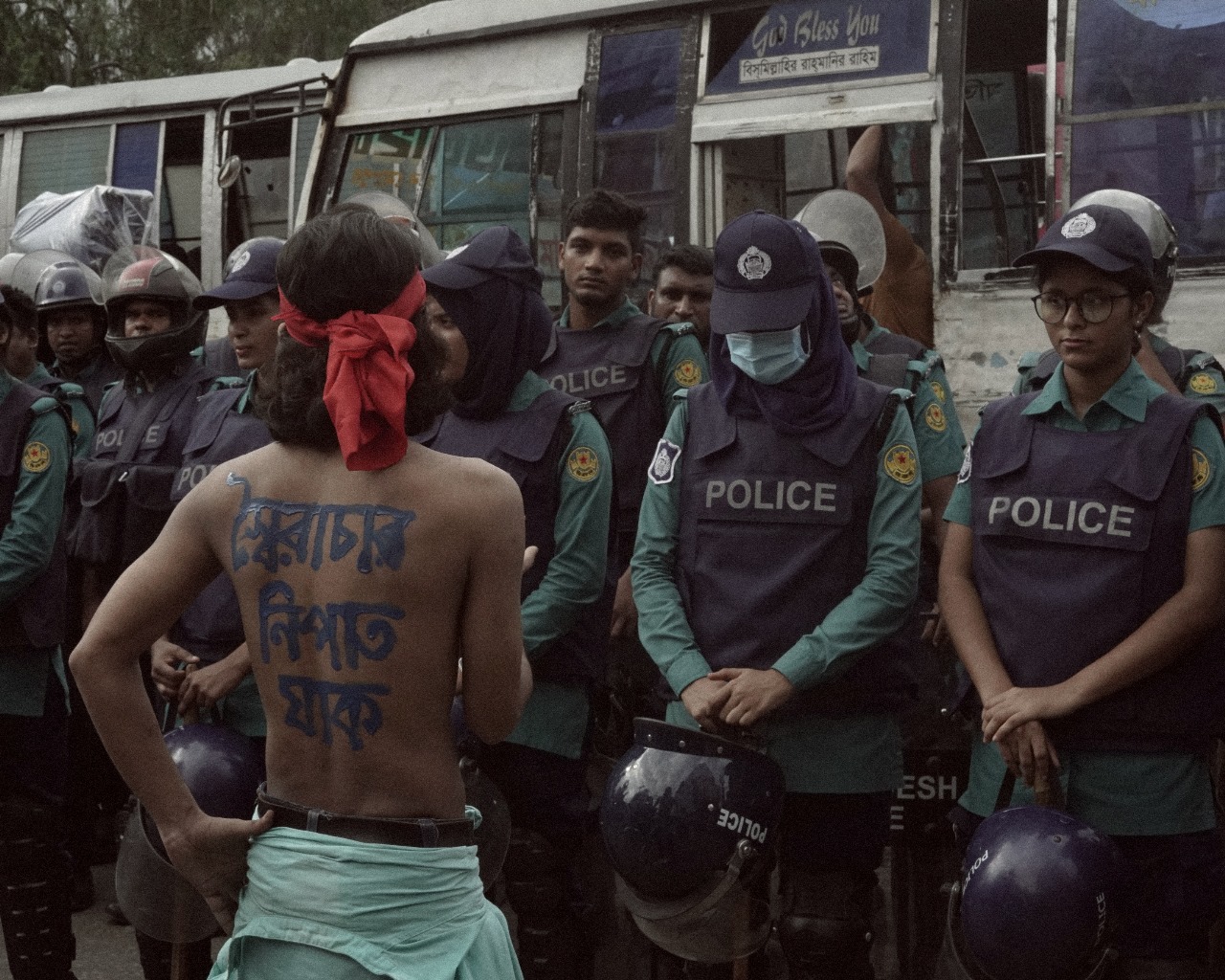
But they are doing this by exploiting the emotions and respect of the common people of Bangladesh for the liberation struggle for their purposes. The Bangladesh state emerged out of an armed liberation struggle. It was a people’s war in a real sense. Except for a handful of Razakars, people from all sections of society stood with the liberation struggle. Many among them participated directly in it. Even those who did not directly participate in the struggle, helped the freedom fighters in many different ways, including providing them shelter, cooking food and secretly reaching it to them. In other words, the question is far bigger than who actually fought and who did not. Even with respect to the actual armed struggle, the situation is not that simple. If one looks at it that way, then it cannot be denied that many Awami League leaders, instead of participating in the armed struggle, were sitting in Kolkata. Some of them were actually serious about their relation to the armed struggle but some of them were simply enjoying life in Kolkata. Some freedom fighters have written about the exploits of Awami League leaders in Kolkata. Anyway, we can let that be…
The point is that the state that was established as a result of that people’s war is a state where the people are supposed to be supreme, they are the fount of all power. The freedom fighters did not fight to free the country in order to institute a division between who fought and who did not. They were the heroes of the nation, so to speak and not “backward sections” of the people. Moreover, the actual fighters in the armed struggle were a mere 0.24 percent of the population. But the quota that has been kept for their offsprings and grandchildren is 30 percent. Does this discrimination accord with the understanding and consciousness of the freedom struggle? Certainly not. After the country became independent, a temporary quota system was established in order to give priority to the freedom fighters in employment. But the idea of a 30 percent quota for the grandchildren of the freedom fighters in a sort of “permanent settlement” stands in total contradiction with the spirit of the freedom struggle.
Here we need to be aware of the psychology of the Awami League. They do not consider the freedom struggle as belonging to the people of all strata of society but rather, as the property of their party. They believe that they can exploit the sentiments of the people towards the freedom struggle and their respect for it, in order to do whatever they wish. Even theft of votes. Between 2014 and 2024, they have done this three times. I will return to this question later. Such psychology and actions can be understood under the rubric of the “chetona industry” (“consciousness industry”), following Norman Finkelstein. Finkelstein notes that in order to exploit the Holocaust trauma of the Jews, Zionists have virtually started a “Holocaust industry”. In Bangladesh too, such a “chetona industry” is active whose sole purpose is to use the glorious history of a people to advance a party’s own narrow vested interests. The biggest irony is that all misdeeds of the AL government – from corruption, massive siphoning off of money from the country, disappearances, crossfire, and torture – are all conducted in the name of the “spirit of the liberation struggle”. There can be no bigger insult to the liberation struggle than what the AL is doing.
The freedom fighters’ quota has basically been used for a long time now to pack the administration with Awami League people. They have made lists of fraudulent “freedom fighters” – people who have no connection with the real liberation struggle. All these fraudulent lists and certificates have been distributed among their own people in exchange for bribes. On the other hand, many actual freedom fighters never got the advantage of the quota. In fact, many freedom fighters and their descendants have refused to partake of this quota. They have stated clearly that they did not participate in the liberation struggle in order to get special favours. Many of their descendants are saying that their earlier generations did not lay down their lives so that they could extract more advantages after attaining freedom.
This was the background to the emergence of the 2018 quota reform movement on a massive scale across the country. The key demand of the students is evident from the very name of the movement. They wanted a rational reform of the quota system, not its abolition. They were saying that it cannot be that of all the jobs available, more than half are put under the quota. This demand of theirs was entirely logical. Consequently they had received the support of the people from all across the country. Indeed, even some AL-supporting intellectuals too had stated that a quota reform was needed. Notice that the demand of the students was very specific. The demand for “quota reform” was formulated so that it could be kept primarily for those who are disadvantaged. Faced with such a demand, any democratic government would have tried to examine its various dimensions. This is only natural and desirable. But the AL government responded, even in 2018, in the first instance by resorting to violent repression by the police and its own organization, the Chhatra League. Many participants in the struggle were picked up and subjected to merciless torture. At that time however, though many participants in the movement were seriously injured, there was no loss of lives. After that, at one point the prime minister Sheikh Hasina stated in her characteristically arrogant style, on the floor of the parliament, that “in that case there will be no quota”.
In other words, in response to the demand for quota reform she just did away with quotas altogether. This was not the students’ demand! And alongside, this canard was spread through its submissive media that the students had taken a position “against” the freedom struggle. There can’t be a more vile and untrue campaign than this. In 2018, one of the main slogan of the students was: “In Bangabandhu’s [Sheikh Mujibur Rehman’s] Bangla, there is no place for discrimination.” By doing away with quota in its entirety, if anyone took a stand opposed to the freedom struggle, then it was Sheikh Hasina herself.
After the quotas in their entirety were abolished, many who had genuinely benefited from it naturally felt peeved about it and approached the courts. The main debate is over this 30 percent “freedom fighters” quota (I have explained above how it is misused). Now using the smokescreen of the “spirit of the freedom struggle”, an organization that actually serves the purpose of Awami politics went to court against the government’s decision, seeking its intervention. There are enough reasons to believe that this step was backed by the government’s silent support. It was in that context that the High Court has overturned the government’s 2018 notification cancelling all quotas and restored the earlier position on quotas.
Here one thing needs to be borne in mind. Whether there will be quotas in government jobs or not is a matter of the government’s policy decision. There is no question of this falling under the court’s jurisdiction. More recently, after the struggle started, the Supreme Court intervened, giving the reference of Article 104 of the Constitution – which talks of “complete justice” – and did a redistribution of quotas. It said 93 percent of the jobs will be open for merit while 5 percent will be reserved for freedom fighters and the remaining 2 percent for “ethnic minorities” (the term is problematic but there is no recognition in the Bangladesh Constitution of any other category except ethnicity), disabled and third gender people. The court also said that the government could change this distribution as it deemed fit. A circular has been issued to this effect.
Firstly, if you want to bring about “complete justice”, then why did you keep the leeway for increasing or decreasing the distribution? And if you do keep it, then why refer to “complete justice”? By doing this the problem has simply been kept alive. In 2018, the government had thought it would issue whatever notification it wanted to at that point, in order to contain the situation, and then if it would make changes to that five-six years down the line, who would remember? In 2024 too, after the High Court order, the situation ultimately remained where it was. Awami League probably thinks the people of Bangladesh have the memory of goldfish.
As you can see, both the creator and the continuator of the problem is this government alone. And if you raise any demand, you are branded “razakar”. You will probably be surprised to know that in 2018 itself, there had been another big movement – the Safe Roads Movement. After two school students were knocked down and killed by a recklessly driven bus, school-college-university students across Bangladesh rose up in anger in a big movement. They had only two demands: one, we want justice. And two, we want safe roads. That movement too was ruthless suppressed by this government. Not only that, small school students were labelled “razakar”! Practically, any opposition to the ideology or decisions of the AL is being labelled “razakar”. By doing this, it is the AL that is doing the greatest violence to the legacy of the liberation struggle.
This time too, Sheikh Hasina has labelled the protesters as “descendants of the razakars”. Naturally, students were very angry and came out late at night from all their halls (hostels) and took out demonstrations in the campuses. In these demonstrations the following slogans were raised: One, ami ke, tumi ke? Rajakar, rajakar/ ke bolechhe, ke bolechhe? Svoirachar, svoirachar (“Who am I? who are you? Razakar razakar/ Says who, says who? The dictator, the dictator” – svoirachar would more accurately mean despot/ism). Two, cheyechhilam odhikar/ hoye gelam rajakar (“I demanded rights/ I became Razakar”). Three, tumi no-o, ami noi rajakar rajakar (“You are not, I am not/ razakar, razakar”). Four, lakho shohider rokte kena deshta karo baaper na (“This country bought with the blood of lakhs of martyrs is not anyone’s paternal property).
Anyone with a minimum conscience and faculty of judgement can see two things clearly in the above slogans. One, the slogans do not expect the tag “razakar” from the country’s prime minister, that is why they are angry. Second, the students do not partake of the history that is tied to the word “razakar”, that is why they are angry and annoyed. Alongside they have made it known that this country, achieved through the valiant liberation struggle, is nobody’s patrimony and those who believe that are the despots.
And yet, after this the AL general secretary and influential minister in the government Obaidul Kader said “the Chhatra League will give a befitting reply to these self-confessed razakars”. Even if you have a little brains, you can see that the students are rejecting the tag “razakar”. But even if we assume for argument’s sake, that they are claiming to be “razakar”, why should the Chhatra League be asked to punish them? Is the Chhatra League entrusted with law and order enforcement in Bangladesh? So, after getting Obaidul Kader’s green signal, the CL ruthlessly pounced upon the students in various campuses, especially in Dhaka University. The truth is that in the campuses this is the responsibility that the CL has been entrusted with for a long time – whenever any genuine movement emerges among students, go and bash them up, then we will see what their demands are!
So basically the “razakar” tag by the AL president Sheikh Hasina and the general secretary Obaidul Kader’s directive to the CL to give a “befitting reply” transformed a peaceful movement into a turbulent one. We have to understand the entire chain of developments in in this perspective.
Q2, I would also like to ask you about the political background to the movement. I should explain this a little. I have spent a long time studying mass/ popular movements and when I saw the videos of the massive student demonstrations taking place not just in the universities in Dhaka but also in districts like Cumilla or Rangpur, they were not like anything I had seen before. In their scale, in terms of the participation of such large number of women – which to me is an index of many things – and for the completely peaceful nature of the demonstrations, the movement was unprecedented. Till videos of firing, presumably by the Bangladesh Police, started coming in, from the 16th I think, from universities that looked like they were in siege, the movement remained peaceful. So from my understanding such massive movements can only be spontaneous: no single issue, no single political force can bring a movement of such scale and intensity into being. Yet, after the 18th, if I am not mistaken, some videos of acts of property being set afire started being circulated? Was that a spontaneous response of some sections within, to the violence of the state? We have also heard, after all, of Chhatra League violence in the early phases but through that phase, the movement seemed very, very peaceful (maybe apart from some skirmishes in hostels). Is this a correct perception? How do you see the different phases of the movement in the past couple of weeks?
ST. Your observation is correct that this movement was peaceful from the beginning to the end and in many respects quite novel. The presence of women students, their dynamism and their leadership were all worth seeing. It wasn’t that only a particular type of women who believe in a particular lifestyle who came out on to the streets. That much is clear even from the varied attire of the women who were active participants in the movement. Like in many other countries, an unnecessary and nonsensical debate on women’s attire is often raised in our country too. The proponents of the “chetona industry” believe that the burqa/hijab in itself is a sign of women’s bondage and slavery. On the other hand, many groups of the religious Right think it is because of the “loose” western attire that the country is going to the dogs. In this kind of a movement both these extreme types of viewpoints get organically defeated. A movement like this automatically and effortlessly gives its reply to questions that we try to address through logical argument in normal times – that women’s attire cannot be the object of culture wars. In the videos and photographs of the movement you will see that women in burqa-hijab, in western clothes and in so-called traditional attire – in all kinds of clothes walked shoulder to shoulder, hand in hand, keeping the highway alive. This was really a scenario worth watching and thinking about. Equally importantly, alongside this they had their own negotiations and adjustments with male participants in the movement, on the basis of equal respect.
Before the CL and police attack the movement was entirely peaceful – your point here is correct. It was only after the CL attack that the students all over the country picked up sticks. This was part of their self-defence because for ages the CL has kept up a regime of fear and terror in campuses. The hostels had become like concentration camps. Many students have been murdered by them. Many students have been permanently disabled by them. CL has played that role in campuses that used to be played once upon a time, during the Pakistan era by the goonda force NSF. NSF’s politics has been wiped out from Bangladesh and CL will have to think if it wants to go the same way.
Consequently, there was an accumulated anger among students against the humiliation and torture meted out to them. Now it got the opportunity to express itself and came out into the open. That is why we saw that a movement that had begun for quota reform, very rapidly became also about the terror, forcible collection of funds, tender-related scams, killings and torture, control over hostels and forcibly taking non-party students to their demonstrations in return for a residential seat in the hostel, by the government-sponsored student organization. This was only to be expected.
The movement has been entirely non-party (not apolitical) and spontaneous and has proceeded in that fashion right through. It was after Sheikh Hasina labelled the protesters “descendant of razakars” and the CL attacked the students that the movement acquired greater intensity and militancy. Students studying in colleges and private universities around the public universities also came out into the streets. The police killed Abu Saeed of Begum Rokeya University, Rangpur, firing at him in cold blood. The unarmed Abu Saeed had opened himself to police fire bravely and finally collapsed. In his final Facebook post Abu Saeed had remembered Shamsuzzoha, the brave martyr of the 1969 movement student-workers-people’s uprising against the Pakistani military despot Ayub. Shamsuzzoha was a professor and at that time, proctor of Rajshahi University, who stood like a shield before the Pakistan army, in order to protect the students and with his fresh blood protected the students. Shmasuzzoha’s history had inspired Abu Saeed’s present struggle. Now Saeed himself is history. There is no doubt that the yet-to-come democratic Bangladesh will give Abu Saeed his bravery and martyrdom the place it deserves.
The whole world has seen the video of the bravery and courage of Saeed and the brutality of the police. On Tuesday the 16th of July, across Bangladesh six students including Abu Saeed, fell to police bullets. At this point the anger and resentment fuelled the movement that spread like wildfire everywhere in the country. Workers, daily labourers, middle class guardians – all started joining the students on the streets. On Wednesday the 17th of July, Sheikh Hasina addressed the nation with a view to control situation. That day she appeared visibly shaken and overcome with sadness. Of course, many people believe that those were all crocodile tears. In her brief address she said that apparently no one can understand better than her the grief of losing one’s dear ones. From this many people expected that there will probably be a softening of the police’s attitude. However, the opposite happened.
At the call of the Student Movement against Discrimination, a complete shutdown was observed throughout the country in a peaceful and spontaneous way. People from different strata joined the shutdown for grievances of their own. The whole country, including Dhaka, was under the control of peaceful, shining young people from all sections. We can understand that day through the slogan of the 1968 students-workers’ movement: “barricade blocks the street but paves the way”. It was as if the way to freedom, rights and justice was opening up. That very day (18 July) according to official count, 42 people were killed in police firing – mainly students. Most people believe that the actual count of the dead is much higher. So you can understand that no one called Sheikh Hasina “crocodile queen” just out of enmity!
Here it is necessary to bring up another matter. Bangladesh gained freedom 53 years ago. If we add the period since 1947, two eras of major struggles and movements, then except for the liberation struggle of 1971, there is no instance of so many students being martyred in one go like this. Even in great Language Movement of 1952, students were not martyred like this. In the Language Movement, in the two days 21-22 February, the number of those killed was stated to be between 26 and 39; in comparison in the ten days (16-26 July) 209 people have been killed has been reported in some newspapers. Though many people have estimated that the actual figures are over 1000. AFP has reported the number of dead at 1174. Many unidentified bodies have been buried even without a post-mortem, many bodies are still untraceable and many have simply disappeared. Even if we hold on to the number 209, more than half of them are students of schools-colleges-universities. In Dhaka alone, the number of people injured is 6, 703! More than 500 of these have been shot pellets in their eyes. This is completely unprecedented in our history.
Two more things need to be mentioned. First, as a keen observer and theorist of popular movements, you have rightly observed that a movement of such a scale and spread cannot emerge out of the directives of any single political party or force. It is impossible. We have seen the movement of opposition parties before the 7 January dummy elections. Common people did not participate in that movement, even though they did not also go and vote on 7 January. A maximum of 2 to 5 percent people participated in voting. The remaining 95-98 percent people neither participated in the movement of opposition parties nor in the election set-up by the government. And yet, between 16-20 July we witnessed an uprising of students-youth-people. From this it is evident that the people will not participate in a movement which only aims to go to power using the movement while the opposition parties remain totally indifferent to people’s issues. In July, the people found their own politics. The throne of the fascist Awami League shook in the face of the popular uprising. This situation of disconnect between the people and the opposition parties is not a very happy one but that is unfortunately the reality at the present moment.
The political parties will have to learn to analyse this situation in depth and with honesty and understand that they cannot they cannot do politics by remaining below the level of people’s own political concerns. I raise this question because whenever there is a movement, the AL has the old habit of smelling doings of the “Jamat Shibir” [the name of the student wing of the Jamat-e-Islam] in it. But anyone even minimally familiar with the 70-year history of this organization and movement will know that this country has never accepted the politics of the Jamat Shibir. Nevertheless, I say that simply because someone is a Jamat activist does not give the government license to beat them to death or to simply “disappear” or kill them in firing. The AL, adept at making political capital out of everything itself makes a kind of killable homo sacer out of the figure of a Jamati and uses that tag to attack others. Anybody can be labelled “Shibir”” at any point of time. This is dangerous in the extreme. Our position on this is very clear. You cannot simply tag anybody “Shibir” and kill them at will. In fact, it is unacceptable that you do that even if the person is a Shibir-activist. If there is any charge against anybody, bring them to a proper legal process of trial. Resorting to extra-judicial killings – disappearances, crossfire or simply beating to death – is not and cannot be any form of expression of the “spirit of the Liberation Struggle”. In the 1990s, when the BNP was in power, AL had no compunctions in doing a joint movement with the Jamat-E-Islam Bangladesh, in support of their demand for a caretaker government. At that time, Sheikh Hasina had said that even though they did a joint movement, they did not bury their ideals to do so. In other words, you can do a joint struggle or movement with the Jamat when it suits you, and when you are in power, you can find the ghost of Jamat in any and every movement! The people of Bangladesh have rejected such fascistic politics of the AL as despicable.
Secondly, from last Thursday (18 July) evening itself the internet blackout had begun. As a result we not only lost contact with the world outside but also among ourselves. Against this background, from Friday (19 July) onwards the movement suddenly acquired a violent character. We suddenly started getting news of attacks on various installations and properties being set on fire from the television media. Who set fire to these various properties? Who are these people who are attacking the various installations? We will probably never come to unravel this whole mystery. The video of the government’s submissive media showing things on fire is being circulated. They are saying they “received the video”. Who reached it to them? The way the news of such large scale deaths of people is being suppressed and this video of things on fire is being circulated, there is enough reason to suspect that the very forces that are responsible for the killings have something to do with the fire. The leading Bengali daily of Bangladesh, Prothom Alo, published a news on 24 July. In that news we can see that a Shramik League (an organization connected to the AL) leader had done a deal for taka 4 lakhs with a Leguna driver [Leguna is a tiny four-wheeled public transport] to set fire to a bus. However, he gave only taka 500. That Leguna driver confessed before the police that he set the bus on fire on the directive of this Shramik League leader. But an inquiry has to happen. How are you propagating in the media, without any inquiry, about who is responsible for the fire?
Now let me turn to the present situation. For the last few days the country has been under curfew. For the first three days, the curfew was very strict but during the last three days, it is being relaxed for about seven hours daily. From the evening on and through the night the curfew is strictly enforced. And in the midst of it continue mass arrests. According to the news in newspapers, all over the country 9000 people have been arrested. Student leaders are being subjected to brutal torture. They are being abducted and the news has also come out in the press of some of them being forcibly injected with some drugs to keep them unconscious. Raids are being conducted almost house to house and regardless of whether they have been connected to the movement or not, students of leading educational institutions are being picked up and shown as arrested. Opposition activists and leaders are being arrested. We are all living in grave uncertainty, anxiety and terror. Which of us will be on the line next, we do not know. The situation in Bangladesh seems far scarier than that which prevailed when Erdogan started a witch-hunt after the failed 2016 military coup against him. This despite the fact that the students did not indulge in any secret conspiracy to dislodge Sheikh Hasina from power. Of course, this much is true now that having failed miserably in controlling the situation, the people from different sections are now spontaneously demanding her resignation. But this is no conspiracy! Then why these mass arrests and crackdown?
Q3. Let me also ask one question bluntly – because this has been circulated in my view, from official circles in India – and relayed by many well-meaning Leftists individuals: the so-called “takeover” or “hijacking” of the movement by Islamists and the Jamat in particular. One video of very doubtful provenance was circulated by some people but I was quite amazed that while no one from Bangladesh was expressing any such opinion, some circles in West Bengal started playing this up as though this were an accomplished fact! How do you see this question of the Islamist presence or otherwise, in the movement?
ST. We have seen this over a whole epoch that in order to suppress any legitimate movement, the AL begins to see the ghost of Jamat-Shibir in those movements. I have referred earlier to the Safe Roads Movement. Even that movement of children and adolescents did not escape this labelling. But this time the situation is far more dangerous. It isn’t just that the scare of the Jamat-Shibir and Islamists is being whipped up but also a rhetoric “militancy” is being put in place. It is being claimed that the “militants” are behind everything that is happening. This is a nihilistic attempt to inject fear and terror. Because the internet was down for a few days, we were completely in the dark about what was going on. Now the news of the deaths is coming out in newspapers and social media. In these we can see that the majority of those killed are all students of some leading educational institution. Apart from that who are the others who are being killed? A vegetable vendor, a tiles worker, and ambulance driver, textile worker, someone in small employment, small “businessman”, water seller, a four or five-year old child, a photographer and many other people from different classes and professions have either been found spot dead with bullets pumped into their bodies or they have been brought to the hospital for treatment and succumbed to their injuries. Most of them have been shot either in their heads or in their chests. Do we have to believe the story that they are all militants?
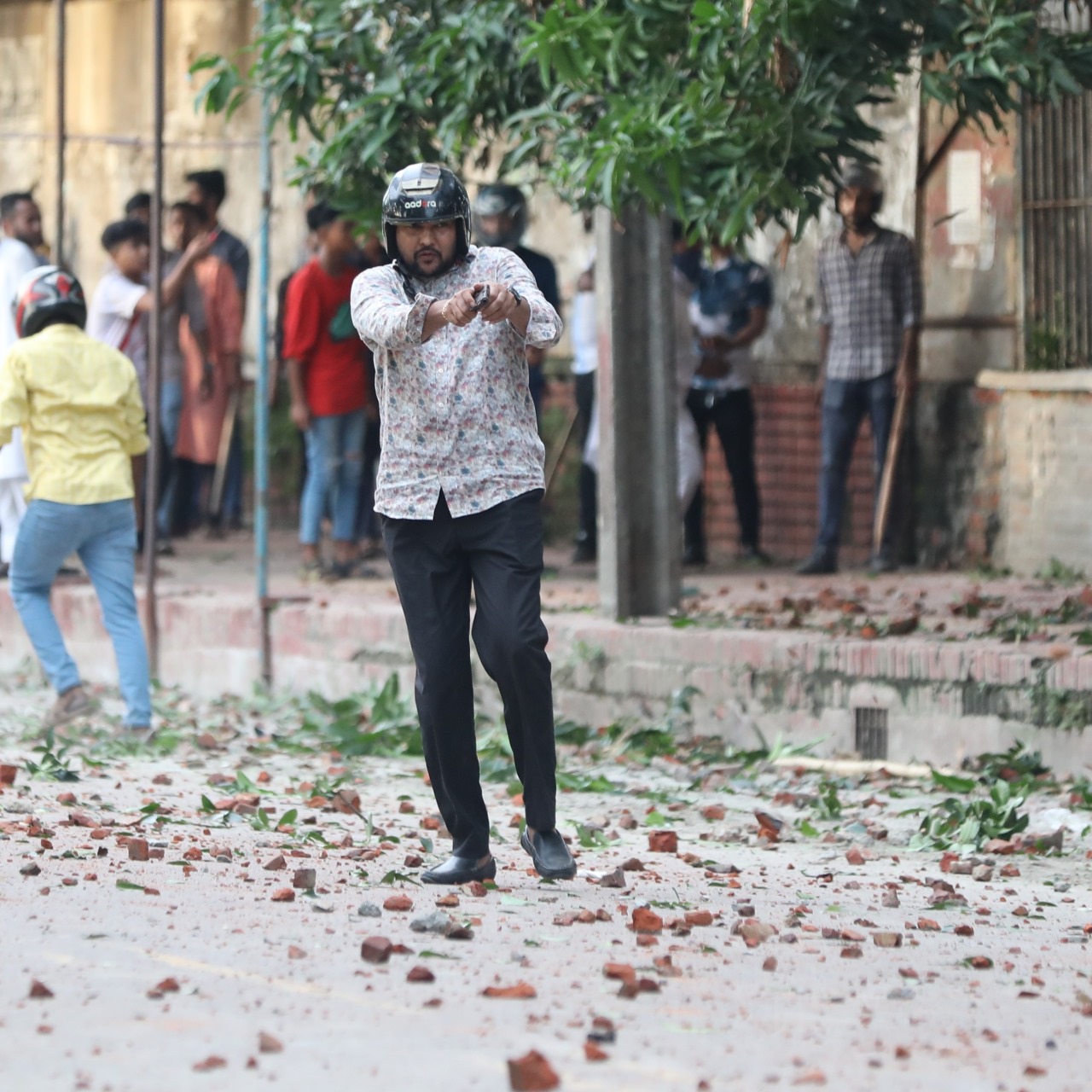
Even before this governments have fired on various mass movements but never have we seen such a frightening situation as this time. A five-seven year old child has been shot even while sitting inside the house. Never before this have we seen firing from helicopters or by snipers from high-rise buildings. These are all beyond the pale of our collective experiences. The whole nation is in a traumatized state. And on the other side, the Bangladeshi television versions of the Godi media are being used to propagate that it is all about militants and fundamentalists. In that case, why in this movement of militants did the state security forces kill ordinary people in such large numbers? Were the six year old child Riya Gope or students of the two leading educational institutions Shahjalal University of Science and Technology and Chittagong University – Rudra Sen and Hridoy Chandra Tarua part of the Jamat-Shibir? The little beautiful child Riya Gope was killed when she was playing on the terrace of her house and was shot from a helicopter. Hridoy Chandra fell to police bullets when, after his tuition he was returning to the hostel. Rudra Sen was seriously injured in a combined attack by the police and Chhatra League and fell into a pond and died.
It seems like we are in the control of some colonial invader!
What you have said about the West Bengal and Indian darbari [official] Left is correct. It is very unfortunate. This shows that they prefer to remain ignorant of the society, culture and history of their neighbouring country. If we want to live side by side with each other, we need to be more respectful of each other. Starting from Rahul Gandhi’s Bharat Jodo Yatra and Kejriwal’s arrest, to India’s recent election, the revival of the case to harass Arundhati Roy, the continued arrest of Sharjeel Imam for six years and of Umar Khalid, the Shaheen Bagh Dadi of the anti-CAA-NRC movement who appeared on the cover of Times magazine – if you discuss the recent history of India in the last many years, you will find that I know far more and with perhaps far greater insight than many Indians. When I know about you and you think it is your greatness that we know about you, then it only shows that the relationship is not among equals.
In relation to Bangladesh, it seems as though the official Left of India and Kolkata doesn’t keep itself informed beyond the old Awami narrative of the older days. This is both sad and condemnable. It is as if, apart from the Awami League, entire Bangladesh is Jamat-Shibir, razakar! Indian and Kolkata darbari Leftists ought to understand that outside AL too there is Bangladesh. We are there. They too have a responsibility toward developing good relations with the people of entire Bangladesh outside of AL. We cannot choose our neighbours but we do have the option of developing harmonious and warm relations with each other. From that point of view, the darbari Left of West Bengal will have to learn to develop a sense of Bangladesh beyond the AL. One of Bangladesh’s very well-known intellectuals Ahmed Sofa had said in the late 1990s, in an interview in Kolkata, that if Bangladesh is attacked, West Bengal has a responsibility to defend it. I want to remind the official Left of West Bengal of this.
At the same time, we are grateful at the way in which India’s critical and radical activists and antifascist intellectuals and theorists have stood with us. However, in the interests of stating the truth we must say that their number has been very small. We hope that with the assistance of the critical and radical political currents, this situation will change.
All this provocations of the movement being “hijacked” or some “third forces” entering it are very old tactics. We might also call it the only tactic of the AL in trying to suppress any legitimate movement. Actually the situation is completely different. No “third force” has entered the movement. There is no point in trying to rake up the scare of Islamists. Bnagladesh’s darbari Left and darbari Islamists have very friendly relations with the government. On the other hand, despite the fact that many youth in the movement have their own Leftist or Islamic orientation, they are motivated by their own demands and concerns alone. They do not have any fixed ideology and they believe remaining captive to the prison of ideology is a kind of backwardness. Of course, in such a massive movement such as this, it is certainly possible that students and youth belonging to both Leftist and Islamist persuasions will participate. In a social and nonparty movement, such a possibility is nothing surprising but the reins and the leadership of this movement is not in the hands of such people. And there is no chance of such a thing happening. Such a movement cannot remain under the leadership of any particular school or tendency. If someone thinks that because they are in this movement, therefore they are either its controller or its theoretician, then we must say that they suffer from the “fly on the wheel” syndrome. A fly sitting on the wheel believes that the wheel turns because of it but that is of course, never the case.
Actually the scare of Jamat is being created so that India’s civil society and activists do not support this movement. Many people have been misled by this campaign. And the BJP government and the AL government, for their own specific reasons, are fanning these provocations. But this is very far from the truth. That the radical youth of West Bengal have not taken the line of their seniors is a matter of happiness for us. Because the struggle for freedom, rights and justice and against fascism and totalitarianism requires the unity of the youth across South Asia and such a situation of solidarity helps in building that unity.
The last point that should be stated here is that the AL has been trying to appropriate the rhetoric of the “war on terror” in order to mislead public opinion in the West as well. That is why the narrative of “militancy” has been deployed. Challenging this official discourse – that has a very close connection with power – is today’s Leftism. Outside this, everything is a kind of officialism.
Q4. Now that the official death toll stands at 204 – the unofficial figure being much higher – as you said in one of your Facebook posts, it seems that the movement has now gone beyond the abolition of quota to demand the resignation of the government and fresh election under some kind of a caretaker regime. How do you visualize this situation? What is the state of the movement now after massive repression, abductions and disappearances continuing? It is also interesting that in the course of the crackdown that the army hasn’t really gone out of its way in repressing the movement, rather this was carried out, according to reports, by other forces including the paramilitary forces. If this is true, how do you read this?
ST. Today’s (27 July) latest official figure according to a news in Prothom Alo, is 209. Here we must remember that at one point the hospitals had to stop keeping records. Many bodies were buried without any postmortem, simply declaring them “unclaimed”. The number of dead has been increasing with every passing day. I have said earlier too that some unofficial estimates put the figure of people killed well above 1000. The government will of course never let us know the real figures. They are busy with their blame game. If one minister of theirs is trying to tell us that the students were drugged another minister is alleging that the Jamat-Shibir in police uniform has conducted this campaign of killing.
One former judge of the Court, very close to the government, came on television and said in a talk show that the police did not do anything wrong by resorting to firing. In order to evade responsibility for the death campaign, the government and individuals close to the government are resorting to massive level of gaslighting. The entire country is immersed in grief. After being able to enter the social communication media (Facebook hasn’t been opened up yet and people have entered via other means, mobile data is blocked till the 27th of July) people have shared the photographs and videos of those who died. The people of Bangladesh have entered the tunnel of an unprecedented trauma. It is as though all of Bangladesh is a Karbala of dead bodies. Not only has the government not shown any remorse or tried to assuage the pain, on the contrary it has tried to terrorize people, abduct people and conduct raids in the dead of night.
Awami League has created a deep wound in Bangladesh society. It will be very difficult and complicated to come out of it. There is enough reason to believe that the relations of the common people of Bangladesh with AL will never be normal again. If you go out of power and sit in the opposition, there is always the chance that you will return to power. Indeed, if only to return to power, the experience of going out of power too should be there. The Congress has been out of power for a decade but whether it is today or tomorrow, return it will to power once again. But the relationship of ordinary people with the AL has reached such a sorry state that it has gone beyond repair. The arrogance of power creates such a distorted sense of reality that common sense goes out of the window.
A few words about the army also are necessary to state here. There is a glorious history associated with the rise of the Bangladesh army. In 1971, the Bengali officers and soldiers of the Pakistan army had raised the banner of revolt. They had declared “we revolt”. That is to say that they refused to be party to the genocide against their own people. Not only that, in different sectors of the liberation struggle, they provided leadership in the struggle for freedom. They knew that if the struggle failed and the country did not achieve freedom, they would be court martialed and certainly face death sentences. Even so they took the huge risk, drawn by the love of the motherland – and won. In popular memory in Bangladesh this display of courage and love for the country still evokes strong emotions. The people of Bangladesh even today see the army as a symbol of their faith. I believe that they will keep this in mind and return the faith that the people of Bangladesh repose in them. That they will not turn against their own people.
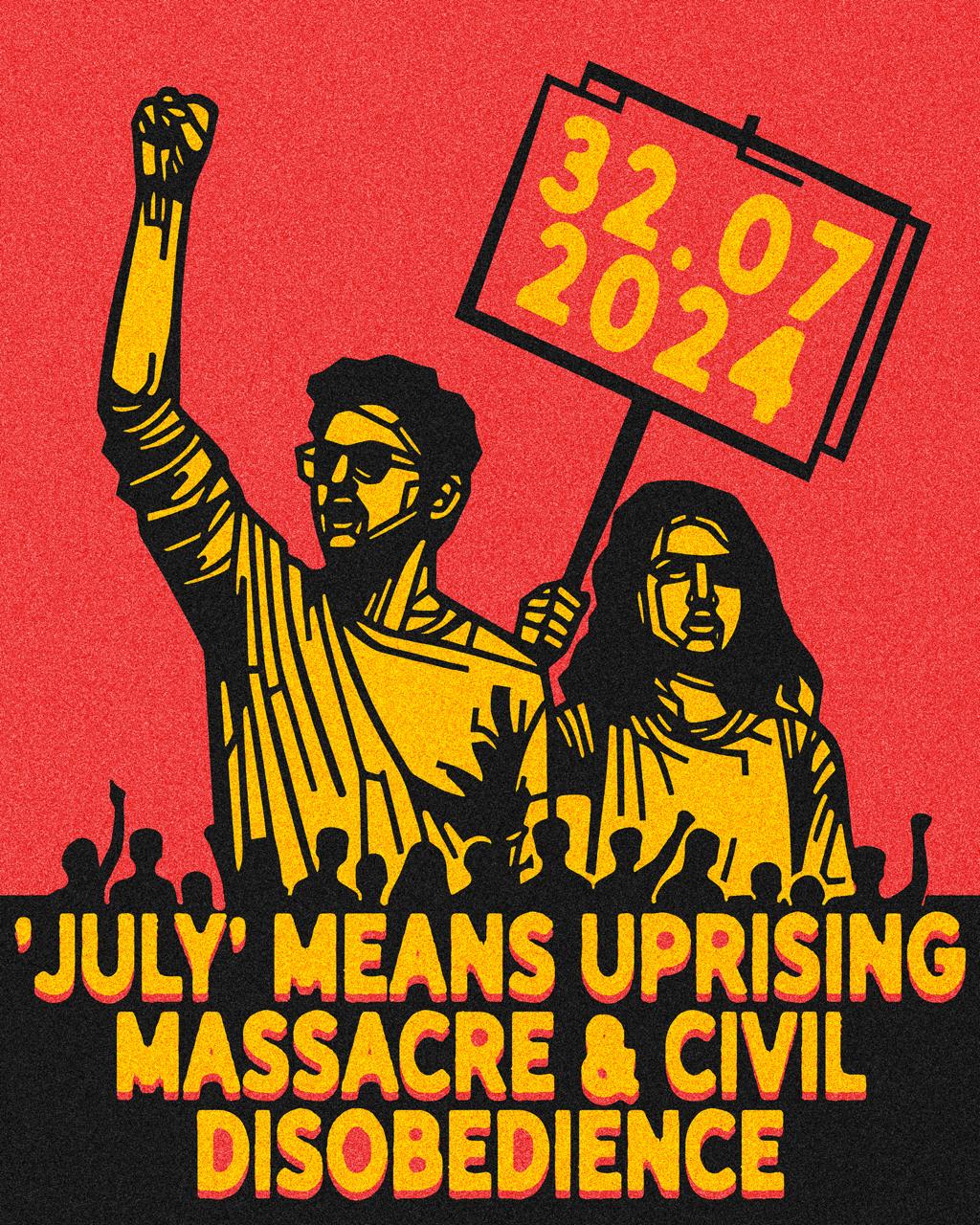
You are correct that the movement is no longer just confined to the question of quotas. The government has to accept responsibility of the mass killings and resign. This is the minimum demand of the people of Bangladesh now. The students in the movement have put out a demand charter of nine demands. The demand for resignation of the government had already been raised by the political parties for a long time because the ruling party has hijacked, through novel methods, three parliamentary elections one after the other (2014, 2019, 2024). After hijacking the voting rights of the people of Bangladesh, they are now playing this game of accusing the movement of being hijacked by other forces. The resignation of the government and the conduct of free elections under a caretaker government – this is been there as a demand for a long time in Bangladesh. But this time this demand has become a demand of all the people – barring known agents of the government. And this time, the youth aren’t simply demanding the resignation of the government; the youth that has emerged from the struggles like the Safe Roads Movement and the quota reform movement is now demanding a radical reform of the entire state machinery. At the time of the Safe Roads Movement, they had called it “state reform”, and they are reiterating it now.
The more politically aware among the youth have raised demands, through the mass uprising, of the replacement of the government with an intermediate national government, the election of a Constituent Assembly, the promulgation of a democratic Constitution and through popular vote eliciting the support of the people for the Constitution. A roadmap to this effect has already been spelt out by them. It is in these two demands that we can see the desire or aspiration for democratic transformation that is active in Bangladesh society. The replacement of the colonial model of a fascistic government with a democratic state and a society free of fear is the deepest desire of the youth of Bangladesh. This is a politics that goes far deeper and is more far-reaching than the narrow aim of replacing the Awami League government by a BNP government. No matter who comes to power as a result of the people’s movement, their sacrifices and their blood, they should remain under the command of the people, rather than become gods in the colonial mold – this time the movement has dared to spell out such a vision. I am convinced that this will be a demand close to the hearts of the change-desiring youth and the people of India and South Asia at large. And this will have to begin with the resignation of this illegitimate fascist government. Otherwise, the fascist force in power will be uprooted through an unprecedented mass uprising. The process is on the way.
Q5. Finally, a question about the general perception in Bangladesh that under the AL and Sheikh Hasina government, it has become a vassal state of India. It has been alleged that the Indian government, regardless of who has been in power here, has treated Bangladesh as its fiefdom. What is your opinion on this matter?
ST. This perception is unfortunate for us but to a very large extent, it is correct. The leaders of India and Bangladesh do not even try to hide it. Regardless of whether it is the Congress or the BJP that is in power, they consider it is best for Bangladesh if it is ruled by Awami League. But no intelligent and thoughtful country should keep all their eggs in one basket. Pranab Mukherjee in his memoirs, Coalition Years has written without any attempt to conceal what role he had played in 2008 in trying to bring AL to power. Even so, the 2008 election was largely a free and fair election. At least the people could vote. But in the three elections after that, the people of Bangladesh could not even exercise their franchise. In 2014, there was an impression in the BNP that because Congress = Awami League, therefore it can be assumed that BJP = BNP. They were soon disappointed. It can be seen that the BJP is even more unrestrained and reckless in trying to keep the AL in power.
In order to ensure that the last election of 2024 is free and fair, the USA was putting some pressure on the Awami League. Of course, behind this were their own geopolitical considerations in the main. So the people of Bangladesh had huge expectations that they would perhaps be able to exercise their vote this time. But this time too, they had to face disappointment. Last November, in the 2+2 summit between the USA and India, held in Delhi, there were strong indications to the effect that India had “contained” the USA on the question of Bangladesh. In other words, India was apparently successful in communicating to the USA that only if AL stayed in power, if need be without elections, would the interests of both countries be secured. As a result we saw the USA go on the back foot. That is why, in Bangladesh society, there is a lot of resentment against the US too, alongside India.
With respect to the 7 January dummy elections, their success in “containing” the US is seen as a great diplomatic victory by Indian policy makers. Of course, after 16 July, all these things have become irrelevant for Bangladeshis. Bangladesh people have started believing in their own power and agency. I do not think there is any reason for India to feel scared of such a situation. Like Palestinians per se are seen as “terrorists” by Israel, India too should give up its similar stance towards Bangladeshis and try to understand this unhappy people with sympathy – that will be to India’s advantage. If India is able to give up its attitude of being the village headman even though the village doesn’t accept it to be so, India can become a natural leader of South Asia. But for that it has to give up its attitude of domination.
I want to give one instance here of how strong is the Indian understanding that in Bangladesh every other side is militant/ fundamentalist. Before the 7 January dummy elections an article was published in the important Indian daily, Indian Express whose title ran thus: Bangladesh Election Tug of War: Islamic Fundamentalism versus Democracy. In that article no attempt was made to understand why the opposition political parties in Bangladesh had boycotted elections; rather it claimed that a dummy election conducted under the AL dispensation, by hook or by crook, was still “democracy”. And all those who were demanding free and fair elections under a caretaker government and were opposed to the farce of elections were all “Islamic fundamentalists”. That is to say that if you are opposed to the open dacoity of elections by the AL, you are “Islamic fundamentalist”. According to this strange logic, even a Bangladeshi Hindu who opposed the AL fascism was “Islamic fundamentalist”. Strange logic indeed!
It will be useful to remind you that in the Bangladesh Constitution there was a provision of a caretaker government during elections. After the Bangladesh Awami League came to power in 2008, with its two-thirds majority, it scrapped this provision. Here we need to bear two things in mind. Having a two-thirds majority in parliament does not mean you have a majority of the votes. The statistics and history of elections in Bangladesh tell us that from 1990 on, no party has ever received more than 40 percent of the votes cast but they manage to get a majority in terms of seats and then use that two-thirds majority to do what they desire with the Constitution. Second, even with absolute majority the power to amend the Constitution should not lie with the parliament. Because the Constitution is the written document of the people’s collective will and intent. And the parliament is the representative of the collective will of the people and intent. The house therefore should not have the power to use that representative position in order to change the very collective will and intent that they are supposed to represent. This is a major political and philosophical debate. But in Bangladesh, the parties in power are not sensitive to these important questions. For that reason, many experts in or country feel that such tampering with the Constitution by the parliament is fundamentally unconstitutional. Because these debates have arisen in our society, that is why the demands for state reform and election of a Constituent Assembly are becoming more and more important and cannot be suppressed by force.
We have great expectations from the Indian radical civil society, intellectual community, students, and above all, Indian people. We expect that they will continue to keep up the pressure on the BJP government to stop interfering in the internal politics of Bangladesh. Even in this time, as events continued to unfold, in a Hindutva television channel of West Bengal there was a discussion on whether India will send a “shanti sena” to “defend” Sheikh Hasina. As a result, a silent resentment is building up in Bangladesh. This is dangerous for both countries. To be able to come out of such a situation an understanding between the peoples of the two countries is necessary. The unity of the people and civil societies of the two countries is necessary to defeat the blueprint prepared by the two fascistic regimes in order to buttress their power.
Bangladesh doesn’t want to be India’s West Bank. If something like what Israel is taking forward its geography minus demography project in the West Bank, occurs here the consequences will be very frightening.
Israel wants the land of West Bank and Gaza but not the Palestinian people. As a result, through the Oslo accord, it has arrived at an arrangement whereby the day to day, non-military administration of Palestine will be done by a Palestinian Authority appointed by Israel; on the other hand, the overall control of the land, water and space of the West Bank will remain under Israeli control. In this way, they will not have to bear the responsibility of looking after the people, while retaining effective control over the territory. This is what I call “geography minus demography”. Many people are calling the Indian presence in Kashmir after the abrogation of article 370 “colonial” [See Hostile Homelands: The New Alliance Between India & Israel by Azad Essa, 2023)]. There is also an instance of calling Kashmir the “Palestine” of South Asia. The whole world is aware of the ideological and military friendship between Zionism and Hindutva. India is the biggest buyer of Israeli arms and surveillance technology. Of the total Israeli arms exports, the Indian state alone buys half.
I do not think India will ever want to directly take over Bangladesh. But the “geography minus demography” that I spoke of, is already at work – and we can observe many signs of it. It is for that reason that the students of Bangladesh have written on the walls that “We have broken the chains of Pindi/ Not to become Slaves of Delhi”. This is not the wall-writing of any Islamist group; it is the Left wing students organizations of Bangladesh who are writing such slogans. India’s policy-makers need to take this perception of the Bangladeshis into account. We expect that in this we will find the people of India’s radical democratic current standing with Bangladesh. You cannot preserve and expand your democracy if you are complicit in the obstruction of the democratic and political development of your neighbours – we believe that the Indian people will force their state to recognize this truth. Bangladesh expects to develop relations of peace and harmony on the basis of equal dignity.
 KAFILA - COLLECTIVE EXPLORATIONS SINCE 2006
One thought on “The Movement in Bangladesh is for a Radical Reform of the State – Interview with Sarwar Tusher”