
Following is a statement of All India Solidarity with Siang Indigenous Farmers’ Forum, endorsed by 43 organizations and fifty individuals.
We, the undersigned, express our solidarity with the Siang Indigenous Farmers’ Forum (SIFF), which has been spearheading the people’s protest against the proposed 11,500 MW Siang Upper Multipurpose Project (SUMP) of the National Hydro-electric Power Corporation (NHPC) in Arunachal Pradesh, which will be disastrous for this whole area. We support the demands of SIFF for withdrawal of Central Armed Police Forces (CAPF) deployed in Beging village for doing the Pre-Feasibility Report (PFR) of the project.
We demand:
- Immediate removal of CAPF personnel from Siang, Upper Siang and East Siang districts.
- Immediate withdrawal of the drilling machine from the survey site in Beging
- An assurance from the State Government that no further forceful activity related to the PFR will be carried out without the free, prior, informed consent of the local communities
We also demand the safety of, and dropping of all charges against, advocate Ebo Mili and other protesters. The Siang Deputy Commissioner had filed a complaint against Ebo Mili on 26th May 2025 for violation of Section 144 in Beging, after which Mili was untraceable, detained by the police without intimation to his family. We note with grave concern that this is the third occasion on which advocate Mili has been arbitrarily detained, after similar detentions in August 2023 and July 2024.
We further demand:
- An immediate halt to SUMP-related activities, and dialogue with the local communities
- A transparent and participatory environmental and social review process of the Siang basin
- Restoration of indigenous land rights and implementation of the Forest Rights Act in Arunachal Pradesh to strengthen traditional community forest governance systems
- Ecologically responsible alternatives to mega-hydropower like distributed mini hydels to meet local electricity requirements
We also urge the Government of India to explore an equitable water-sharing agreement with China, rather than both countries competitively pursuing mega-hydro projects.
Context:
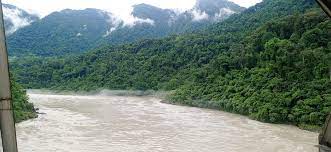
The Siang river, known as Yarlung Tsangpo in Tibet, flows from China into Arunachal Pradesh before joining the Brahmaputra in Assam. The SUMP proposes a network of 43 dams across the river and its tributaries, at a cost estimated by the NHPC of Rs. 1.13 lakh crore.
For centuries, the Siang river has been the lifeline for the region’s indigenous communities like the Adi, Memba, Khamba, and Idu Mismis, providing water for their farms and enabling a cultural connection to their ancestors. If implemented, SUMP will submerge extensive tracts of fertile farmland, sacred forests, and traditional hunting grounds, displacing thousands of indigenous families and disrupting centuries-old agricultural and ecological systems. SIFF says at least 27 villages in Siang and Upper Siang districts will be directly impacted by the dam. People from the Adi community say that their language, forest, rivers, culture, tradition, and identity will perish.
The basin is rich in forest biodiversity. More than 82% of the Siang basin (more than 15,000 sq km) is under forest cover, rich in orchids, rhododendrons, bamboo and canes; overall, 27 rare, endangered and threatened (RET) and 46 endemic plant species. Twenty-five mammalian species found such as the red panda and clouded leopard are under Schedule I of the Wildlife Protection Act, facing the highest threat of extinction, while 26 are under Schedule II. There are 447 species of birds, of which 31 are Schedule I species. The basin consists of 5 Important Bird and Biodiversity Areas (IBAs), vital for conservation of bird populations of species like hornbills.
The Siang river basin study submitted in 2013 as part of the EIA had said that if all the proposed 43 dams on the river were built, of its total course in India, only 85.5 km (29%) of the free-flowing water regime of the Siang river would be left.
Implementation of SUMP will accelerate deforestation, degrade river ecosystems, and disturb the region’s flora and fauna. Altering the natural flow of the Siang river is expected to:
- Alter the entire Siang river aquatic system which would adversely impact the aquatic biodiversity and disrupt the breeding patterns of native fish species, many of which migrate upstream during specific seasons.
- Deplete aquifers and groundwater levels, affecting agriculture and potable water access.
- Cause irreversible damage to the habitat of endangered species.
- Increase the risk of landslides and flash floods in an already fragile mountain terrain.
Located in Seismic Zone V, the area is prone to powerful earthquakes, which could compromise the dam’s structural integrity and lead to catastrophic flooding downstream in Assam. Additionally, the fragile mountainous terrain increases the likelihood of landslides, which can cause sedimentation, disrupt river ecosystems, and threaten local communities.
Climate change is causing Himalayan glaciers in Arunachal Pradesh to melt at an alarming rate, further increasing the dangers of floods and mudflows, which can also cause dam bursts and flooding downstream.
The SUMP has been justified by the Union and Arunachal Pradesh Governments as a necessary countermeasure to China’s proposed 66-GW hydropower project on the upper course of the Siang. It has been argued that the SUMP will maintain the natural flow of the Siang river and mitigate potential flood risks from water releases by China. But our past experience from Kerala in 2018, Uttarakhand in multiple years, and Sikkim in 2023 has shown that hydropower-based big dams have caused bigger floods, rather than mitigate flood risks.
The State Government sees hydropower as a major source of revenue for the state, without considering the social and environmental impact of dam projects. The Power Minister of the state has said that Arunachal Pradesh has the potential for 58,000 MW, which is 40 percent of the total hydropower capacity in India. The State Government has estimated that Arunachal Pradesh will receive Rs. 10,000 crores in revenue every year from hydropower. One hundred and sixty-nine MoUs/MoAs had been signed with various power developers for the development of power projects in Arunachal Pradesh. But 53 MoAs had also been terminated due to breaches of agreement clauses by the developers. The State Government had also said that most of the hydropower projects signed between 2004 and 2015 had failed, causing huge losses to the state.
The hydropower projects in the state, including SUMP, lack transparency, as key information such as environmental impact assessments and social impact analysis has not been disclosed to local communities in an accessible manner. Public hearings held by the Government have been designed to assert its own plans rather than hear from the public. The input and demands of community representatives have been ignored or dismissed by the government.
Signatories:
Organisations:
- National Alliance of People’s Movements (NAPM)
- National Alliance for Climate and Ecological Justice (NACEJ)
- Campaign to Defend Nature and People (CDNP)
- All India Feminist Alliance (ALIFA)
- Nadi Ghati Morcha
- Bharat Jan Vigyan Jatha
- CPI (ML) Liberation
- National Alliance for Justice, Accountability and Rights (NAJAR)
- Akhil Bharatiya Mazdoor Kisan Sangharsh Samiti (ABMKSS)
- Loktantrik Rashtranirman Abhiyan
- Citizens for Democracy
- All India Union of Forest Working People
- Affected Citizens of Teesta, Sikkim
- Climate Front India, Jammu & Kashmir
- Youth for Himalaya, Himachal Pradesh
- Chalakudypuzha Samrakshana Samiti, Kerala
- Sir JC Bose Science Heritage Museum, West Bengal
- South Asia Network on Dams, Rivers and People, New Delhi
- Nodi Bachao Jibon Bachao Andolan, West Bengal
- Chennai Climate Action Group, Tamil Nadu
- All India Inquilabi Youth and Students Alliance (ALIYSA)
- People for Aravallis, Haryana
- Mehanati Publication, West Bengal
- Manipur Nature Society
- Indian Community Activists Network – Maharashtra
- Jagrit Adivasi Dalit Sangathan, Madhya Pradesh
- Bargi Dam Oustees Organisation, Madhya Pradesh
- Kosi Nav Nirman Manch, Bihar
- Queers for Constitution, New Delhi
- Maharashtra Small Scale Traditional Fish Workers Union
- J&K RTI Movement, Jammu & Kashmir
- Kalpavriksh, Maharashtra
- Caste Annihilation Front, Tamil Nadu
- Aashray Abhiyan, Bihar
- Eco Warriors Nagaland
- Sangtin Kisan Mazdoor Sangathan, Uttar Pradesh
- Poovulagin Nanbargal, Tamil Nadu
- Jol Japon, West Bengal
- Shramik Mukti Dal, Maharashtra
- Khedut Mazdoor Chetna Sangath, Madhya Pradesh
- The Flora Project Goa
- Van Gujjar Tribal Yuva Sangathan, Uttarakhand and Uttar Pradesh
- Jharkhand Kisan Parishad
Individuals
- Maanasee Hatkar, Haryana
- Moncy M. Thomas, Kerala
- Dr. Piyush Kumar Rai, Uttarakhand
- Swapnil, Uttarakhand
- Abhayraj Naik, Karnataka
- Daniel, Kerala
- Safia, Tamil Nadu
- Joya Mitra, West Bengal
- Anamika Singh, Uttar Pradesh
- Bhumi, Delhi
- Sudhir Katiyar, Rajasthan
- Anjali, Madhya Pradesh
- Heman, Gujarat
- Uma Shankari, Andhra Pradesh
- Usman, Maharashtra
- Shekhar Roy, West Bengal
- Varsha Mehta, Gujarat
- Sehjo, Delhi
- Nikita Naidu, Telangana
- Swapnanil, Karnataka
- Kasturi Saha, West Bengal
- A. Suneetha
- Ravi Joshi, Uttarakhand
- Dipak Dholakia, Delhi
- Neetisha Xalxo, Jharkhand
- Milind Wani, Maharashtra
- Ita Mehrotra, Delhi
- Daniya Dabre, Maharashtra
- Vishal Ashok Palled, Karnataka
- Radhika Desai, Goa
- Ravi Chopra, Uttarakhand
- Emmanuel Murray, Telangana
- Devanshi Srivastava, Uttar Pradesh
- Nandini Oza, Maharashtra
- Raju, Tamil Nadu
- Sharad Lele, Karnataka
- Manish Kumar, Bihar
- Anupradha Singh, Delhi
- Sudhir Kumar, Tamil Nadu
- Rachit, Delhi
- Gaurab, Assam
- Anuja Mital, Assam
- Aditi Vajpeyi, Himachal Pradesh
- Malaika Mathew Chawla, Maharashtra
- Sinead D’Silva, Goa
- Reema Shah, Maharashtra
- Jerusha, Goa
- Banhi Chakraborty, West Bengal
- George Monippally, Jharkhand
- Drishti, Himachal Pradesh
 KAFILA - COLLECTIVE EXPLORATIONS SINCE 2006