
Guest post by SANDEEP MENON
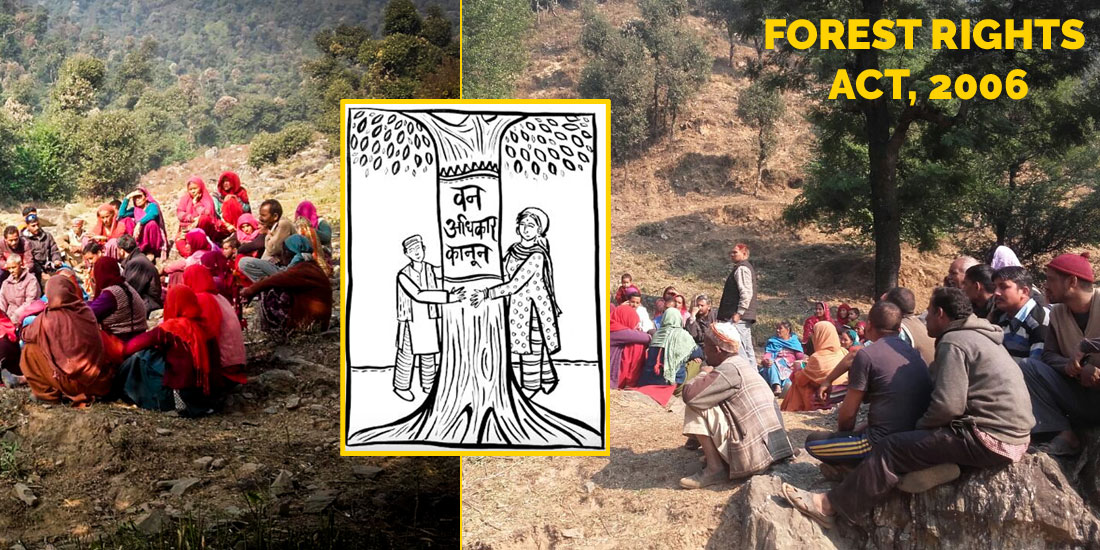
The road to hell is paved with good intentions. That’s the first, visceral reaction that many passionate wildlife conservationists have, when you utter the 3 letters: FRA. The Forest Rights Act (2006) aims to give native tribal and forest dwelling populations ownership of, and decision-making rights over what happens in the wildlife areas that they are residents of. But many conservationists see it as a gateway for rampant encroachment into protected areas.
I was initially a bit more circumspect, having been a longtime advocate for community-based conservation. Having always believed that ivory tower conservation can never work, without putting the people involved at the center of it. But I have also had to temper my position over time, as I witnessed the complexities of how it was playing out on the ground. (ref- https://india.mongabay.com/2020/07/commentary-making-communities-central-to-conservation/ )
Today, the FRA has become highly contentious and has driven a schism between hitherto left leaning conservationists and human rights advocates. This is unfortunate because both communities ostensibly want to protect forests at the end of the day, albeit for the sake of different species. Things reached a flashpoint in 2019, when a group of Wildlife NGO’s petitioned the Supreme Court, which resulted in a judgement that all individuals whose claims had been rejected under the FRA, must be evicted from the land they occupy. This became contentious because it assumed that the claims process had been rigorously followed in the first place.
This whole debate came sharply back into focus after the recent demise of a “celebrity” conservationist who was well known and respected within wildlife circles. While the accolades and eulogies poured in, one WhatsApp note struck a sharp contrast. It claimed that while he may have been a friend to wildlife, he was anti-tribal and a poor example of humanity in general. The note was somewhat jarring, but it was also a sharp reminder of the current divide. Many of India’s last generation of celebrity conservationists came from the urban, privileged sections of society, often having little connection to the lives of common folks living in and around wildlife areas. They tended to view all human interaction with wildlife areas as undesirable. Local communities were viewed through the lens of suspicion, and it was automatically assumed that they would be susceptible to inducements from criminals. This is a rather partisan view of things, but that was their lived experience. The core issue though, is that the reality lies in the middle. And neither side is willing to acknowledge it.
As mentioned before, I started out as a strong supporter of the FRA, while understanding that it was designed to prevent wholescale exploitation of wild areas and forest dwelling communities by large corporations and greedy middlemen. This has been the root cause for several peoples uprisings, and it was clearly in everybody’s interest to see that the right safeguards were provided under the law. There is also some evidence to indicate that this has worked to deter large scale environmental destruction in some cases like the high-profile Vedanta bauxite mining case in Niyamgiri, where 12 gram sabhas successfully managed to block a 1.7 B$ project. Or the lesser-known case of Lippa in Himachal Pradesh where the community managed to block a Hydel project that would have submerged their lands. At the same time, several projects like the Great Nicobar island development project as well as multiple Hydel power projects in the North East, continue to forge ahead despite local opposition.
The Joint Forest Management (JFM) framework that was introduced in the 1990’s was a precursor and clearly demonstrated potential benefits for conservation management. It sought to de-vilify local communities and involve them into the conservation process, while also driving some of the benefits back to them through a defined regulatory framework. One great example of this working successfully is the Kerala Forest Ecodevelopment Committee model, which allows tribal communities to get a stake in sustainable eco-tourism. Over time, it has rehabilitated several tribal community members who had excellent knowledge of the forest but had no option other than engaging in small, subsistence poaching to get by. If one was to go by the broken window theory, cutting off small time transgressions nips the creation of hardened criminals in the long run and is hugely beneficial. Similarly, several eco committees in areas like Uttarakhand and Karnataka have rolled out sustainable angling programs, while protecting river systems with great success. There have also been several areas in Maharashtra and Madhya Pradesh, that have managed to formalize the collection of forest produce to some extent.
The issue gets complex though, when this framework extends to “ownership” as the FRA seeks to do. In a country rife with identity politics and seasoned corruption, it opens the floodgates of “unintended consequences”. Especially when policy makers may not have thought through the contours in detail. This is especially true when the ownership aspect focuses on individual ownership and title grants, rather than community ownership. At its core, the FRA was supposed to work on 3 levels: Individual forest rights, community forest rights and community forest resource rights. But implementation often got focused on individual rights, driven by local political interests. By some estimates, Individual Forest Rights (IFR) claims are seen to be more than 4 times the land sought to be claimed under community rights. Throw poor land records and land use mapping into the mix and the potential for misuse gets amplified.
There are other aspects that do not seem to have been assessed rigorously as well. Scheduled Tribes need to prove they have occupied the land before 31 December 2005, while other forest dwellers need to prove 75 years of occupation. For an act envisaged in 2006, requiring just a few years of land occupation as proof is bound to result in false claims as the backdating is not hard. And there are enough middlemen willing to coach claimants on what to do.
Another critical aspect affecting already fragmented protected areas and wildlife corridors, is that enough thought has not been given to habitat fragmentation arising out of granting dispersed individual titles across wildlife areas. The act makes no provision for concentration of grants into clustered areas, which could have helped mitigate this impact.
Ironically, the implementation process also does not recognize the futility of using the same framework of implementation agencies and bureaucracy that have excluded forest dwellers in the past and treated them as headaches to be “managed”. They cannot suddenly be expected to empower them overnight. The trust deficit between the participants runs too deep to be bridged easily. Any attempt to reset power equations is met with outright opposition from players who are experts at obfuscation, delay and denial.
The implementation approach also over-simplifies the intense politics that exists between ground level stakeholders such as gram sabhas, panchayats, local landlords, NGOs, activists and the bureaucracy at various levels. This is not a rosy, co-operative world of good intent that we are dealing with. It is the same complex world, driven by self-interest, that we are used to in other spheres.
In terms of sheer numbers, almost 16% of India’s population consists of forest dwellers. Impact assessment in terms of what the result can be, as many of them start trying to gain individual rights is also something that does not appear to have been modelled effectively.
Then there is the reality that one witnesses on the ground. I have personally seen large swathes of land being cleared near the Nilgiris Biosphere protected areas by communities that were predominantly settlers, recently migrated from nearby hamlets. When questioned, they were naïve enough to tell me that they had been advised by a local “leader” to do so. Apparently coached to say that they had been living there for several years. They were told that this would entitle them to land grants under the FRA. The underhand plan may have been to try and take control of the land later, in return for the right inducements or to garner valuable political mileage at the very least. But the settlers did not see it that way. To them, their advisors were angels promising to get them ownership of land that could be monetized, and that was all that mattered. The fact that pristine forests were being hacked down and shanties were coming up, the fact that forest departments were reluctant to interfere for fear of having atrocity cases registered against them, was all par for the course. In other areas near Coorg, I found political committees joining hands with dominant local families that had received rights under the FRA. They were blocking popular trekking routes and charging an “entry fee” to trekkers, with no official sanction for the same. “Camping grounds” were coming up inside protected areas, where you could pitch tents for a fee. Public goods were now being bartered for money. In a bizarre twist, the very act that seeks to democratize access was being used to restrict and monetize access to common areas. There are several other stories of cornering of forest resources by dominant families within the community, who were now hand in glove with non-tribal actors with vested interests. These are all admittedly anecdotal narratives, but one cannot turn away from the fact that they flag the various possibilities for misuse. Ultimately, it is a sad fact that instead of correcting historical injustice towards marginalized communities, a cabal of middlemen and politicians started using provisions of the FRA as a tool for encroachment regularization and power politics.
Clearly, policy makers had not thought through the fact that any form of power or ownership in India gets immediately viewed through the lens of monetization and can boomerang into the same form of exploitation that was sort to be avoided in the first place.
This is not to say that the FRA is all bad. But it’s current implementation leaves much to be desired. And in its current form, it is actively resisted by several stakeholders, rendering it largely ineffective. Despite the FRA being active for over 17 years now, recognition rates vary across states. Estimates suggest that on average, 42% of claims are rejected, while 15-20% remain pending. This is not counting many cases that would not even have managed to submit a successful application.
Meanwhile, the central government quietly stepped in with a Forest Conservation Amendment Bill in 2023 and a new framework called the DAJGUA programme, launched in Oct 2024, that seeks to streamline the FRA process under the tribal affairs ministry. (Hitherto implementation was largely with state governments.) More importantly, it seeks to do away with the need for gram sabaha approvals for diversion of forest land and it seeks to redefine what the term “forest” means as well. In short, it dilutes the community ownership and decision-making aspect that the FRA sought to formalize.
Under these conditions, it becomes even more important to re-imagine the FRA as an inclusive conservation tool, rather than only a land rights mechanism. Perhaps the way out of this complex maze lies in relooking at the 3 imperatives of the FRA and start giving a higher priority to implementation of community rights and forest resource rights, rather than individual title rights. Empowered communities have a higher incentive to protect common resources as well as social checks and balances to avoid short term monetization temptations. It is also an effective tool to prevent the greatest threat, which is large scale deforestation proposed by so called big ticket, “development” projects.
The answer to making effective progress could lie in:
- Prioritizing community rights over individual titles.
- Building social accountability systems within communities to prevent misuse.
- Ensuring land-use decisions respect ecological integrity, not just tenure claims.
- Treating empowered communities as the strongest defense against destructive mega-projects.
The choice before us is stark. We can allow the FRA to degenerate into a political currency for land regularization. Or we can reclaim its original spirit: a tool to reconcile the rights of people with the needs of ecosystems.
India’s forests and its dwellers deserve nothing less.
Sandeep Menon has been associated with wildlife conservation for over two decades and has spent many hours in the field, as part of his work with one of the leading wildlife NGOs in South India.
 KAFILA - COLLECTIVE EXPLORATIONS SINCE 2006
Based on anecdotal evidence, it is strange to put forth new binaries like forestry (good)/agriculture (bad) or community rights (good)/ individual rights (bad). The Forest Rights Act emerged out of the struggles of forest-dwellers against being labelled as encroachers and summarily evicted, for the crime of occupying land that they had been cultivating for generations. The Act categorically says that forest dwellers have rights of various kinds and lays down procedures to record and recognise those rights. It has its inbuilt checks and balances. Despite that, just because of instances of misuse of the Act, the individual right to cultivate cannot be arbitrarily separated from the community right to collect forest produce or the community resource right to manage forest area. The Act is a powerful instrument to decolonise and democratise the governance of forests, and for this very reason, it is resisted by the forest bureaucracy through non-implementation, dilution and legal challenges. I have argued in https://ecoinsee.org/journal/ojs/index.php/ees/article/view/1371 that only popular mobilisation around the Forest Rights Act will save forests and forest-dwellers from nefarious moves like the 2023 amendment to the Forest Conservation Act.
LikeLike
No argument with most of what you say. Yes, we must try and draw the best outcome for all. But it is a fact that sometimes interests collide and problems amplify as populations grow (e.g. shifting/jhoom agriculture vs forests). In such cases, policy makers have to tread carefully and balance outcomes, instead of becoming absolutist in their stance. Thats all
LikeLike
Consider the following facts:
LikeLike
Good, detailed points. The article actually does not dispute most of these points. We may be largely on the same page here.
The difference again comes down to what practically transpires on the ground. For e.g. while you are right that IFR grants do not allow resale etc, you must be aware that locals now refer to it as “forest patta”. It is pretty much treated as ownership and there is no practical administrative mechanism to monitor land usage in the long run. For e.g. informal leasing, including long term leasing cannot be controlled. To add to this, the NAC itself suggests convergence of livelihood schemes, including MNREGA to such land grants. Hence dwellings, modern agriculture, even extension to home stays etc… will be facilitated by other schemes of the government, over time. In the long run, they are likely to simply turn into rural-agri landscapes, at best.
ref: https://www.rcdcindia.org/PbDocument/1e4379ad93641f2-32a6-4aba-a638-ae25612cd4bbStudy%20on%20actual%20use%20of%20FRA%20recognized%20land.pdf
Again, on the point of shifting agriculture. Yes, it is regenerative when practiced at small scale and over long periods of rotation. But when 10 families become 100 and rotation cycles gets crunched, then it’s just semantics for deforestation. And so on…
LikeLike
Point 1, by the way is an old English proverb used among others by writers and philosophers like Byron and Charlotte Bronte, Kierkegaard and Marx and of famously, Lenin. Are you contesting the proverb? I think the date (13 December rather than 31) is probably a typo but maybe the author himself will clarify that.
I am of course, not a expert on the FRA but I do see every law in this country being misused not just violated. Maybe, FRA is immune to misuse. But violations of its provisions e.g. regarding consent of gram sabhas are evident everywhere as far as I can see. So, yes you may have the best law in the world while forests after forests are chopped down or handed over to corporations. I wonder how that best law helps in cases like Hasdeo forest for instance.
LikeLiked by 1 person
A famous proverb being contested,? No. Simply stated the fact that the path to hell is usually paved with bad intentions. The choice is between the colonial oppressive forest regime and democratisation of forest governance with all its flaws. Would the forest be better off with FRA or without FRA, given that the Forest Conservation Act, 1980, a law to facilitate forest diversion for non-forestry purposes is doing its job well despite the Wildlife Protection Act 1972 and FRA in line with the policy of ‘ease of doing business’ (Hasdeo too falls within its scope) speedily executed by the state with communities, environmentalists, human rights activists etc. trying to resist it: data shows that only close to or less than 1% of the projects did not obtain forest clearance during the period 2014-2020.
The relevant question is whether FRA is, has been and can be used to strengthen the resistance to forest grab in the name of development and conservation? If yes, then there will be those who would deride FRA by pointing out how bad it is despite its good intentions and how terribly it is being misused especially when the Supreme Court is slated to hear the anti-FRA case in mid October, There were two such diatribes in the mainstream media on Sept. 17 and 18th already by retired foresters. This repeats every time the hearing date is listed. Its was the same last time when the case was slated to be heard on 4 April this year. For instance, see the counter on 1 March to the first petitioner’s article where too facts are arraigned for the consideration of the readers. The case is filed by retired foresters and some conservation NGOs. Incidentally Bombay Natural History Society and Wildlife Trust of India who were amongst the first petitioners to challenge FRA in the Supreme Court withdrew their petitions.
LikeLike
To my mind, the core issue is actually in the assumption that forest dwellers should not have the same commercial and lifestyles aspirations as us, over time. And how that will drive behavior in this context, is not being planned for.
LikeLike
Not planned for? Plans have been on with the state actively facilitating it attempting to force the people to behave in certain specific ways no doubt. See https://timesofindia.indiatimes.com/city/nagpur/farmers-in-tribal-areas-can-lease-land-to-private-parties-bawankule/articleshow/124004941.cms
The question is to what extent FRA can assert the larger common good when all others are pitted against it.
LikeLike
Laws and their provisions, their checks and balances, are all on paper. They come alive in specific situations. To succeed, laws like FRA need mass mobilization on the one hand, and a modicum of sincerity on the part of the implementing bureaucracy. When big guns like Adani move in, all levels of the state, from Panchayat to PMO fall in line to meet their needs. Gram Sabha resolutions can be faked, or many of its members can be simply bought out. No amendment to FRA to strengthen community rights over individual rights, as Sandeep proposes, can ever stave off such an attack. But if there is a set of people determined to resist, FRA becomes an instrument they can potentially use in a very unequal battle. But judging from his article and the subsequent comments and responses, Sandeep’s concern is not the Hasdeo Arand type of situation. It is the other, creeping kind, where forest-dwellers start dreaming big, want to extend their agricultural fields, expand their homes, open a shop, even a homestay, increase their cattle herds, improve their roads, and in time, their own numbers will grow. All this will be at the cost of loss of forest cover. So, the proposition to forest-dwellers is, if you want to live in the forest, curb your aspirations. This is a colonial, undemocratic and unjust view of forest conservation. FRA has the inbuilt checks and balances to deny fake claims, but the reality today is of huge rejection of claims without following due process, or of simply allowing claims to languish without any further action. Finally, let’s not have any illusions of careful policymakers and balanced outcomes. Forest people are part of the informal sector in which 90% of the population lives and works. The state here is not a coherent, autonomous actor standing above society. Its agents, from the local bureaucracy to national politicians, are participants in a socially-regulated process of accumulation. It actively participates in and regulates, through corruption and patronage, a socially-embedded reality. To have brought in a law like FRA was itself a huge achievement for people’s movements.
LikeLike