
Guest post by PARTH PRATIM SHIL and ANKITA PANDEY
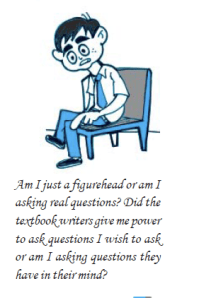
Unni [a cartoon character] asks:
“Am I just a figurehead or am I asking real questions? Did the textbook writers give me power to ask questions I wish to ask or am I asking questions they have in their mind?” [Page 85, Chapter 4: Executive, Indian Constitution at Work, for class XI]
This cartoon appears in the context of the discussion on the powers of the President of India in the political science textbook of NCERT. It seems this question has a function far wider than the limited task of revealing the institutional blueprint of Indian politics. It pushes the student to ask something very uncomfortable. Am I really the one asking the questions I ask? Or am I rehearsing questions that someone else has decided for me?
As teachers of political science, our constant effort is to understand the ways in which power operates. None of the themes of our syllabi can be taught without reference to the resistance, critique and offending positions taken by groups who challenge the status quo. Sanitizing the history of critique and resistance that is encapsulated in satirical modes of representation like cartoons, can only be at the cost of keeping the discipline of political science uprooted from its very object of study. In the recent cartoon controversy, however, the issues at stake are many more than a defence of critical pedagogy.
Ironically, the defenders of a critical pedagogy find themselves in confrontation with precisely one of the significant movements that inspired the political nature of these political science textbooks of NCERT – that is, the a section of the Dalit movement. In the debates that have followed, it has become clear that there is a vibrant and nuanced debate among Dalit intellectual themselves, and it is one such voice that we would like to present here.
On 18th May 2012, Jawaharlal Nehru University Teachers’ Association organised a panel discussion on the attack on academic freedom represented by the summary review of the entire set of NCERT textbooks. One of the speakers was a leading political theorist and Dalit intellectual of India, Prof. Gopal Guru, who threw what appeared to us, an extremely powerful challenge to the ways in which Dalit politics was taking shape through the demands for deletion of the cartoon and the sources from which support for this demand are emerging.
Prof Guru stated his view that in a Brahmanical political order the Dalit community is “pathologically condemned to being emotional”. They are denied the privilege of being equal partners in any deliberative process. They cannot be considered capable of rational debate. They seem to only have emotions and sentiments. These sentiments can be hurt or assuaged. But they must remain sentiments and emotions, and never be allowed to turn into critical rational questions. The current cartoon controversy he argued, thus was an insult to a long tradition of deliberative processes, a tradition that has remained an integral part of the Dalit public sphere. Ambedkar’s decision to move toward Buddhism was not supported by Dalit ‘followers’ only because Ambedkar was doing it. There were challenges, discussions and deliberations, said Prof Guru, which ultimately led to the movement taking this course.
Listening to Prof Guru, we wondered – are Dalits are being made the scapegoats here? Why has the issue of this cartoon and following from there, of cartoons in NCERT text-books, received the kind of importance it did from the likes of Kapil Sibal? This very Minister and his Department have been comfortably ignoring the indignant voices of the many social movements that have been recently challenging neo-liberal reforms in higher education. Is the neo-liberal regime riding high on the sentimentality that they have imposed on Dalits, in order to legitimise their designs for a wholesale restructuring of education in India? Is the authentic site of Dalit experience getting misused and re-deployed for the agenda of the neo-liberal regime?
Prof Guru’s argument, we believe, attempts to unsettle the almost natural way in which it is assumed Dalits would respond to an allegedly ‘offensive’ portrayal of Ambedkar. It is as though the Brahminical world has a formula for the fundamental anatomy of a Dalit mind – a reassertion of the caste order with its storehouse of stereotypes for all caste groups. Prof Guru was telling us that this is nothing but yet another form in which the Brahmanical social order is attempting to essentialize the Dalit self. And this self, in their opinion and for their convenience, is primarily sentimental.
Through this pathological naturalism Dalits are accommodated and yet systematically denied their due space in a democracy. They can join the mainstream only as sentimental beings. We understood Prof Guru to be arguing that the undoubted humiliation of Dalits is being depoliticized into a discourse of ‘hurt’. Dalits are then naturalised into a sentimental species. We are all equal under the Indian Constitution. But just that, in this discourse, Dalits are not as equal as the savarna rational individuals. Savarnas reason. Dalits feel.
As feminists, we have struggled for long to navigate through the dichotomy of feeling and thinking. We have seen how being emotional is precisely the ground on which women are systematically discriminated against in each sphere of life. We have also seen feminists reclaim sentimentality and celebrate it as an alternative mode of thinking. The question that Prof Guru has raised for us through his lecture resonated with that question we have long struggled with. In the Dalit movement, how does one negotiate the experience of humiliation with the claim to reason?
Prof Guru provocatively ended his lecture by asking us, what would we consider the most non-offensive statue or picture of Ambedkar? Since his statues and images available all over India and indeed, the world, are of various sizes, colours, and facial features, he wondered, which of those will hurt us least?
Hidden in this rhetorical question is an exposure of the structures of caste oppression that have adapted so surreptitiously. Confronted with a militant Dalit assertion, the Brahmanical order creates another cast(e) of containment . In this new cast(e), at all points of time, Dalits ought to remain feeling entities. And in expressing sympathy for Dalit feelings, the Brahmanical order can seem to accommodate Dalits even while disallowing their actual entry into spaces of power.
Partha Pratim Shil and Ankita Pandey teach Political Science at Hindu College and Indraprastha College (University of Delhi) respectively
 KAFILA - COLLECTIVE EXPLORATIONS SINCE 2006
One thought on “Humiliation condemned to remain ‘Hurt’ – Notes from a talk by Gopal Guru: Parth Pratim Shil & Ankita Pandey”