
Guest Post by VISHESH KOTHARI
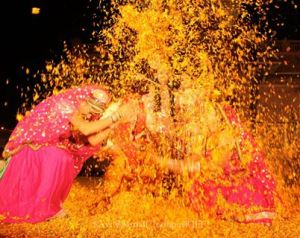 Medieval feudal social systems and attitudes in Rajasthan persisted until very recently. This, and perhaps a host of other reasons, allowed several aspects of culture to remain preserved here for much longer than in other parts of our country. While Rajasthan has become well known for its architectural heritage, it is the intangible heritage of this state that is in need of the most urgent intervention to protect it from being lost – from the oral lore to the epic ballads, everything is threatened by the onslaught of modernity.
Komalji Kothari and Vijaydanji Detha embarked on such a project many years ago and achieved great success – however an even greater amount remains to be done. For more than a decade now, the Jaipur Virasat Foundation has been continuing and enhancing this project to protect, preserve and promote the oral musical traditions of this state.
The Foundation has lately been pursuing a two-pronged approach – on the one hand it delivers this music to urban music lovers who are looking for something exotic. At the same time it has realized the fact that these traditional forms of music will never survive and evolve if they exist completely outside their traditional contexts. Patronage by their traditional patrons from within local communities is essential for the artistes. Moreover, these art forms also have the power to rejuvenate these communities and break down the aloofness that has settled in with rapid modernization.
Thus on the one hand, the Foundation partners with the Mehrangarh Fort Trust to organize the very successful Rajasthan International Folk Festival (RIFF) in Jodhpur. On the other, it has also been holding the brave and increasingly successful Momasar Mela in the Shekhawati region.
I was fortunate to be able to attend RIFF earlier this year and I must confess that though I was delighted to see such a platform provided to Rajasthani folk, I was also disappointed in some measure.
RIFF is certainly a huge success insofar as turnouts, organization and response are concerned. Big names such as Mick Jagger can be seen attending the festival. It has presented many hitherto unknown folk performers to many hundreds of people and a lot of the music presented is excellent. However, I personally feel, it is still quite a long way off in achieving some of its very core motivations. Even the well known folk performers are accorded nowhere near the same respect or paid amounts even proportionate to the amount foreign bands coming to the festival are paid. I still remember Bhanwari Devi, the now famous singer from Churu, who sat squatting along the footpath with her sons before her performance. Suddenly there descended a horde of youngsters who’d seen her on MTV. They danced themselves crazy on her remixed Meerabhajan. They clicked pictures with her and left. Afterwards, I saw her squatting at the same place, waiting for a car to drop her to her accommodation. On another occasion I saw a group of Manganiyar performers being chastised by a festival authority for daring to ask for a higher amount than had been fixed. The festival seems to have, very ironically, a feel of urban mai-baaps patronizing downtrodden rural performers.
However to focus on this would be to deny the great success this festival is otherwise achieving. These rural performers would have otherwise been forced to abandon their art forms had it not been for such events – and hence any patronage, whether or not at par with that provided to other artistes, is not only welcome but is crucial to the sustenance of these art forms for another generation.
India today is at the curious stage where everything ‘local’ and ‘Indian’ has become uncool and passé within its local context, even as it becomes an aspiration among urban elites. Just like the handloom industry, the folk music scene is going through this stage. The JVF, comprised of people with a keen understanding of the society and communities they are dealing with, realizes that these folk performers are getting cut off from their immediate surroundings. No longer do the dholis and bhopas sing for patrons in and around their homes, instead they are now restricted to performing for tourists and at events in cities. This is even while their erstwhile patrons take to DJs and other mass manufactured music and entertainment. The phrase in Hindi for ‘folk music’ is ‘lok sangeet’ which actually translates to ‘popular music’. Ironically it seems this folk music is no longer the popular music in its home territory and has instead become the alternative choice.
JVF has thus been focusing greatly on reviving patronage within local communities. The traditional fairs and melas are almost all finished – however the JVF hopes that by organizing events like the Momasar Mela, it will be able to provide some substitute where the entire village gets together and gets entertained by performers whose ancestors must have entertained their own. I haven’t yet attended any such events, but I am told they are a great success.
Unfortunately, the stumbling block for such events is the usual one – there is not much money available to organize them. Mostly, these rely on the largesse of individuals and companies and as such the source of funding is unsteady and limited. I did enquire about why the festivals couldn’t pay for themselves- many belts in rural Rajasthan are very prosperous, and paying for an entry should not stop people from attending. However, I was told that here it was the government which was perhaps responsible in an indirect way. For so long had it organized events with both classical and folk performers for which entry was free that it had created a bad precedent and people were now unwilling to pay to see and hear such performers. Moreover, having an entry fee also meant several organizational problems such as barricading the fair grounds and so on. However after many years, they are now being able to source a portion of the required funds from rural donors. This is an unseen phenomenon where the village has acquired a sense of ownership over its festival. The efforts of the JVF here are certainly laudatory.
A secure source of income is essential to the working of such organizations. Currently, the JVF benefits from the largesse of its trustees- however relying on individual largesse is always an unstable arrangement. It is trying to establish other sources of income. For example, the JVF also helps organize several private performances of folk artistes. This service is provided free currently, however it is mulling charging a fee for organizing such events and providing consultancy services.
One area which I feel that JVF has somewhat ignored is the problem of language. Rajasthan had a very unfortunate fate in this respect as despite having a rich linguistic history, Marwari (I must add that this itself is a contentious term) has never been accorded language status. This has meant that even inside Rajasthan, the local language is not one which can be taught in a school or be used in any official context. This has further exacerbated the rural-urban divide and even the divide between generations.
In the present context, appreciation of folk music relies heavily on an understanding of language. With speakers of the local language on the decline along with the fact that in India language is inextricably linked with class, the urban connoisseur capable of understanding the music is becoming harder to find. It is also natural that the new generation in these villages is not keen on the local folk as they are not able to understand or relate to it. Hindi, in my eyes, is a hegemony that has been imposed on this culture. Conducting even these local village festivals in Hindi surely but subtly strengthens this hegemony. I do feel JVF should certainly focus more on issues of language for without this language, the oral traditions of this language are bound to die.
However, the JVF has now initiated steps which take it far beyond an organization providing employment to folk artistes. In the aftermath of the floods in the Barmer region, funds were collected in Jaipur to rebuild damaged houses of the some of the artistes. It has undertaken the responsibility of providing pensions to ageing and now incapable artistes. This very important step aimed at providing financial security to artistes is vital if the new generation is to be encouraged into their traditional livelihoods. The JVF has indeed started a movement – one to give our art forms their due.
The author is a student of mathematics and is native to Rajasthan. He maintains a keen interest in the folk traditions of Rajasthan.
 KAFILA - COLLECTIVE EXPLORATIONS SINCE 2006
“With speakers of the local language on the decline along with the fact that in India language is inextricably linked with class, the urban connoisseur capable of understanding the music is becoming harder to find. It is also natural that the new generation in these villages is not keen on the local folk as they are not able to understand or relate to it.” The urban connoiseur will not be able to rescue folk music, just as the urban consumer has failed to rescue the small scale dairy farmer, or the potter. What would happen is that the form would be seen in a much modified, digitalized, version targeted to a select audience of “connoiseurs” and based upon immense publicity that would create a wide class divide within the class of artisans, some of whom will be given facelifts, others left unemployed.
LikeLike
I agree. I’m not sure that such efforts can ‘save’ the endangered traditions. They transform these traditions and art forms through the demands of the audience and the efforts of those who seek to save them. What will emerge are reconstructed art forms based on the ideas of how ‘traditional forms’ ought to be, as held by those who support them. This is of course, not to suggest that we should abandon these efforts. I merely think it is important to remain aware of this nuance.
LikeLike
Any intervention will after all change the nature of the art form. What is important is that today these art forms are alive at all because of such interventions. I think thats enough to be thankful for.
LikeLike
Thank you very insightful and very important post. In my three years in India I have constantly heard moan of how “uncool” India’s traditions are unless repackaged and bought back via the West. There re many wonderful exceptions but without the glit nd glamour of marketing they could be replaced. I know tht many travelling musicians in Rajasthan have struggled againt the excitement of Bollywood for example.
LikeLike
Reblogged this on Rashid's Blog.
LikeLike
Awesome blog! Do you have any hints for aspiring writers?
I’m planning to start my owwn website soon but I’m a little lost on everything.
Would you propose starting with a free platform like WordPress
or goo for a paid option? There are sso many options out there that I’m completely confused ..
Any recommendations? Thanks!
LikeLike