
Guest Post by UJITHRA PONNIAH
In what is known as the heart of Shiva, the majestic Parvati Valley in Himachal Pradesh, a trekker writes about a chance encounter with a Russian man and the impending destruction of the valley.
My growing alienation with Delhi and city life in general has been buttressed by my frequent, life breathing trips to the mountains. One such getaway took me on a week long trek to the beautiful Parvati valley in the Kullu district of Himachal Pradesh along with a friend. The valley is home to majestic waterfalls tucked away at every turn, lush green forests with the promise of thriving wildlife, unique flowers and a well marked trekking trail. The waterfalls are generous and since we went in the rainy season every shade of green was visible in the forest. The forests are generously sprinkled with their share of marijuana plants that provides a living to many locals and keeps the travellers, especially a large number of Israelis in states of bliss.
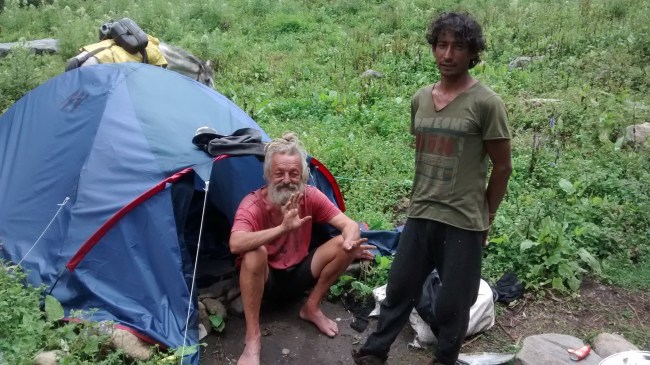
Russian Baba with Prem
The trek to Kheerganga begins from Barshani village, which is the last motorable point. It is a 14km uphill trek through the forest. The forest is alive and buzzing with life and the Parvati River accompanies you through your walk. Having recuperated from our long trek to Kheerganga and enjoyed the dip in the hot spring and rejuvenating sight of the first layer of snow on the surrounding mountains, we trekked further with the hope of reaching Tunda Bhuj, a place adorned with a wide variety of sub-alpine forests. About half way into our journey it began to get dark and started pouring. The mist was setting in impeding our vision and we were happy to see a couple of tents in the middle of the forest, next to a small brook. When we stopped by we were warmly greeted to join in for a cup of hot tea. This is where we met a foreigner, in his late 60s and his two companions – Prem and Mansingh (both from Nepal). The initial round of niceties revealed that the foreigner was from Russia and I realised this is the ‘Russian baba’, we had heard about in Kheerganga. He had dreadlocks in his hair, a pair of torn shoes, a torn t-shirt and a bundle of beedi that he constantly drew on. He could not hear too well and retained a thick Russian accent.
I asked him what had brought him to India. He said, “you want drugs you take it, you might die from it, but you have the freedom to do it”. He said, he had travelled widely in Europe and had never encountered a place like India. Over the years, he was aware of the changes that were inevitable in the country, but his love for the country had not decreased. Not wanting to get into a debate with a joint rolling, semi drunk and what appeared to me as a loony foreigner I politely nodded along. Taking comfort in his disarming nature, I continued to ask him about his life in Moscow. He said, he was a communist for 15 years and lived in undivided Soviet Union. “We would huddle around in the kitchen and talk about all the wrong things that the government was doing, but during the day we could not mention it to anyone”.
At night, in the stupor of self- brewed daaru that he and Prem make with jaggery and sell if there is any left, baba said in Moscow he was a businessman. In the morning when the spirits had dulled their effect, he said he was a director of a bank. It did not matter what he was in Moscow, what he was now that he proudly proclaimed was happy. He said, “I had money, house, a wife, and a child, but I was not happy. Life made me weary, however now I have nothing, but I go to bed a happy man”. His daughter, he said was 35 years old now and had a Swedish partner but he was not in touch. I asked him if he would ever go back to Moscow, he said “people travel when they seek something and in the heart of Shiva I have everything, I have great power”. At night, the locals had given them a sheep. They generously shared it with us and the local dog named Lali, who accompanied us from Kheerganga. Mansingh bhaiya said it was baba’s first meal of the day. It was evident that both Mansingh and Prem loved baba dearly and they were all co-travellers, sharing the last draught of liquor or a joint. At night, we pitched our tent close to theirs. We were told that at dawn there was a herd of buffalos that would rampage through the place and we should just stay in our tents. My city bred scepticism had lost its hold by morning, it was easy to dismiss the man in front of me with his message of unadultered happiness as a drunkard but it was hard to go past his innocent child like chuckle, polite demeanour and underlying calmness which persisted despite his chronic smoke induced cough.
With the rising sun, I could also hear the sound of an engine running close by. I asked baba what it was, and Prem said it was a local company that went by the name of Shivalik. They wanted to burrow holes in the mountain and divert Parvati River to the turbines. On my way back to Delhi, locals said that the 520 MW Nakthan hydroelectricity project which was being aggressively pushed and protested against by many groups. The affected Barshaini Gram panchayat (consisting of Nakthan, Barshaini, tosh and 7 other Gram Sabhas) have registered their opposition in written multiple times[i]. Despite the objections it is clear that the work has already begun. The valley has already witnessed the massive deforestation and environmental pollution caused by 800 MW Parbati II. All of this is happening in the light of the aggressive push both at the state and central level to dilute clearance procedures[ii].
The place baba had pitched his tent for years now, was marked by white stones, indicating that all of it would soon cease to exist. As I stood there next to the Parvati River, I could see the heavy machinery burrowing its way through the sides of the mountain. The monstrosity of the act which would soon rip this paradise of all its ecological glory was hard to contain. The guzzling brook, the mystic forests that the locals claim you can find the sapphires that Shiva gave Parvati, the numerous medicinal plants including the naughty jangli lasoon (wild garlic) that locals use in soups for male potency, the soothing greenery and the myriad flowers would soon all be under water. We left Parvati valley with a heavy heart. It was clear Baba’s life and message of love and happiness had no place in the corridors of corporate and government greed and I wondered what it would take to make them stop.
—————————————————————————————————————————–
[i] ‘Discussion on Forest Rights Act at Nakthan, Parvati valley’, March 3, 2014, Viewed on August 15th, 2014 (http://www.himdhara.org/2014/03/03/discussion-on-forest-rights-act-at-nakthan-parvati-valley/)
[ii] ‘Felling laws from environment from Manmohan’s government to Modi’s’, Viewed on August 20th, 2014 (http://www.hindustantimes.com/comment/analysis/centre-s-rush-to-clear-industrial-projects-will-imapct-environment/article1-1254342.aspx)
Ujithra Ponniah is currently in the PhD programme in sociology at Jawaharlal Nehru University (JNU), New Delhi


It is sad we are losing so much of our natural surroundings. No one seems to talk about the population pressure on our limited natural resources, including land. How can we provide everyone with the kind of life style they aspire? How many of us are willing to let go of our comforts? decent place to live, malls, top quality medical care, entertainment unlimited, cell phones, xerox machines, cars, foreign travels, one could go on and on… If we believe and wish that all our 125 crore population should have access to all this, how are we going to provide it? Talking about population is politically incorrect, right? If we all want all these things, natural resources and forests are bound to shrink.
LikeLike
Reblogged this on avant-garde.
LikeLike
Thats a beautiful article uji….
LikeLike
Thanks Anna :-)
LikeLike
Very nicely written Uji. :) very refreshing read.
LikeLike
Thanks Anuja :-)
LikeLike
This is an eye-opener, Ujithra!
LikeLike