
Authors’ Note:
The Chennai based Forum Against Manual Scavenging, (FAMS) can be contacted at famschennai@gmail.com. We have tried to create some awareness on this issue especially among student community (with the assistance of some of the Professors/Faculty based in Chennai) in which we were guided by Safai Karamchari Andolan, Rashtriya Garima Abhiyan, Tamil Nadu Untouchability Eradication Front, Janodayam Social Education Centre, Republic Trade Union of India, Red Flag Union of Tamil Nadu and other similar organizations (in and outside Chennai) struggling on this issue which are led primarily by the Dalit Women from the community itself.
A documentary, ‘Sahar se Pehle’ (Before the Dawn) on sanitation workers in Jawaharlal Nehru University (JNU) campus in Delhi was made by some students of the university. The JNUSU has been consistently raising the issue of abysmally bad condition of sanitation workers in JNU for quite some years now. Earlier in 2012, JNUSU had also participated in a signature campaign against manual scavenging (signed by the then JNUSU President). The documentary shows the manual scavenging is still prevalent in the premier university even after the ban on manual scavenging by the Delhi government (sanitation is a State subject according to the Constitution of India) and after the enactment of “The Prohibition of Employment as Manual Scavengers and their Rehabilitation Act, 2013.”
This documentary was also selected for the Canadian Labour International Film Festival, 2014, and was available online on YouTube and other sites from February 2014, but was not widely circulated on mainstream media or social media. We also came to know about it only a fortnight ago because the write-up attached to it does not explicitly mention manual scavenging.
The JNU student community has started a campaign called Stop Manual Scavenging in JNU, with the message “Use hashtag #StopMSinJNU to SPEAK OUT against the inhuman practices of manual scavenging and hazardous cleaning in #JNU.”
Both the Delhi government ban and the Prohibition Act 2013 were the results of long, relentless and arduous struggles by different organizations, comprising mainly Dalit women, working at the grassroots level against manual scavenging. A significant development in the campaign is that the legal definition of manual scavenging has been expanded (though still inadequate from the perspective of the organizations), to include sewage drain cleaning also as manual scavenging. According to the The Prohibition of Employment as Manual Scavengers and their Rehabilitation Act, 2013:
‘manual scavenger’ means a person engaged or employed, at the commencement of this Act or at any time thereafter, by an individual or a local authority or an agency or a contractor, for manually cleaning, carrying, disposing of, or otherwise handling in any manner, human excreta in an insanitary latrine or in an open drain or pit into which the human excreta from the insanitary latrines is disposed of, or on a railway track or in such other spaces or premises, as the Central Government or a State Government may notify, before the excreta fully decomposes in such manner as may be prescribed, and the expression “manual scavenging” shall be construed accordingly.
Explanation – For the purpose of this clause (a) “engaged or employed” means being engaged or employed on a regular or contract basis; (b) a person engaged or employed to clean excreta with the help of such devices and using such protective gear, as the Central Government may notify in this behalf, shall not be deemed to be a ‘manual scavenger’.
Thus, as per the expanded definition, hazardous cleaning (meaning without protective gear) of even sewage drains where disposal of domestic or sanitary sewage takes place) is manual scavenging. This is so because sanitary sewage includes “body wastes”.
Since these legal developments, Delhi has seen a Congress government in both the state and at the centre; an Aam Admi Party-led government in the state; a Bharatiya Janata Party (BJP) run municipality; President’s rule; and now a BJP Government at the centre. But no action has been taken against the continuing prevalence of manual scavenging in the National Capital Territory of Delhi itself. Rather, Narendra Modi has (in)famously referred to manual scavenging a “spiritual activity”. It is also worth reminding ourselves that prior to this new legislation, not a single case had been registered by the authorities under the 20-year old Employment of Manual Scavengers and Construction of Dry Latrine (Prohibition) Act, 1993.
‘Sahar se Pehle’ (Before the Dawn) strives “to highlight the plight of contract workers, especially those engaged in sanitation work.” According to the write-up attached with the documentary, “most of these workers come from historically underprivileged social backgrounds (‘Backward Castes’)”. Moreover, according to reports prepared by different agencies, like the Government of India’s Planning Commission, the National Campaign on Dalit Human Rights (NCHDR), the International Dalit Solidarity Network (IDSN), and a report by the United Nation Development Programme (UNDP) among others, more than 95% of manual scavengers in India are Dalit women.
A particular shot (at 18 minutes 35-39 seconds) relating to manual scavenging seems to have been shot around 14th November 2013 as evident from the very next shot of the Administration Notice Board, (at 18 minutes 40-47 Seconds) in its campaign to promote Hindi, declaring the word of the day as – “Democracy”.
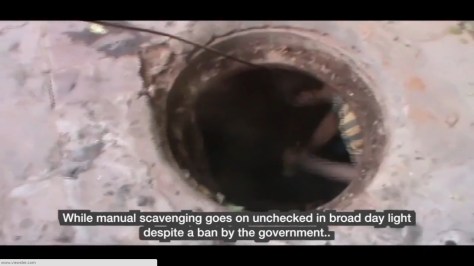
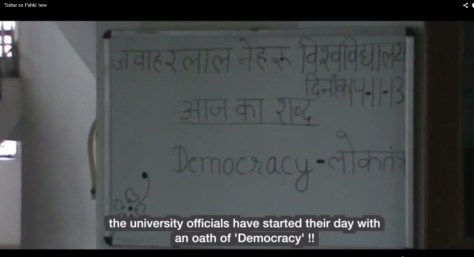
According to the students of JNU who made this documentary, manual scavenging still continues unhindered, and in clear violation of the provisions of Act passed in September 2013, which states that, “No person, local authority or any agency shall, from such date as the State Government may notify, which shall not be later than one year from the date of commencement of this Act, engage or employ, either directly or indirectly, any person for hazardous cleaning of a sewer or a septic tank.” The Act further makes it clear that, “’hazardous cleaning’ by an employee, in relation to a sewer or septic tank, means its manual cleaning by such employee without the employer fulfilling his obligations to provide protective gear and other cleaning devices and ensuring observance of safety precautions, as may be prescribed or provided in any other law for the time being in force or rules made thereunder”.
In such a case, the persons concerned who are being forced into manual scavenging under the garb of Sanitation Work, needs to be rehabilitated with a compensatory mechanism. Though far from being appropriate or adequate, it includes:-
- Initial, one time, cash assistance, as may be prescribed.
- Their children being entitled for scholarship as per the relevant scheme.
- Allotment of a residential plot and financial assistance for house construction, or ready-built house, with financial assistance.
- At least one adult member of her/his family shall be given training in a livelihood skill and shall be paid a monthly stipend of not less than three thousand rupees, during the period of such training.
- Subsidy and concessional loan for taking up an alternative occupation on sustainable basis.
The documentary says in conclusion, “Liberation of the masses would be only achieved by the struggle of the workers. And thus the role of youth and students in fighting injustices both inside and outside the university campuses would be of utmost importance”.
Given that Dalit women and men are still being forced into manual scavenging even in the NCT of Delhi, it would not be imprudent to add that the liberation of masses in India would be only possible if fight for annihilation of caste; against such dehumanising, casteist, patriarchal practices of untouchability; and abolition of such forms of segmentation and slavery like manual scavenging become an integral part of the struggles of workers, students and youth in this country.
P.S. Meanwhile, a Report prepared by JNU students on Manual Scavenging and Hazardous Cleaning in JNU was released in the presence of Bezwada Wilson, National Convenor of the Safai Karmachari Andolan (SKA) and a key campaigner for eradication of manual scavenging; Dr. Pradeep Shinde, Assistant Professor in Sociology, CIS&LS; Bhasha Singh, noted journalist Outlook, author of Unseen: The Truth About India’s Manual Scavengers; and Com. Satbir Shramik, trade union activist from Narela.
 KAFILA - COLLECTIVE EXPLORATIONS SINCE 2006