
On a day when we woke up to the seemingly incomprehensible barbarism of a woman being beheaded in Saudi Arabia, we may do well, apropos Nivedita Menon’s post on MLK, to remember the barbarism that hides in broad daylight within seemingly civilised societies. One such floodlit hideout, so bright it blinds us, is the state of our prisons. Before Guantanamo and Abu Ghraib inaugurated a new era of dehumanisation in the American “correctional system”, there was Attica, and hundreds others like it that continue in the U.S and around the world to this day. We may also remember Professor G.N Saibaba of Delhi University who, despite being 90% disabled, has been not only imprisoned but kept in solitary confinement for almost two years on mere suspicion in an Indian jail somewhere. Really, what more does it take these days?!
This is a guest post by Ipsita Barik

When Al Pacino’s character Sonny Wortzik yells and hollers “Attica – Attica” in the film Dog Day Afternoon, the cops and the FBI officers are left stunned & dumbfounded, but the civilian population collected at the scene, behind the police barricades began to cheer & applaud. The air is soon filled by the chants of the noun and Sonny in his soaked white shirt, flaying his arms and stomping on the ground, gestures at the cops and adds “you put them guns down; you put them down – “AATTICA aattica”. So what was happening here? Why were these people cheering and supporting a man who had come to rob a local bank and was holding hostages inside! And what was Attica all about?
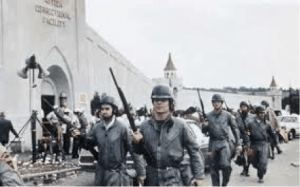
Attica prison riots/uprisings happened at the Attica Correctional Facility, New York, United States; when the prison cells and yards were seized by the inmates, who also held hostages, on September 9th 1971, opening a series of negotiations and dialogues between the establishment and the inmates, which included civilian observers, Tom Wicker of the New York Times, Republican State Senator John Dunne, radical lawyer William Kunstler and Black Panther’s Bobby Seale, on the request of the inmates. The primary demands of the inmates were related to the inadequacies and brutalities within Attica, such as related to insufficient food and medical care, racial discrimination, physical abuse, restricted access to educational and training facilities, all a serious indictment of the prison rules and environment, as the New York State Special Commission on Attica/McKay Commission (set up by the state) subsequently went on to assert and highlight.
The New York State Special Commission’s report was a seething critique of the conditions and circumstances inside Attica that build up to the riots. The report detailed that the prisoners were isolated in the cells for 14-16 hours daily, wages were a pittance – at 30 cents a day (compared to the work done – which largely imparted no vocational skills), activities entitled to human adults, were highly regulated and restricted such as food, recreational time, access to reading material, radio and television, family visits, mails & letters, clothing etc, (which served no purpose other than antagonize, disparage and embitter the prisoners). The state provision of personal articles had to be supplemented by purchases at the commissary using their meager wages and hustling was often resorted to. Medical facilities though provided, the doctors were emotionally inept to interact with the inmates whom they treated with marked despise and hostility. Even sleep schedule (lights out) and movement outside the cells were monitored and restricted. Communication and interaction with the external society was minimized while the society (constructed) inside was highly distorted with minimal and censored personal freedom, choice, assimilation, interaction, self-worth or confidence.
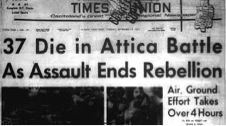
The uprising winded up in the failure of the negotiations, particularly on the point of granting general amnesty to the inmates. Even as the observers repeatedly requested Governor Rockefeller to visit Attica at least once, Rockefeller went ahead and ordered the state troopers to take the prison by force and to unleash assault on the unarmed inmates. In the mayhem that followed, a number of inmates and hostages were killed in the onslaught of tear gas and bullets fired by the state troopers. The official stand in the media, which went on to dominate the public version of the deaths was that the hostages were all knifed and their throats slashed by the inmates and hence the state troopers retaliated. But the local coroner, John Edland, who examined the bodies subsequently, documented that the deaths, of both the inmates and the hostages occurred due to the bullet wounds.
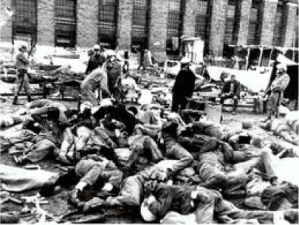
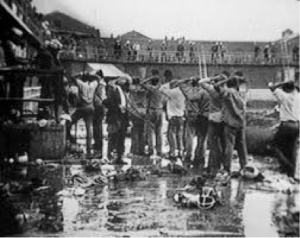
In the aftermath of the ambush, the jail officials forced the inmates to strip naked and crawl back to their cells, many who were grievously injured. Maximum torture and abuse of the inmates followed in the coming weeks. Later in a continuation of the official stand, the state troopers were granted absolute immunity and the Attica records were sealed.
Michel Foucault went to visit Attica along with John K. Simon. In an interview that followed Foucault argues that prisons are both punitive and eliminative in nature and hence work towards not the rehabilitation of the inmates but rather their entrenchment into a vicious cycle of elimination. Once sent into the prisons the process of brutalization, penalization and dehumanization is set rolling and by the time they get out of the prisons, their identities are so mutilated, that the society rejects their re assimilation and thus begins the perpetuity of being trapped in the vicious cycle. It concludes in their elimination. The McKay Commission affirming the above view, noted that the correction program in reality meant “to keep the inmates in line, enforcing rules and run things smoothly — it definitely didn’t mean to help inmates solve their problems or becomes citizens capable of returning to the society.”
Foucault regards prisons as a place of punishment, akin to concentration camps, for largely those on the margins and the underclass, where the promise of rehabilitation is merely nodded upon, never asserted. The McKay Commission in a damning statement revealed, “In the end the promise of rehabilitation had become a cruel joke. If anyone was rehabilitated it was in spite of Attica, not because of it.” Foucault illustrated this theory by the existence of the gated iron bars in the prisons. These iron bars first occur on the prison gates, which is justified by the need to separate the society from the dark underbelly. What Foucault questions is the second level of separation which occurs inside the prison complex. What are the iron bars on the prison cells for? What or who are they separating? The inmates of course – from each other. But why? If the purpose of prisons and correctional institutions is re assimilation and rehabilitation, then why separate the inmates? Why are prisoners treated as caged beasts?
In the movie Cell 211, a new correction officer finds himself stuck in an ensuing prison riot on the first day of work. Fortunately for him, none of the inmates knew his identity, so as a survival strategy, he pretends to be a new prisoner. Slowly he’s drawn into the web of the prison riot and its complexities. At one time, identifying with the demands of the inmates he announces to the mediator “for the system we are trash. And what do we do with trash? Put it away some place, so it won’t stink.”
In the movie Starred Up, a brutal and gruesome, almost naked look into the insides of a British prison, there are many convoluted and layered instances of violence, but in one incident where the protagonist, locked up in a solitary cell, is almost strangulated by a group of guards who harbor a strong dislike towards his disobedient streak. In a pertinent moment afterwards, as the protagonist succeeds in surviving, one of the guards walks out announcing into his walkie talkie, “an attempted suicide by the protagonist”, which the viewer immediately knows will be the official truth recorded, asserted and believed.
The McKay Commission on Attica in its opening statement declared “43 citizens of New York state died …80 wounded …with the exception of the Indian massacres in the late 19th centuries, the state police assault which ended the four day prison uprising was the bloodiest one day encounter between Americans since the civil wars.. .” Note the report includes both the hostages and inmates in their definition of citizens. It is an important inclusion, as Foucault argues, the society often forgets.
What’s happening inside the Indian prisons? The increasing number of undertrials locked up in Indian prisons, due to their inability to pay the bail money and often legally underrepresented, reflects upon the dark underbelly of both the Indian justice system and Indian penitentiary system. It is also one of the worst kinds of class wars, as a huge percentage amongst these undertrials constitute of the lower classes and the minorities. In the US, the classes of poor African-americans dominate the prison facilities, trapped in an endless multigeneration cycle of poverty, crime and prisons (Michelle Alexander). Custodial deaths, third degree torture, custodial rapes, overcrowding, medical negligence, lack of sanitation, health facilities and basic protection inside the Indian prisons is widely documented.
Arun Ferreira who was arrested and tortured by the Nagpur police under the Unlawful Activities (Prevention) Act 2004, details the period of his incarceration. His confinement in the windowless and airless Anda barracks (solitary confinement) to exert maximum isolation and pressure, where prisoners often buckle due to lack of human contact , spending 15 or more hours alone in the cells . The lack of basic bathing facilities, where “Four hundred prospective bathers laying claim to a 60 by 3 foot trough means a hurried bath even at the best of times. The ones who don’t learn to brush teeth, take a bath and rinse out their underwear in 10 minutes flat are destined to scrape the bottom of the haus.” The food supply leaks are quite marked with the (inmate) commander of the kitchen restricting the food supply and allowing a portion to flow into the open market and many jail employees tapping into the food stock to feed their home kitchens. Maharashtra government’s ban on provision of non vegetarian food in the prisons made “trapping and hunting of squirrels, birds, bandicoots and other types of small game a serious occupation”. Family visits or mulakats are done through heavily meshed windows to disallow physical contact or intimate touch. There were no funds for provision of books and magazines and subscriptions from outside were heavily censored. Ferriera remarks that even the Indian constitution wasn’t allowed into the barracks because it was considered a heavy read!! Arun Ferreira notes that the nights carry the sobs, wails, terrified shrieks and howls, some which refused to abate, probably of those who were most emotionally scarred and needed professional psychological assistance. Instead what was provided was a good thrashing in the mornings by a prison official “to ostensibly get rid of the demon who had possessed at night”.
Prison violence and the use of razors & knives, drug abuse, hustling, physical and sexual abuse are rampant in prisons globally. Salman was murdered with a sharp weapon inside Tihar’s high security ward (2014), Raju Hakla was attacked with a sharp object inside sub-jail No.1 of Tihar (2014), Mohammed Shirajuddin (an undertrial) allegedly committed suicide in the toilet of Jail No. 8 in Tihar (2014), Amolkar (an undertrial) was found hanging from the grill of a vent in a toilet in Tihar (2014), Vinod (an epileptic inmate) fell in the toilet of Jail No.4 in Tihar and died (2014). State and crime records contend that the number of unnatural deaths are far less than the cases of natural deaths inside prisons. Many of these natural deaths are caused due to medical negligence and spread of contagious diseases like HIV/AIDS, hepatitis, typhoid, tuberculosis etc.
In the Attica prison a memorial has been built, to mark the deaths in the prison uprising of 1971. But the granite monument remembers only the civilian deaths and not the inmates who were killed. Jerome Washington, an ex-Attica inmate writes, ” …as if no prisoners ever lived, therefore never died, none of the dead prisoners’ names are memorialized in the granite. Each morning a trusted prisoner strolls out to raise the flag. Each evening he returns to lower the flag. In between he sits in his cell. In between he doesn’t exist.”
Foucault states escaping the eliminative mechanism of prisons is possible “only through collective action, political organization and rebellion.” Jerome Washington writes, “To remain human in prison, one must break rules.” Foucault was an academician and philosopher, Jerome Washington an ex-convict, and yet both reached the same conclusion.
 KAFILA - COLLECTIVE EXPLORATIONS SINCE 2006
In 2004, an Afghan woman inmate of Tihar jail was beaten to death by a Matron. She had complained of pain after the beating, but the Superintendent and Doctor in the Jail dismissed it as ‘ nakhra ‘ (pretence), and eventually she died the next day. After this, women had united across Wards to wage an all-out battle; 8 women then served terms for ‘rioting’ in the jail. When I was in Tihar in 2006, I saw high walls with iron netting being built between Wards. Women prisoners called those walls pinjra/chidiaghar (cage/zoo), and told me they were being constructed to prevent women prisoners from being able to mobilise easily across Wards, as they did after Zohra’s death! The Matron was suspended but later transferred to another jail, I believe. http://expressindia.indianexpress.com/news/fullstory.php?newsid=33501
LikeLike
Reblogged this on oshriradhekrishnabole.
LikeLike
I think by choosing to juxtapose this article with the beheading of Saudi Arabia, and the way it has been juxtaposed, highights the big problem with left-thinking in general. The problem of religion (of peace) based violence is different from violence by establishment where religion does not necessarily roost. In Saudi religion based violence is the norm. Elsewhere, largely and especially in places like India, West, etc violence by establishment is an exception and not the rule.
By juxtaposing these two, you are doing a great disservice to people.
LikeLike