
As the ongoing livestreamed genocide in Gaza reaches its most despicable and horrendous phase of killing masses people through forced starvation, I am posting here a piece that I wrote for the art journal Art Deal last year. It was also delivered as a talk in a discussion organized by the All India Students’ Association (AISA) in JNU in September 2024. I am publishing it here with some minor additions/ changes.
‘Israel told U.S. officials in 2008 it would keep Gaza’s economy “on the brink of collapse” while avoiding a humanitarian crisis, according to U.S. diplomatic cables published by a Norwegian daily on Wednesday.
Three cables cited by the Aftenposten newspaper, which has said it has all 250,000 U.S. cables leaked to WikiLeaks, showed that Israel kept the U.S. Embassy in Tel Aviv briefed on its internationally criticized blockade of the Gaza Strip.’
– Reuters, 5 January, 2011, Jerusalem.
I
No, it did not begin on 7 October 2023. Notwithstanding all the gaslighting by Israel and its guardians and arms-suppliers in the USA and Europe, the evidence says something else. The US cables leaked to Wikileaks show that not only had Israel been carrying out its genocidal activities for a very long time, its sponsors in the USA knew everything all along.
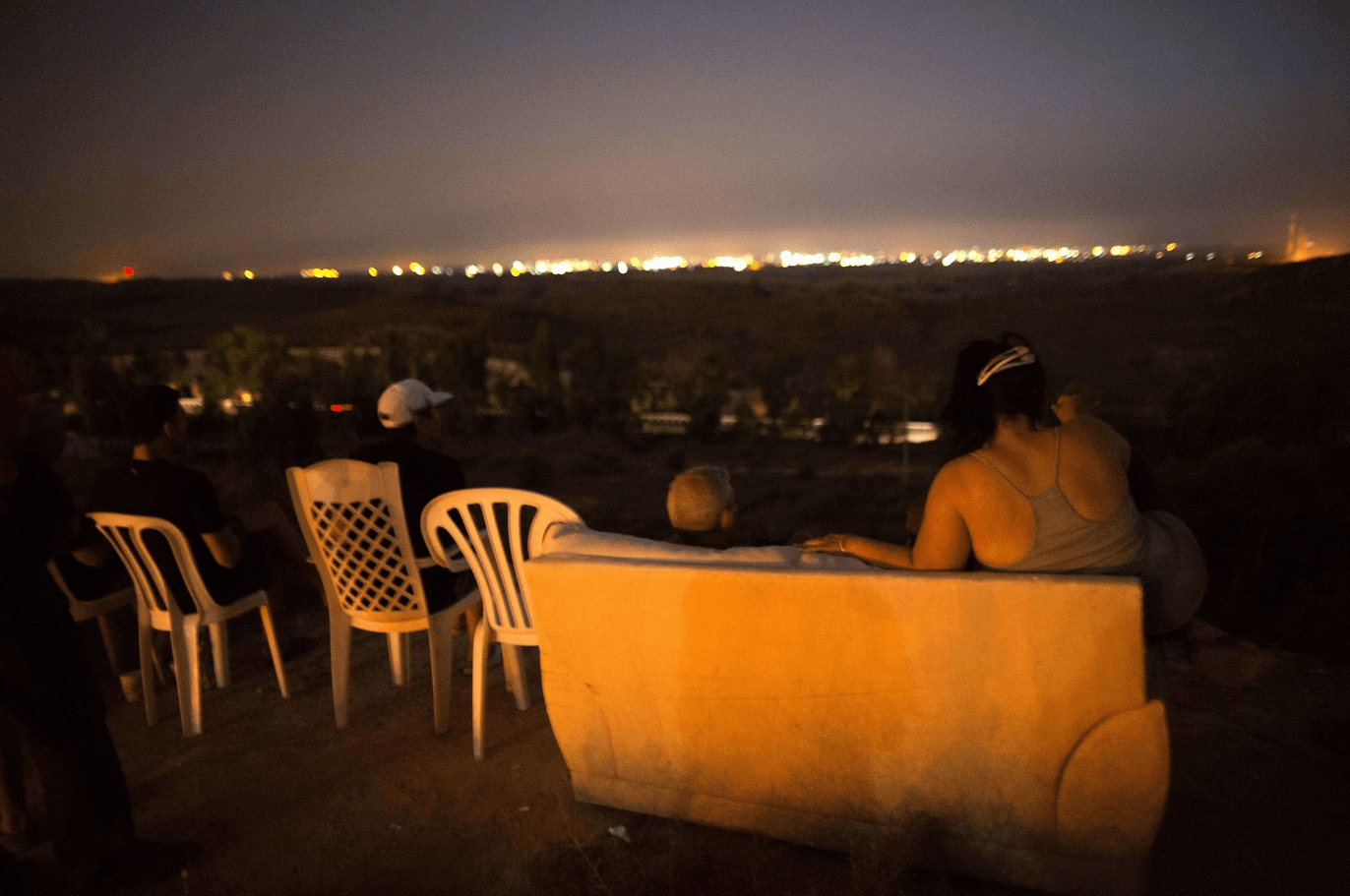
On 11 July 2014, Peter Beaumont reported in The Guardian from Gaza city, under the title ‘Ramadan in Gaza’ that it was ‘the fourth day of Israel’s intensive bombing of the Gaza Strip’ and that 100 Palestinians had been killed, many of them children. He went on to observe that families there had ‘settled into a tense-wartime regime, a daily-routine hard-learned from Israel’s previous military campaigns of 2008-09 and 2012.’ 2014 was also the year when we saw bizarre photographs of middle class Israelis sitting on hilltops, watching the spectacle of the bombing of Gaza – as though they were at some picnic spot. (see one such photograph above) Such bombings were thereafter to be repeated every Ramadan. Did we hear a squeak from the great defenders of free speech and the ‘free world’ in the Western media and their lackeys in India?
There’s blood on those hands still. We are not talking of Israel’s hands alone but also those of its sponsors – the genocide enablers of the so-called ‘advanced’ and civilized world of Europe and the settler colony known as the United States of America. I will call it the Axis of Evil (AoE, for short). The ongoing genocide in Gaza is, of course, not the first that the torch-bearers of civilization have delivered to the world as we will see below, starting with the most proximate one that necessitated it being defined clearly as a crime against humanity.
Let us be clear, we aren’t using the term ‘genocide’ here in any figurative sense. The United Nations Genocide Convention, in 1948, defined the term as any of five ‘acts committed with intent to destroy, in whole or in part, a national, ethnical, racial or religious group’ – the acts being: killing members of the group, causing them serious bodily or mental harm, imposing living conditions intended to destroy the group, preventing births, and forcibly transferring children out of the group.
Back in 1948 too, the need for the adoption of a genocide convention was felt not because of anything ‘uncivilized barbarians’ living on our side of the globe had done but due to what Europe came to call the ‘Holocaust’ with a capital H. Giving the Nazi genocide of the Jews a proper name was a way of insisting on its singularity. That campaign for the extermination of Jews, also known as the ‘Final Solution’, which started in 1941 and lasted till 1945, was of course unprecedented in Europe’s living memory.
That is, this violence by Europeans on Europeans was unprecedented. In his searing Discourse on Colonialism, Martinican poet and thinker Aimé Césaire had to remind the world that the Holocaust was not unique. He underlined that Nazism was not quite the singular episode that it was made out to be, if one were to look at Europe’s relation to the colonial world. What Europe could not forgive Hitler for, Césaire emphasized, was ‘the fact that he applied to Europe colonialist procedures which had until then been reserved exclusively for the Arabs of Algeria, the “coolies” of India, and the “niggers” of Africa.’ More recently, Ugandan-Indian scholar Mahmood Mamdani has underlined the fact that the Allies who ‘prosecuted individual Nazis at Nuremburg were invested in ignoring Nazism’s political roots, for these roots were also America’s.’ The United States, he argues, is the outcome of the history of genocide, ethnic cleansing, official racism, and concentration camps – also known as ‘the Indian reservations’. Hitler, says Mamdani, had actually ‘modelled his plan of the genocide on that of the United States.’ [Those interested in a more detailed examination of that history can look up Roxanne Durbar-Ortiz’s book Not a Nation of Immigrants (2021)]
II
The story of Israel however does not begin even in 1948 – the year of the dreadful Nakba, when hundreds of Palestinian villages and major cities were cleared of their indigenous inhabitants in what Israeli historian Ilan Pappe calls the ‘ethnic cleansing of Palestine’. That year, as the name Nakba (meaning ‘catastrophe’ in Arabic) itself suggests, is seen as the most crucial milestone in the dispossession of the Palestinians. But 1948 was merely the culmination of one process and the beginning of another, even more bloody and vicious than the preceding one. The fact is that the history of Palestine’s colonization by a non-existent entity, now known as Israel, cannot be understood without reference to the twin phenomena of imperialism and settler colonialism and the scramble among European powers to extend their dominion across the globe.
Around the beginning of the twentieth century, Zionism was still a fledgling movement that had begun eyeing the state of Palestine as its mythical ‘Promised Land’ Israel. Though its violent intentions in attempting to colonize that land by dispossessing the indigenous population was clear from the very beginning, it had little power to do so. In fact, Jews living in Palestine in the first decade of the twentieth century, Palestinian historian Rashid Khalidi tells us, ‘were still culturally quite similar to, and lived reasonably comfortably alongside, city-dwelling Muslims and Christians.’ ‘They were mostly ultra-Orthodox and non-Zionist, mizrahi (eastern) and Sephardic (descendants of Jews expelled from Spain), urbanites of Middle Eastern or Mediterranean origin who often spoke Arabic or Turkish, even if only as a second or third language.’ In other words, this was the Jewish population that lived in Palestine, prior to the increase in Zionist activity which had begun by the end of the first decade of the twentieth century. However, between 1909 and 1914, Zionists had managed to arrange for the arrival and immigration of about forty thousand Jews who were settled in eighteen new colonies, initially in land purchased from absentee landlords, says Khalidi. Already by this time European Jewish settlers had started setting up their paramilitary units for emptying out these lands of local Palestinian peasants.
Violence was integral to the imagination of Zionists although as long as they did not have the full state backing of Britain, in particular, they had to depend on buying up of Palestinian lands from absentee landlords, many of whom were often not based in Palestine anymore. During World War I, in 1917-18, as a consequence of the major battles between Britain and the Ottoman forces, the former gradually gained control over Palestine. It was while the war was still going on that the British secretary of state for foreign affairs, Arthur James Balfour made his notorious ‘Balfour Declaration’. Khalidi underlines that while this single sentence ‘Declaration’ favoured the ‘establishment in Palestine of a national home for the Jewish people for which the government promised to ‘use their best endeavours’, it did not even mention the Palestinian and Arab people. It merely stated that ‘nothing shall be done which may prejudice the civil and religious rights of existing non-Jewish communities’ [all quotes are from the Declaration itself], reducing 94 per cent of the indigenous Arab population to a non-descript status, defined negatively as ‘non-Jewish communities’. Their political or national rights, argues Khalidi, were simply not recognized, which effectively meant that the British government thereby endorsed Theodor Herzl’s Zionist agenda of ‘Jewish statehood, sovereignty and control of immigration in the whole of Palestine.’ Obviously, this sat well with the idea current in those days in pro-Zionist circles that Palestine was a ‘land without people’ and the Jews a ‘people without land’. In other words, like all settler colonialisms, local populations counted for nothing – all the lands thus colonized were terra nullius – or vacant lands belonging to nobody. In addition, in the case of Palestine, the Biblical myth of ‘Israel’ as the God-given land for the ‘chosen people’ came in handy. In parenthesis, it is interesting that William Dalrymple has recently stated in an interview that ‘Britain’s education system sold me a lie about Palestine‘ – that Palestine was barren desert land with no people before the Israelis came along! Talk of propaganda and brainwashing!
As an interesting aside, Ilan Pappe points out that though ‘Eretz Israel’ was the name of Palestine in Jewish religion, ‘Jewish tradition and religion clearly instruct the Jews to await the coming of the promised Messiah at “the end of times” before they can return to Eretz Israel as a sovereign people in a Jewish theocracy’. It was not and could not be seen as a modern political project – which is why several streams of ultra-Orthodox Jews remained either non or anti-Zionist.
Once Britain assumed formal control over Palestine consequent upon the Mandate of the League of Nations in 1922, the process of the Zionist dispossession of Palestinians proceeded rapidly under its tutelage. As in the Balfour Declaration, in the Mandate too there was no reference to the Arabs or the Palestinians, whereas the commitment to the establishment of a national home for the Jewish people was affirmed. As was to be expected, the understanding of the Balfour Declaration, now incorporated into the Mandate, heightened the pace of the violent takeover of Palestinian lands and their dispossession of the Palestinians right through the 1920s.
Let us pause here a bit and let it sink in. Right through the period of the rise of Adolph Hitler and his Nazi party, we see the parallel violent core of the Zionist project being enacted with British and more generally, European sponsorship. It is indeed true that the number of European Jews migrating to Palestine rose exponentially around the end of the 1930s as Nazism went on a rampage but it would be a travesty of facts to say that the violence of Zionism simply mirrors that of Nazism. It was equally violent and resorted to pretty much similar methods in Palestine, all through the same period that Nazism was putting in place its own violent totalitarian order in Germany. Both Zionism and Nazism were the products of European imperialism and its colonial domination of the world.
III
An interesting question that arises, of course, why was Christian Europe so interested in finding the Jews their promised homeland when, across its territory Jews were being subjected to persecution and pogroms? Was it really that the heart of European rulers bled for the Jews? Was it really the case that Christian Europe really cared for the religious beliefs of the Jews – beliefs that the more Orthodox among them actually saw as incompatible with the violent political project of Zionism? Or was this simply a solution to their own longstanding problem of anti-Semitism, which they wanted to accomplish by pushing them out into West Asia? Was it really ironical that while the Jews were being persecuted elsewhere, the British government of which Arthur Balfour was a part, enacted a new law – the Aliens Act of 1905 – that was meant primarily to keep destitute Jews fleeing the Russian empire and Eastern Europe, out of Britain? Or was it of a piece with the logic of anti-Semitism that was growing at an alarming pace across Europe?
This question is important because there is no denying the fact that from the end of the nineteenth century there was an exponential growth in anti-Semitism, some scholars suggesting that it increased in Western Europe from around the end of the 1870s. In fact, some have even gone on to assign a specific year to its rise: 1879. They suggest that there was a sharp increase in anti-Semitism at a popular level, discernible from 1879 on, for that is the year of the emergence of political parties and a mass media that made it possible to propagate explicit anti-Semitic ideology in some parts of Europe.
What is even more telling is that as late as in 1939, practically on the eve of Hitler’s ‘final solution’, when persecution of Jews under Nazi rule was no secret anymore and thousands of them were fleeing Germany, many states were unwilling to accommodate them in their countries. Political scientists William Brustein and Ryan D. King have argued that when delegates from 32 countries met in July 1938 in the French town of Evian-les-Bains, in order to discuss how to help ‘Jewish refugees fleeing the Nazi Third Reich’, they could do no more than express their sympathies with the refugees. ‘Most countries, including the USA, Great Britain and Australia offered excuses for why they could not accept more refugees’, while ‘official delegates from Romania, Hungary and Poland proposed that their countries also be relieved of their Jews.’
So the point very simply is that anti-Semitism was a specifically European problem, it was never Asia’s. But the point, equally is that even in the face of the Nazi horrors, Europe was unwilling to accommodate its Jews – the Jewish question could apparently only be resolved by sending them out of Europe. And here the Biblical myth of the ‘Promised Land’ came in handy. The process that had begun under British tutelage in the face of the rising tide of anti-Semitism in Europe was now ready to be actualized with the formation of the state of Israel in 1948.
The formation of Israel and the Nakba are indeed, one and the same. As the Jews of Europe trooped to Palestine to salvage Europe’s guilt, Palestinians in their millions were dispossessed. Ever since the Balfour Declaration, Britain, Europe at large and the League of Nations had tried to tell the world that Palestine was a land without people. At best, they conceded that there were some ‘non-Jewish communities’ living there who had no political existence and therefore no claim to a state and self-determination. That was the story that only Europe and the settler colonies spawned by it believed and continue to believe today. Today, Palestine is recognized as a state by practically the rest of the world except Europe, the USA, Canada and Australia. Indeed, lately the cracks seem to be showing within Europe too.
The event of October 7 2023 was one desperate attempt by the people of Gaza to break out of the largest open-air prison that they had been confined to for a very long time. We may have our own critiques of Hamas and the way in which the operation was carried out but at the end of the day, when your back is to the wall, you have to fight back in any way possible – or simply be erased from the face of the earth, which is what the Wikileaks cables cited in the epigraph to this essay show. This Israeli intention of exterminating the Palestinians of Gaza was what was displayed every year during the holy month of Ramadan, when Israel stepped up its bombardment of Gaza.
The immense continuing tragedy of Gaza notwithstanding, the event of October 7, 2023 and its aftermath has finally shown up Israel and its European sponsors for what they are and for the first time now we have Israel standing in the dock before the world community, charged with crimes against humanity and genocide. South Africa’s case against Israel in the International Court of Justice was but one step in what promises now to be the final unravelling of this rogue state and its eventual replacement by a democratic, de-Zionized state one day. The huge student protests in American universities that eventually spread elsewhere, actually picked up on the Boycott, Divestment and Sanctions (BDS) movement that had been initiated by Palestinian activists in 2005, which called for boycott of Israeli products and divestment from Israeli institutions – a movement that had proved effective against apartheid in South Africa. The depth of popular anger against Israel is evident in the massive demonstrations globally in support of Palestine across the world, despite vicious repression unleashed by the respective regimes. These demonstrations have naturally brought alive the memories of the anti-Vietnam-war protests and has also kindled the hope that once more, Vietnam will repeat itself – this time in West Asia.
 KAFILA - COLLECTIVE EXPLORATIONS SINCE 2006