
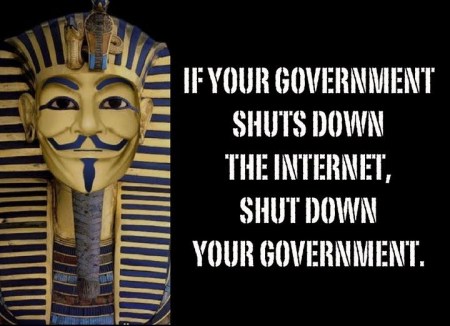
Sounds alarmist? Perhaps. But under the IT Amnedment Act of 2008, the Government of India gave itself the power to do so. The Economic Times reports:
The Indian government has armed itself with powers to ‘switch off’ or kill the internet during times of national emergencies, becoming one of the first few countries to assume such far reaching authority. Even as the US and other western nations debate the judiciousness of giving the government’s complete control to shut down cyber traffic, India has moved a step ahead and incorporated a provision under the IT Act of 2008, giving the Central government, or any of its officers specially authorised by it, to block the internet if necessary. The shutdown can happen in the interest of sovereignty and integrity of India, its defense, security of its states, friendly relations with foreign states or for public order. Failure to comply will result in imprisonment of up to seven years. [Link]
We have come to this pass, that we are only now waking up to what’s worrisome in a law made in 2008 and brought into effect in 2009, not only because we were sleeping back then but also because the IT Amendment Act 2008 was passed in a hurry in the 2008 winter session of the Parliament, with a lot of other laws, with no discussion in Parliament whatsoever. The provision that the Economic Times story refers to is Section 69A of the IT Amendment Act 2008, which gives the government the power to block websites, for which a separate set of rules have been prescribed. However, the Economic Times story rightly interprets Section 69A as giving the government the power to shut down he internet as such:
69A – Power to issue directions for blocking for public access of any information through any computer resource
(1) Where the Central Government or any of its officer specially authorised by it in this behalf is satisfied that it is necessary or expedient so to do in the interest of sovereignty and integrity of India, defense of India, security of the State, friendly relations with foreign states or public order or for preventing incitement to the commission of any cognizable offence relating to above, it may subject to the provisions of sub-sections (2) for reasons to be recorded in writing, by order direct any agency of the Government or intermediary to block access by the public or cause to be blocked for access by public any information generated, transmitted, received, stored or hosted in any computer resource.
(2) The procedure and safeguards subject to which such blocking for access by the public may be carried out shall be such as may be prescribed.
(3) The intermediary who fails to comply with the direction issued under sub-section (1) shall be punished with an imprisonment for a term which may extend to seven years and also be liable to fine.
Am I sounding paranoid? Well, then go further in the ET story and read this:
Not satisfied with this provision, India is now moving ahead to develop alternate plans in case the ‘switch’ does not work. The draft plan by the Cabinet Committee on Security and Ministry of Home Affairs along with Ministry of IT & Communications to ‘choke’ the internet at will, which ET reported last year, is also learnt to be in its final stages.
The story quotes cyber law expert Pavan Duggal:
Although it may be technically possible to block the net in India, theoretically it may be very difficult given the dynamic nature of the constitution and the judiciary.
As the Hindi saying goes, the world lives on hope!
From Kafila archives:
- How is Savita Bhabhi a Threat to India’s National Security?
- A Curtain Call for the World’s Largest Democracy: Neerja Dasani
- ‘How Leaving the Internet Fueled Our Revolution’
- Here’s What India’s Communications and IT Minister Thinks About Online Freedom
- Get Ready for India’s Blogger Control Act
- Crazy Internet Censorship Time in India, Again
- Of Journalist Citizens
 KAFILA - COLLECTIVE EXPLORATIONS SINCE 2006
SO, RTI is one option. But isn’t there need to activate voices? Who speak in the favour of freedom of speech?!?
LikeLike
Sir, Whatever the intentions of the Indian government, I am a little skeptical about their abilities in this regard. That said I think the right way to respond to this is by having ready our modes of internet access for that day when the kill switch is activated. I think it should not be that hard. Just as there is HAM radio for regular radio there should be individual run servers.
LikeLike
Can’t take free speech for granted in India!
Press release by The Free Speech Hub on World Press Freedom Day
LikeLike