
Nations build memorials to the Unknown Soldier. A militarized imagination in which the glory of the Nation is embodied in a nameless and faceless figure who courts death. This faceless Unknown Soldier must die so that the myth of the nation can live, and a mythical National Interest devastate the everyday lives of the powerless.
This May Day, let us sing to the memory of the Unknown Worker – celebrated by no one, not even in abstraction! The faceless figure on whom rest our lives of luxury, our ‘growth’ and the profits of the bourgeois. I borrow the the term ‘unknown worker’ from Susie Madrak.
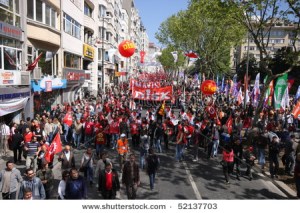
Let us, we who have no nation – antinationals, postnationals, aliens, refugees, immigrants, undocumented workers, development refugees – sing the strains of the Internationale. Let us recall the days when the poetry of the International truly belonged to the ‘wretched of the earth’, the time when the Internationale was not yet taken over and made into the official anthem of nations, parties and governments. The long winter of party-state-nation appropriations of the voices of struggle, that set in more than a century ago, and once again imprisoned them, may be nearing its end.
Heroic struggles against Capital that, it seems, were fought only to find their legacy taken over by the State or the Party-State. Once more, workers were bound hand and foot and thrown at the mercy of Capital – this time by ‘vanguards’ who spoke in their name. But things are beginning to change. As Susie Madrak’s report (linked above) on the burgeoning wildcat unions across China puts it:
“An epic rebellion has now begun in China against this abuse – and it is beginning to succeed. Across 126,000 Chinese factories, workers have refused to live like this any more. Wildcat unions have sprung up, organised by text message, demanding higher wages, a humane work environment, and the right to organise freely. Millions of young workers across the country are blockading their factories and chanting, “There are no human rights here!” and, “We want freedom!” The suicides were a rebellion of despair; this is a rebellion of hope.”
Western corporations, backed by their governments dripping with concern for democracy, did everything in their power to prevent the Chinese government from enacting a new law that would provide for elected workers’ unions. Democracy sounds good as long as it does not reach corporate profits! The Chinese government and Western capitalist corporations – one pursuing its GDP, the other its profits!
Earlier this year, on Kafila, we had posted two reports by Madhumita Dutta and Venkatachandrika Radhakrishnan (here and here) on the ruthless exploitation by global transnational corporations in Sriperumbadur and neighbouring regions on Tamil Nadu, following the model of Shenzen and other Chinese Special Economic Zones. They also reported on the strikes and brewing unrest in these industrial units, where managements have been resorting to brutal methods to crush unions even before they are formed. Fellow Kafila-ite Sunalini Kumar wrote on how integral ‘accidents’ are to the whole business of profits and GDP. She wrote of a fire in a Lakhani shoe factory where six workers died and about 30 were injured. Workers protesting the deaths were lathi-charged. We could go on.
But let this May Day not become an occasion of simply recalling the pain, oppression and exploitation that workers are subjected to.
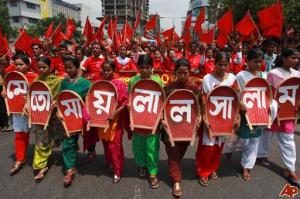
Workers’ struggles against capital began with the beginning of industrialization. Former peasants or artisans who were thrown into labour markets struggled for basic working conditions, fair wages, a regulated eight-hour working day, and minimum social security provisions. Questions of union rights arose in this context. However, today, in contemporary India, we see the simultaneous attack on both forms of life – that of the peasant and small producer on the one hand, and the impoverished and dispossessed worker on the other. For two long decades now, we have seen the most predatory form of corporate capitalism play havoc with lives of ordinary people. The stories of its exploits stretch from the highly protected and highly exploitative industrial enclaves in the neighbourhood of major metropolises to the most far-flung forest and mining areas. But this is also the time that has seen the re-emergence of the most ferocious class battles in different parts of the country – and these class battles are no more of the so-called industrial proletariat alone. They are at the same time, battles of the peasant at the point of dispossession and of the worker thrown into unregulated, dangerous workplaces with practically no protection. A pincer movement against capital, if you will, even though the urban industrial struggles are still relatively very weak. But the signs are there, as we had noted in our comment on the workers’ struggle in the Italian firm Grazziano Transmissioni in Greater Noida, over three years ago.
More importantly, the last year has seen a global turning of the tide. As governments in country after country in Europe imposed severe cutbacks on social spending, different sectors of the population erupted in unprecedented protests. That will not only mean huge job losses, but also cuts across the board in housing benefits, child benefits, disability allowances etc. Apart from massive students protests against cutbacks and fee hikes in England, struggles in countries like Greece reached a peak with as many as six general strikes in the course of 2010. Last year we also witnessed the eruption of vast sectors of the French people in mass demonstrations against the raising of retirement age. In the United States, we saw the occupation of the Capitol building in Wisconsin as the proposal to ban the right to collective bargaining, which had a galvanizing effect across the US.
And of course, how can we forget that the year 2011 began with the revolutions against dictatorships in North Africa and West Asia – struggles that have not stopped with the overthrow of hated individual dictators but which continue to push for workers’ union rights.
The important thing to realize is that in many parts of the world, it is not just workers who are pitted against capital. It is really increasingly becoming a battle between capital and the rest of society. Radical politics in this context must seize the opportunity and dare to be creative and stretch the imagination.
 KAFILA - COLLECTIVE EXPLORATIONS SINCE 2006
it is observed that labour unions,which are generally”sold out to management”are becoming irrelevant(peter drucker)in imagining india,it is observed that democracy should depend less on individuals and more on institutions as nehrus are rarity and devgowda is norm-hence unknown worker.in india,52%of economy represent agriculture which is largely unorganised.where is labour day?
LikeLike
Quite true. The stench of the WTO wafts through your piece.
yes, the battle deepens. and at the same time, how despicable is it to be unknown and faceless? (I tried to infer that, but couldnt.) The fact that the workers, have ‘no face’ can be a source of comfort, in an age when recoginizability is a commodity in itself.
Second point, how are ‘we’ making workers any different from ‘love’ and ‘mummy’s’ and daddys (other empty signifiers?) if we actively choose to remember ‘our’ struggles on May the first? if its an ongoing process and struggle, choosing a day to remember, becomes yet another project under construction.
LikeLike
Solidarity Forever!!
LikeLike
While agreeing broadly with the fact that the worker’s movements have and need to become stronger, I felt that the article missed one critical point.
It fails to point out the states that were friendly to labour and those that were not.
Country after country (USA, UK, Greece, France, INDIA) took measures that were anti-union, the Chinese govt. actually did not obstruct the Unions and in fact backed them in their positions which gave more Unions the confidence to further take up stances against their exploitative conditions.
Now, the problem here is that China has recently stated that it would be moving higher up in the value chain in exports in order to remove these ‘exploitative’ jobs from its economy which prompted the Indian Planning Commission Chairman ‘MSA’ to say that India can now increase its exports through manufacturing from where China is relinquishing.
Which means that those jobs are now going to come to India !! In India you can always get dirt-cheap labour which you can abuse !! Unfortunately, I would say that the worst is yet to come in India.
LikeLike