
Guest post by T RIYAS BABU

It all started on March 16 this year when a Tibetan monk named Phuntsok set himself ablaze in protest against China marking exactly three years since the bloody crackdown by Chinese troops on the people of Ngaba County of Tibet in 2008. Chinese government tightened security and its stronghold on Ngaba in general and Kirti monastery in particular. Tibetans allege the authorities even blocked food supplies to the monastery in an attempt to starve around 2,500 monks. They say many have been arrested and a large number are missing.
In protest of the repression of Chinese authorities three executive members of Tibetan Youth Congress (TYC) – Dhondup Lhadar, Tenzin Norsang and Konchok Yangphel were on an indefinite fast that began on 25th April at Jantar Mantar in New Delhi. But they had to call it off after 25 days due to the deteriorating health of the three activists.
“In view of staunch requests from the delegation of European Union and their assurance for a continued support for Tibet, in particular the issue at Ngaba Kirti Monastery coupled with pleas from our brothers and sisters inside Tibet, we have decided to indefinitely call off the hunger strike,” the TYC said in a statement posted on its Facebook page.
They were on fast for 25 days, challenging the scorching heat of summer in the Indian capital, right under the nose of our vivacious media, at Jantar Mantar. The multicolored Tibetan flags hung on the makeshift tent where the activists were on fast, but they didn’t attract their attention of the OB vans. In the information age, gathering information and disseminating it have been the biggest challenge for Tibetan organizations. Since the Chinese government keeps a razor-sharp eye on independent journalists entering Tibet, it is a mammoth task to facilitate information flow from there. Tibetans in abroad gather it through relatives and friends who are still in Tibet; but they say, most of the time, they do not get the real picture.
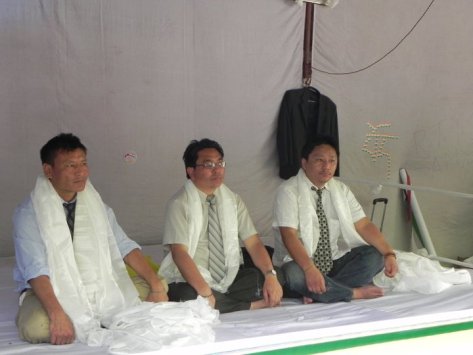
Tsewang Rigzin, president of TYC, the largest and the most active non-governmental organisation of Tibetans in exile, in an interview spoke about the state of affairs in Tibet, TYC’s strategies and its stand on issues and mainly the negligence of the vibrant Indian scholars, social activists and media in particular towards Tibetan issue.
What is the present situation in Ngaba?
According to the reports we have received, the Chinese authorities have detained 300 monks and beaten two elderly to death. The situation there in Ngaba is getting worse. They have started implementing the same policy that they did in what they call Tibetan autonomous region. They have restricted the number of monks in monasteries and the age limit of the monks too. If you are below 16 years age, you can’t be a monk, which completely goes against our tradition.
You have been demanding the intervention of the United Nations. What has been its response so far?
Yes, we have been demanding the UN intervention apart from the international community. Unfortunately, from the UN, despite all our efforts and struggles, we have not got any official response. The UN hasn’t done much on the matters of human rights violations happening in Tibet and we are really disappointed about that.
Isn’t asking for US intervention a contradiction, as US is criticized for its stand on many such issues?
We all have seen US stand for democratic values. They act against the autocratic governments in the world. We could see that in the case of Egypt and Libya too. They might have their own purpose but that does not put down the cause they stand for.
How has been the approach of Indian government?
We are grateful to the Indian government and the people. Their hospitality for the last 52 years; we will never be able to repay what they have given us.
You have been critical of the negligence of the Indian media towards Tibetan issue.
I think we haven’t got the coverage that we would want in India media. But particularly on fasting of our members, what has happened is there have been several issues filling the media all these days such as the death of Sai Baba, Dorji Khandu and Osama Bin Laden, and there was the Royal Wedding. And there were the state elections as well. However, by and large, I think we haven’t got enough space in Indian media.
Another painful approach of the Indian media was the way they dealt with the Karmapa issue. They almost jumped over. There were many stories that were not true being published in India media; they were completely cooked up ones. Nobody dared to disseminate our version of the issue.
What do you think the reason for the negligence?
Well, unfortunately I am not in a position to answer this. It is them who should answer why they do that. We have done our part. Now it is their duty to inform the people. However we will not give up. We will continue our struggle and try our best to keep in touch with media.
Do you think Indian scholars and social activists have ignored the Tibetan issue?
We have tried to reach out to the scholars and writers of India. We are getting support from some people who believe in Gandhian way of life. We haven’t got enough support but I am sure there is still a lot to be done from our part. I am sure we have to try hard to reach out to them and get them involved. However, we strongly believe that our struggle is all for our people. As far as our people are united and they take up their own responsibility we do not need to be bothered of it as obtaining national support is only secondary in that case.
You have been protesting the “patriotic re-education” of China.
Yes, that is the biggest problem we face today. China has been forcing people to go through their rigorous political re-education. They are forcing monks and people to denounce His Holiness Dalai Lama and to accept the regime of China, which the Tibetan people can never do. They can try as much as they want. But they are never going to succeed as Tibetan people in their heart they believe that Tibet was an independent country and it deserves to be so.
How do they forcefully implement their culture among Tibetans?
Well, they torture people. They arrest monks. They have even killed many on some forged basis. However they are not going to succeed. Just like China belongs to Chinese people, Tibet belongs to Tibetans.
There are arguments that China’s intervention on environmental resources in Tibet is a big threat to the entire sub-continent.
Well, I think that is the biggest threat to India and other nations in the sub continent. A majority of fresh water resources of the Asian continent are from Tibet. China has diverted many of the rivers into it. They are building dams for the usage of their own people. If this keeps happening, it will be a serious blow to India and other Asian countries. They will have to suffer famine and starvation. I fear, people say the next world war will be on water and that may happen because of China.
How do you deal with diversity of opinion among Tibetans about the issue?
It is true that there are different opinions among Tibetans themselves. While some demand an autonomous status for Tibet, some stand for complete independence. But as an organization TYC thinks that independence is the only way we can find the solution to the entire problem.
We understand there is a growing frustration, especially among students and youth. But as an organization and as a struggle we have always followed the way of non-violence. That is because we follow His Holiness who always preaches peace and non-violence. That is why our struggle has been non-violent so far. But in the case of future, nobody can predict what will happen. That is not in our control.
*
The fast of the TYC activists was called off on a request from the EU delegation who assured that they would keep the issue of Tibet high on their agenda. The assurances are not new for them; words have been given before, by several international organizations. The intentional negligence of the Indian media on the issue of Tibet is distressing. I felt Mr. Tsewang was careful while commenting about the approach of Indian government and media. Maybe, he had to show that they were still “grateful” for the space they were given. For the government, there is no “passing the buck,” no “blame game”. It is just dishonorably mum. There is logic in the silence of the authorities, but why has that been mimicked by media? Looking at the larger perspective, is it logical for the government too to keep quiet on the issue?
 KAFILA - COLLECTIVE EXPLORATIONS SINCE 2006
One does feel for the plight of the Tibetans. The reluctance of many to highlight the annexation of Tibet, changing the demographic profile etc probably has to do with closing the possibility of visits to China. But apart from that, some of us are also rather discomfited about the equation of religion and nationality, I guess.
LikeLike
great work…………. still we are solidarity to Tibetans.
LikeLike