
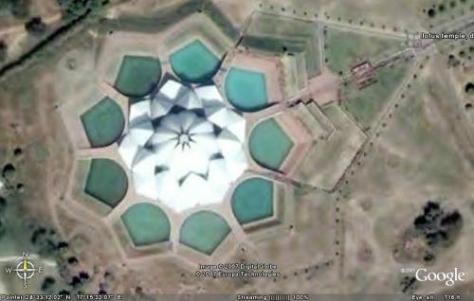
On a hot Sunday morning, tourists wait 30 minutes in a queue to get inside the House of Worship of the Bahá’í in Kalkaji, better known by its unofficial name, the Lotus temple. Once inside, they spend less than 30 seconds. The tourists, who include burqa-clad women and sadhus in saffron, don’t seem to be in need of a multi-faith prayer hall. The multi-faith prayer service, held thrice a day, is also sparsely attended. People are apparently disappointed there’s only a large hall inside that beautiful white Lotus building, and they can’t even take photos of this hall.
Even the Indians among the volunteers speak in foreign accents, guiding people for an orderly entry and exit, gathering a hundred odd to enter at a time and explaining them that this is a temple, that they should pray in silence inside. Tourists find it hard to suspend their holiday gaiety. They come to the Lotus temple not for god but to see its expressionist architecture. The temple turns only 25 this December, yet its gets more visitors than the Taj Mahal. Thanks to the Kalkaji Metro station that opened a year ago, the number of visitors at the Lotus temple is likely to touch 6 million this year, as compared to the Taj’s four.
There is no entry fee, but like other tourist sites it is closed on Mondays. The monument’s 25th anniversary will be commemorated on its lawns on 13 and 14 November. Bahá’ís from all over the world are likely to attend the event, which has been promoted by the Incredible India tourism campaign from Johanesburg to Japan since the beginning of this year. The temple’s Iranian Bahá’í architect, Fariborz Sahba, who lives in Canada, is likely to be in attendance. Sahba worked on the project for 10 years, and it continues to win him awards and acclaim.

A third of the world’s six million Bahá’í s live in India. The Lotus temple acts as an ambassador of the faith, yet there is little knowledge among the tourists about who the Bahá’í s are and what is it that they do. The Bahá’í s have neither clergy nor any rituals that would bring them public visibility; they don’t proselytise and so controversy rarely arises.
Men in formal clothes will prevent you from entering the Information Centre if you haven’t yet returned from the temple with a free ‘exit pass’. The Information Centre is like a museum, a walk through which will familiarise you with the Bahá’í faith and also tell you about the teachings of other religions. Its director, Shatru-Ghun Jiwnani, a Sindhi from Greater Kailash who wears a tie and speaks in a foreign accent, is hard pressed to explain what the faith is about. It is not a sect, he emphasises, but a religion. To be a Bahá’í you have to recognise that all religions are meant for the advancement of human society and that the Iran-born Bahá’u’lláh (1817-1892) was a messenger of god.
“We don’t make Bahá’ís,” he says. “We discover them.” To become a Bahá’í you have to undertake an “independent investigation of the truth”. An elected “administrative” body of nine, a Spiritual Assembly, will give you admission and record your name. You can’t just land up at the Lotus Temple and demand to join the faith; it works through word of mouth. Meetings are held in Bahá’í centres spread across cities around the world, including many in Indian. The one in Delhi is on Canning Lane but regular meetings are also held in several neighbourhoods. The Spiritual Assembly “witnesses” marriages, which, according to the faith’s basic tenets, cannot be held without the consent of both parents, even if they are not Bahá’í. The dead are buried, the prayers are prosaic.
Many see the Bahá’í faith in India as being open only to the elite; Jiwnani claims there are poor, rural folk who are members too. A large part of the funds to build the temple were donated by Ardishír Rustampúr of Hyderabad; Jiwnani says there were also those who donated a rupee. Rustampur had donated his entire life savings for building this temple.
Tourists couldn’t care less about any of that. “Didi let’s leave for India Gate now,” a girl tells her sister, who replies, “I am telling you there is nothing at India Gate!”
(First published in The Caravan.)
- My Bahai Faith, a blog maintained by Rajendra Upadhyaye


Good article and good observation!
This was also what I observed. I know little about them. There are many Bahais in India but mostly they are found in Iran. They are being persecuted in Iran for several reasons. They are accused of Spying and working to topple the government. I have googled and found some high profile Bahais also involved in some crimes. Like one Payam Shoghi who was involved in fake passport scam and was held by delhi police, he is now running a school in Maharashtra. Some foreigners regularly visiting India and indulging in illegal conversion activities in Panchgani. Some Bahais were also arrested in Panchgani.
LikeLike