
Guest post by SOHUL AHMED
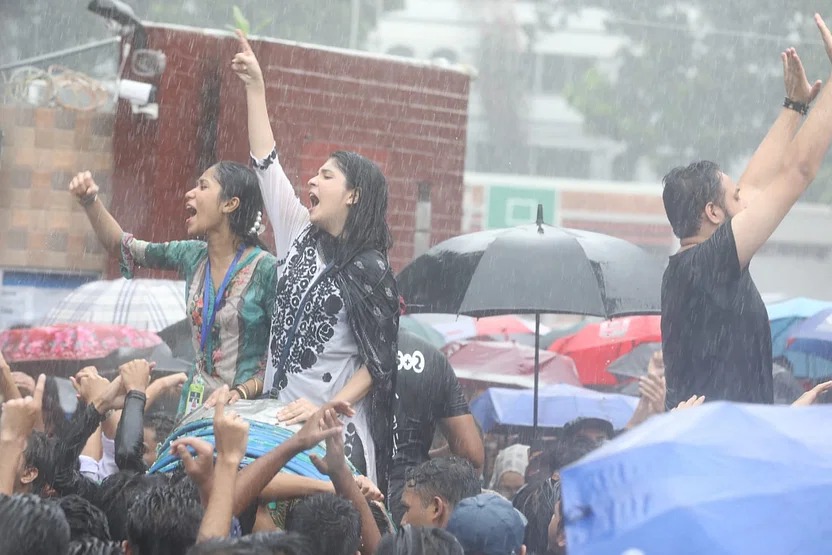
Sheikh Hasina, often labelled as fascist and autocratic leader in Bangladesh, was forced to flee the country following a popular uprising in July-August 2024. Many writings have appeared exploring the character of the movement and the consequent developments. Recently, renowned Indian historian and journalist Vijay Prashad published an article titled ‘Will Bangladesh be another Egypt?’, where he expressed the concern that Bangladesh could follow a path similar to Egypt’s. Vijay presents the popular uprisings as both a continuation and, to some extent, a counter-response to the Shahbagh movement, while drawing parallels to the Arab Spring. However, his disregard for certain political realities in Bangladesh—such as the country’s long tradition of democratic movements and the presence of major centrist parties like the BNP—makes his comparison uneven and incomplete in some respects.
What stands out in Prashad’s article is his portrayal of the popular uprising of July as either being led by or inevitably leaning toward, Islamist forces. He frames the situation as a conflict between the Awami League and Islamists (or Pro-liberation and anti-liberation). This narrative is not unique to Prashad, as Indian media and the public domain have also tended to depict the uprising as a victory for pro-Islamist forces. Claims that minorities will be endangered, with the Awami League portrayed as their protector, and that the legacy of the Liberation War is being undermined—common themes in many discussions—result from a flawed tendency to mischaracterize Bangladesh’s political reality as a simple dichotomy between the Awami League and Islamist forces.
During the movement, Indian media frequently published daily reports, citing sources like Reuters or various Bangladeshi newspapers. Their coverage typically focused on key details such as casualty numbers, the movement’s objectives, curfews, and government statements. A clear bias emerged, with greater emphasis placed on government statements than on the perspectives of the protestors.
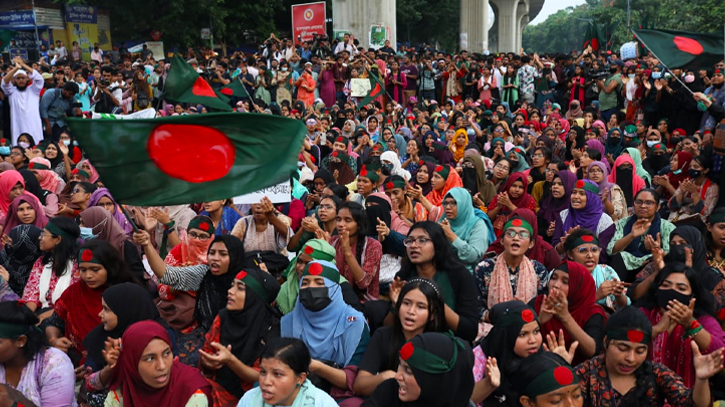
When Sheikh Hasina insulted the protestors by calling them ‘razakar’—a deeply loaded term referring to collaborators with the Pakistani Army during the 1971 Liberation War—the movement intensified. The protestors’ response clearly indicates that they perceived Hasina’s remark as an insult. This reaction can be traced to the historical trauma of 1971, compounded by the Awami regime’s pattern of branding critics as ‘anti-freedom’ or ‘anti-liberation’ over the past decade.
However, Indian media often misinterpreted this sentiment. For instance, a column in The Print suggested that the youth of Bangladesh were largely indifferent to the history of 1971, in contrast to earlier generations. It stated that, ‘As is evident from the current quota protests on Dhaka’s streets, Bangladeshi youth do not dig their 1971 origin story in the way previous generations did. By extension, many today are dismissive of the role the Indian Army played in helping Bangladesh become an independent nation. Pakistan Army’s 1971 ethnic cleansing in the country has also been largely forgotten, with the average Bangladeshi youth more inclined to cheer for the Pakistan cricket team in a match than India.’
The same author, Deep Halder, framed the movement as a ‘razakar versus dictatorship’ conflict, suggesting that protestors would prefer ‘razakars’ over a dictator like Hasina : ‘If not Hasina, who’ has been a standard response from the PM’s supporters. But now that students say they’d much prefer ‘Razakars’ over a dictator like her, it’s time for the PM to take stock of the narrative.’
Framing the movement as Pro-Islamist in Indian Media
The Anti-Discrimination Movement that began in July was remarkable for its inclusivity, with nearly every group except the Awami League joining under a non-partisan student platform. This kind of spontaneous and horizontal, student-led movement was unprecedented in Bangladesh and, arguably, rare even globally in recent times. Despite the involvement of various political groups, including the BNP, Leftists, Jamaat-e-Islami, and others, the movement remained fundamentally student-driven. People from all walks of life took to the streets to protest the massacre of students.
Yet, when Indian media reported on the events, they would often portray the forces of Jamaat-e-Islami or Islamist groups as leading this movement. Within that context, such a narrative helped solidify the framing of Bangladesh’s political arena as a pure binary: Awami League versus Islamists. The basic argument was that without Awami League, the Islamists would take over—a line of thinking that also influenced the foreign policy of India towards Bangladesh and only reinforced fears that the fall of Hasina’s government would pave the way for Islamist rule.
The vandalism of Mujib’s statue and the burning of his residence in Dhanmondi following Sheikh Hasina’s fall on August 5 were not merely seen as expressions of outrage against the Awami League’s misrule. Instead, these were framed within the broader narrative of ‘secular’ versus ‘religious’ politics. A report in Anandabazar after Hasina’s downfall suggested that supporters of the Liberation War and secular Bangladesh remained marginalized during the regimes of Ziaur Rahman, Hussain Muhammad Ershad and Khaleda Zia, only reemerging with Hasina’s rise in 2008. With her fall, fears about the revival of the ‘banned’ Jamaat-e-Islami have resurfaced. Although this was a political strategy banning of Jamaat four days in advance prior to Hasina’s fall, the report presented the issue in such a way as to create a different impression-that Jamaat had been banned much ahead of this period. The demolition of Mujib’s statue was dubbed as a symbol of the process of marginalization of secularist supporters, and again this created an impression that the fall of the Awami League would open ways to the resurgence of Jamaat-e-Islami.
The Indian print media, after Hasina’s fall, was filled with reports speculating about Jamaat-e-Islami gaining control. For example, The Times of India published an article titled What is Jamaat-e-Islami? ‘Pakistan-backed’ political party that brought down Sheikh Hasina govt in Bangladesh, claiming that Jamaat, backed by Pakistan, played a key role in Hasina’s downfall. The Economic Times went further stating that, ‘Intelligence agencies have identified Pakistan’s ISI and its Chinese patron as key players in agitating protests and subversion that compelled Bangladeshi leader Sheikh Hasina to flee the country. Information reveals the involvement of Islami Chhatra Shibir (ICS), the student wing of Jamaat-e-Islami Bangladesh, in converting protests over quotas into efforts to establish a regime favorable to Pakistan and China, undermining the previously installed Awami League government, as reported by TOI.’ The report, citing unnamed intelligence sources, warned that Jamaat’s ultimate goal was to establish a Taliban-style government in Bangladesh, with ISI support.
Indian media also perpetuated fears that Jamaat’s rise would lead to the persecution of Hindus in Bangladesh. Reports titled ‘Jamaat may take control in Bangladesh, expect an influx of Hindus’, citing statements from BJP, leaders echoed these concerns: If this situation doesn’t come under control within three days, mentally, be prepared to give refuge to one crore Hindu refugees. The Centre should inform the (Bengal) Governor and Chief Minister. There is CAA. If the situation is not controlled there, Jamaat (an opposition party in Bangladesh) and radicals will take control.
This fear-mongering extended to claims of violence against Hindus, with media spreading rumors and unverified reports of Hindu persecution. The narrative surrounding the rise of Islamist groups is evident in the captioning of various media reports. For instance, a video depicting the gang rape of a Hindu woman has gone viral on Telegram, with a caption alleging that “The so-called Jamaat-e-Islami quota protesters leaked a video of the gang rape of a Hindu girl to the Islamic army group. If Hasina’s government falls, they have threatened to rape all Hindu girls out of their homes”. However, it is important to note that this video has been circulated in different contexts before, including during an event in Manipur, India, in 2023, and it also went viral in Indonesia in 2021. On August 6, The Times of India quoted a BJP leader claiming that Hindus are being killed in Bangladesh, with as many as one crore Hindus potentially entering India.
Additionally, Indian media used the tragic death of Swarna Das, a 14-year-old girl who was killed by BSF firing on the border, to further fuel tensions. The Times of India falsely reported that Swarna Das had been shot by the BGB, framing the incident as part of a broader narrative of persecution since the regime change in Bangladesh. It stated: ‘Reportedly, Swarna and her parents had been facing problems in Bangladesh since regime change. In the last three weeks, they attempted to cross over to Tripura thrice but failed…. When they were attempting to cross the border near pillar No. 57 taking advantage of the absence of BSF at night, the BGB opened fire.’ The narrative presented in this report suggests that, after Sheikh Hasina’s downfall, Hindus in Bangladesh are fleeing to India in large numbers, only to be shot dead by the Border Guard Bangladesh (BGB) while trying to cross the border in the absence of the Border Security Force (BSF). The headline employing the Hindu identity of Swarna Das insinuated that she was killed just because she was a Hindu; again, this framed her death as a direct result of religious persecution. It is really an overt example of misinformation in Indian media in an attempt to twist the narrative around the ongoing situation in Bangladesh.
It is to be noted, for years border killings were justified by India through demonizing and blaming the victims, broadly accepted by the Awami League government. Recent reports shifted the blame for border killings onto the Border Guard Bangladesh (BGB), amplifying the dominant narrative of Hindu oppression that aligns with the framing of the movement as driven by Islamist forces. The Indian media has amplified Hasina’s own rhetoric, which claims that without her government, the Hindu community would be in a precarious position. This portrayal goes hand in hand with the depiction of Bangladesh as a ‘fundamentalist’ nation, with the Awami League being cast as the ‘savior’ or protector of the Hindu minority.
By dividing the people of Bangladesh into two broad categories—Awami League supporters and Islamists—several significant distortions occur. First, it creates a narrative that portrays the entire population of Bangladesh as inclined towards ‘Islamism,’ suggesting that, if given democracy, they would replace the Awami League with Islamist rule. This assumption diminishes the importance of democracy, framing the containment of ‘Islamism’ as a more urgent priority. This framing serves to justify India’s foreign policy stance on Bangladesh, aligning it with the narrative promoted by the Awami League itself.
Second, this reductionist view collapses the complexity of Bangladesh’s political landscape into two simplistic groups, ignoring the presence of major political entities like the BNP and numerous smaller parties. These parties are either downplayed or sidelined entirely, simply so that the focus remains narrowly on Islamists. Even a prominent scholar like Vijay Prashad, in his analysis, fails to break away from this problematic dichotomy. He falls into the same trap by implying that Islamists will inevitably rise if democracy is restored, effectively erasing any political force outside the Awami League that is not Islamist.
His conclusions are shaped by viewing Bangladesh through an Indian and Awami League-centric lens, overlooking the broader political and social dynamics. The Awami League itself has cleverly positioned Islam as being opposed to the ideals of the Liberation War, equating opposition to the party with opposition to the Liberation War itself. This framework allows the party to frame any opposition as inherently ‘Islamist,’ creating a false dichotomy that conveniently serves its interests.
Indian state policy reflects the same narrative
The framing of Bangladesh’s political landscape as a binary struggle between the Awami League and Islamists has long been a reflection of Indian state policy toward Bangladesh. This view has deepened over the years, cemented by India’s consistent support for Sheikh Hasina and the Awami League, regardless of electoral legitimacy or popular opposition. Even after Hasina’s fall, prominent Indian figures, including opposition leader Rahul Gandhi, echoed concerns that Pakistan might have fueled the recent movement, reinforcing India’s tendency to view Bangladesh’s politics through a narrow lens of security concerns.
The unequal nature of the India-Bangladesh relationship, often characterized as a ‘client-patron’ relationship, stems from India’s strong role in backing the Awami League, particularly since 2009. This bond is evident from various accounts, including former Indian President Pranab Mukherjee’s admission that India played a crucial role in bringing the Awami League to power in 2009. When the 2014 elections in Bangladesh were set to be boycotted by the opposition, raising concerns in the international community, India stepped in. It advised the United States and other Western nations to view Bangladesh through India’s eyes, essentially advocating for continued support of the Awami League to suppress Islamist forces.
Indian diplomacy directly intervened in that 2014 election when Sujata Singh, then India’s Foreign Secretary, met with Jatiya Party leader Hussain Muhammad Ershad, persuading him to participate in the election despite his earlier commitment to boycott it. After a meeting with Sujatha Singh, Ershad announced, “They have told me to participate in the election. If I don’t, then apparently fundamentalist forces like Jamaat-Shibir will come to power.” This participation allowed the Awami League to present the election as competitive, despite the absence of the main opposition, and solidified India’s role in shaping Bangladesh’s political trajectory. By framing the opposition as ‘fundamentalists,’ India justified its support for a deeply flawed election, further marginalizing the broader political spectrum of Bangladesh.
Under the BJP, this unequal dynamic not only continued but deepened. Analysts described this relationship in this way: ‘under the current Bangladeshi government, the relationship between Dhaka and Delhi has steadily evolved from being that of two theoretically sovereign and equal nations to one of client and vassal in the image of the former communist countries of the Eastern Bloc and the erstwhile USSR.’ Bangladeshi officials, including its foreign minister, openly embraced this subordinate position, even likening the relationship to that of a ‘husband and wife’ and publicly requesting India to keep Hasina in power at any cost.
In 2024, Awami League leaders, including Obaidul Quader, admitted to having struck a deal with India to ensure Hasina remained in power. Even candidates declared themselves to be backed by India in this ‘dummy’ election. In this election, as pressure mounted for transparent elections, India reportedly advised the U.S. to refrain from pushing too hard on democracy, warning that Bangladesh could become a breeding ground for Islamists if the political system opened up.
The continuity from 2008 to 2024 shows that India’s primary interest has been in maintaining Hasina’s rule, regardless of the democratic cost.
What emerges from this is a clear message: India’s long-standing fear of Islamist influence in Bangladesh has driven it to support an authoritarian regime in Dhaka. Whether it was persuading Ershad to participate in a rigged election in 2014 or pressuring the U.S. in 2024 to tolerate a ‘dummy’ election, India’s central argument has been that democracy in Bangladesh would lead to the rise of Islamists, thereby threatening regional stability. As a result, the citizens of Bangladesh have been reduced to caricatures in Indian policy—viewed as either potential Islamists or ‘unfit’ for democracy.
This attitude, shared by both the Awami League and Indian policymakers, is not only deeply insulting to the people of Bangladesh but also reflects a fundamental mistrust of the country’s democratic potential. Following Hasina’s ouster, the Indian media and their political elites went into overdrive with propaganda on minority attacks, portraying the majority population of Bangladesh as ‘fundamentalists’, while reinforcing the narrative that only the Awami League is capable of protecting the minorities and preserving secularism. This attitude and policy trapped Bangladesh in a cycle of authoritarianism under the guise of safeguarding against extremism.
The question of ‘terrorism’ and its use during AL-regime
Are we denying the history of militancy or terrorism in Bangladesh? Or, should we not be concerned about the potential endangerment of ‘secularism’ or the prospect of increasing ‘Islamization’? Two key points need to be discussed here.
First, when we speak of secularism, we do not imply a strict separation between religion and the state, nor do we equate any element of religion in politics with fundamentalism. While global discussions critically engage with this issue, we will limit ourselves to noting that in Bangladesh the secularism promoted by Bengali nationalism has largely adopted a stance of rejection toward religion, lacking meaningful engagement with religion and religious discourses. However, there are growing efforts among activists and the general populace in Bangladesh in recent years to explore the relationship between religion and secularism, rather than positioning them in opposition to one another.
Though many remain cautious of categories like secularization, secularism, or Islamization, recently researchers attributed Islamization to the secular Awami League, mentioning (semi-) authoritarian rule as one of major causes. Jasmin Lorch in a 2019 article, mentioned that, under conditions of political competition and (semi-) authoritarianism, the interests of secular rulers in ensuring their political survival can enhance the political influence of Islamic religious actors. Lorch comments that,
‘The findings … also refute alternative explanations that have been raised by foreign diplomats and aid experts and that portray Bangladesh’s current Islamization process as the result of an increase in religious orthodoxy in society, a change in the AL’s ideology from secularism to Islamism, or both…. This assessment is also backed by the fact that the change in the AL’s religion policy, from strengthening secularism to promoting Islamization, has occurred within <5 years, whereas religious and ideological convictions are unlikely to change quickly. However, the AL’s Islamization measures may strengthen orthodox Islamic forces in the long-term, particularly if these measures interact with authoritarian government practices that weaken secular opposition to Islamism and strengthen radical Islamist forces through divide-and-rule tactics.’[1]
This observation challenges the binary of Awami League versus Islamists, often presented by Indian media and puts in perspective the Islamization question.
Secondly, The history of terrorism and militancy creates a sensation of fear among analysts, who want to portray Awami league as an active agent against the terrorism. There is a tendency in the media to portray madrasa (religious school) students as potential ‘militants.’ However, recent evidence contradicts this depiction; the studies show that elitist secularly educated people are more engaged in this kind of activity, which corresponds to global trends.[2]
Moreover, this discourse of terrorism and counter-terrorism has often served as a pretext for committing human rights violations during the Awami League’s rule, and also been part of the League’s political rhetoric. Ridwanul Hoque, in his analysis of Bangladesh’s counterterrorism laws, warned of serious risks to human rights. He pointed out that, the laws are ‘overly broad and largely incoherent definitions of terrorism or terrorist acts.’ After examining the laws of counterterrorism, he stated, ‘a closer look at the various provisions of Bangladesh’s counterterrorism laws reveals that they do not fully comply with constitutional norms and international human rights standards. The gravest concern is the flagrant breach of human rights through the actual criminal law practices followed by law enforcement agencies.’ Although Bangladesh is often highly praised for its effective approach to counterterrorism, Ridwanul Hoque argues that ‘this praise studiously hides the costs paid by the principle of legality and the fundamental rights guarantees of the Constitution.’[3]
Not only have human rights been violated under the guise of counterterrorism, but the discourse itself has contributed to the authoritarian regime that has emerged in Bangladesh over the past decade. The Awami League’s reluctance to fully engage in discussions about terrorism stems from the fear that it would undermine its political advantages. Mohammad Sajjadur Rahman has explored this politics of counterterrorism, revealing how this politics undermined the human rights of accused and the public. By comparing the August 21 grenade attack under the BNP government and the Holy Artisan attack under the Awami League, Rahman shows the continuity in the state’s use of repressive tools and the politicization of the judiciary. He showed that, Awami League uses counterterrorism rhetoric more effectively to justify its repressive regime. This discourse, according to Sajjadur Rahman, revolves around two key narratives: first, that domestic and foreign conspirators are hindering Bangladesh’s development; second, that the BNP-Jamaat alliance is the origin and sponsor of terrorism. This narrative has been actively used to justify mass arrests of opposition leaders and activists under the pretext of combating terrorism. Pro-Awami intellectuals have also equated terrorism with political Islam, producing a body of literature that conflates the BNP-Jamaat alliance with terrorism. [4]
The Awami League government, under the guise of countering ‘terrorism’, has enacted various laws that have deprived citizens of their basic democratic rights, curbed freedom of expression, violated the right to privacy, and denied access to justice. As Sajjadur Rahman noted, this politics of counterterrorism has played an important role in creating an Orwellian dystopia under the Awami regime.[5]
In other words, portraying Bangladesh’s political scene as a contest between the Awami League and the Islamists is not only a distortion of the reality but also masks the actual complex reality of Bangladesh. This narrative has been carefully manufactured and propagated by the Awami League to bolster its autocratic rule while systematically eroding democratic values. On one hand, the Awami League has played a significant role in creating space for far-right elements by repressing political dissent; on the other hand, it has exploited the discourse of terrorism, rather than addressing it in a meaningful way, to further restrict Bangladesh’s democratic space. The consequences have been devastating, with people from all walks of life falling victim to systematic enforced disappearances and extrajudicial killings.
Thus, interpreting political movements and popular uprisings, like the July Uprising, as mere conflicts between ‘Islamists’ and ‘secularists’ distorts the broader political context and disrespects the true struggles of the Bangladeshi people. A people-centered approach—one that transcends the limitations of nationalist and statist narratives—can pave the way for a new kind of liberation in South Asia. Such a shift in perspective could not only reshape Bangladesh’s political future but also enhance its relationship with India, fostering greater understanding and cooperation between the peoples of both states.
Sohul Ahmed, a researcher at the 1971: Genocide-Torture Archive & Museum in Khulna, focuses his work on genocide, violence, history, politics, and decolonization studies.
[1] Lorch, Jasmin. “Islamization by Secular Ruling Parties: The Case of Bangladesh.” Politics and Religion 12, no. 2 (2019): 257–82. https://doi.org/10.1017/S1755048318000573.
[2] Riaz, Ali. “Who Are the Bangladeshi ‘Islamist Militants’?” Perspectives on Terrorism, vol. 10, no. 1, 2016, pp. 2–18. JSTOR, http://www.jstor.org/stable/26297515. Accessed 22 Oct. 2024.; Saimum Parvez, “Digital media and violent extremism in Bangladesh: Profiles and narratives,” Journal of Bangladesh Studies, vol. 21, no. 1, 2019, pp. 60-67.
[3] Ridwanul Hoque, ‘Bangladesh’s Counterterrorism Laws and Their Discontent’. In S. Parvez & M. S. Rahman (Eds.), The Politics of Terrorism and Counterterrorism in Bangladesh (1st ed.), 2022, Routledge.
[4] Mohammad Sajjadur Rahman, ‘The Other Side of Counterterrorism in Bangladesh’, In S. Parvez & M. S. Rahman (Eds.), The Politics of Terrorism and Counterterrorism in Bangladesh (1st ed.), 2022, Routledge.
[5] Ibid
 KAFILA - COLLECTIVE EXPLORATIONS SINCE 2006
Interesting article. But it spells out a wrong simplistic analysis pursued by the Indian government without giving sufficient details of the right analysis.
LikeLike