
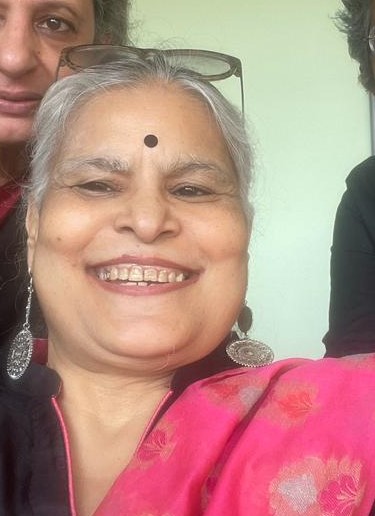
Anita Ghai with friends on her birthday in 2021
Anita Ghai (October 23, 1958 – December 11, 2024) psychology scholar and practitioner, feminist and disability rights activist, taught at Jesus and Mary College, Delhi University, for about three decades, then moved to Ambedkar University Delhi, from where she retired as Professor. She is the author of (Dis)embodied Form: Issues of Disabled Women (2003), Rethinking Disability in India (2015) and a significant edited volume Disability in South Asia: Knowledge and Experiences (2018)
How much I learnt from you, Anita my friend, and how am I performing this unthinkable task of writing your obituary! I feel as if I am writing this for you to read, for you to be gently critical about, because for sure I would have missed a nuance or two while writing about the points at which gender and disability intersect, for you cannot be written about without reference to your thinking and your scholarship. About three decades ago you sought me out to have a conversation on disability, and that destablizing conversation never ever ended. You blew open my theoretical horizons by introducing me to the field of Disability Studies, to the idea of decentering disability from a medical to a social model, to the idea that we are not divided between abled and disabled bodies, but that we all occupy a continuum of being Temporarily Abled Bodies. A sudden fracture, an illness, and within a split second you move from abled to disabled body. You wear spectacles, your hearing is mildly impaired, you have that problem in bending your wrist because of a childhood fall – each one of us is on that continuum.
I read you, taught your work. Your conceptualization of the idea of the “male stare” as it is directed towards the disabled female body, as opposed to the more common feminist understanding of the “male gaze”, always produced that exciting moment of rethinking in young students coming into feminism, as it did for me when I first read you. What you were suggesting was that to be objectified by the male gaze is still to be produced within a framework of desire and sexuality, whereas the disabled female body, transfixed by the male stare, is an object in a different way – of revulsion and disgust. The de-sexualisation of the disabled female body, you mused, is also starkly revealed in the way teenage girls with disability are exempted from the strict rules segregating young male and female cousins during vacations at family homes, for fear of adolescent sexual experimentation – you said it was assumed that if there was a space crunch, the disabled young woman could be put into the same room as her male cousins, it being assumed that she could not possibly be within that nexus of illegitimate desire. You forced me to recognize a radically different aspect of the disabled woman than as the exploited, abused, oppressed body – that very body as expressive of desire, sexuality and agency.
You reminded your feminist friends that the autonomy we prize may not be the foundation on which to build a new world, because autonomy is a highly individualist value. Rather, our feminist futures should celebrate interdependence and mutuality, for that is how feminists become strong, by building community and solidarities.
Your warmth and kindness enveloped your friends. You never forgot my birthday, not once. I mostly forgot yours, (because I don’t remember any birthdays, I would plead) and you forgave me always. The plant you sent just to cheer me up during the lockdown still brightens my days. Your incredible spirit left us all spellbound. Journalist Pamela Philipose said, while some of us were expressing our grief, shock and disbelief at your going – “A vivid memory of Anita – steering her wheelchair on a flyover with a group of feminists protesting the Delhi gang rape!”
In October this year you had that bad fall, tore your lip open, had multiple bruises and injuries. You wrote to me: “…the pain is terrible. Almost bed ridden.” And the next text, the very next second, said – “The only plus point is that I will finish the Dalai Lama manuscript.”
Your fabulous multidimensional mind kept spinning brilliantly despite all the vagaries of your body.
But you also allowed yourself sometimes to feel justifiably low and depressed. I remember you quoted a disability rights activist who said, on being praised for being brave, “I wish I didn’t have to be”.
I wish I had been there for you more.
You stood your ground in the long battle against injustice we are all engaged in, you were such a precious part of our movements.
I wish I had met you more recently, I wish I had more time with you, I wish you could read this. I imagine you would laugh in your characteristic out-loud way and say, “do you really mean all this or are you just saying it because I am…” but no, not that word. I can’t use it for you. You are more alive today than you have ever been – always in our hearts. Salaam friend, steadfast comrade-in-arms.
Go gently, my dear, rest now.
 KAFILA - COLLECTIVE EXPLORATIONS SINCE 2006
Very moving. I am sharing on FB.
LikeLike
I will always remember Ghai Ma’am as the one who opened a discourse on academic ableism in India. Rest in Peace.
LikeLike
This is so beautifully penned, so emotional and so real…
She was my teacher in JMC…. But in those care free years, little did I reflect on what all she accomplished in spite of life’s limitations.
Proud of you Ms. Ghai.
This piece is a must read inspiration and an eye opener for everyone, esp to understand a bit of the life and mind of the specially abled.
May the Lord grant her eternal happiness and freedom from the constraints of bodily limitations
Susan George
LikeLike
Thank you for writing such moving words. Your reference to the idea of ‘continuum’ and not able or disable; interdependence and not autonomy, underlines result of Anita’s unique insight.
LikeLike
I am waking up to the reality of the disable people in India. Most of them are hostage in their homes, as we lack both the awareness as well the infrastructure.
Good news is many are waking up to this reality, and things are getting better.
One point which is rarely discussed and understood is that we are all partially disabled when we become old, and that is a reality we can’t escape if we are lucky enough to live long.
LikeLike
Very very poignant – only someone who felt this close to Anita could write like this
Here is mine: https://www.linkedin.com/pulse/adieu-my-friend-anita-ghai-enakshi-ganguly-wz28f/?trackingId=B00mmYyTRKi6DudJT5X8yw%3D%3D
LikeLike
Thank you for these beautiful words. I had the privilege of being her student at JMC. I too wish I had called her every time I returned home to visit from US or sent her another letter telling her how my career is intertwined with Industrial Psychology and Counseling. I think she would have been proud of the woman I have become and of the path I chose to pursue as a career navigating my own disabilities albeit smaller in proportion compared to her story.
I did not know she had moved but have thought of her more often that I called and wrote.
May all of be comforted by our paths crossing with hers and of the role model she was to so many amongst us
take care all and keep smiling and laughing the Anita Ghai way.
Aruna Rao-McCann
LikeLike