Dear Colleagues
I am writing to you about the dire situation in Kerala with reference to the strike of the Kerala ASHA Health Workers’ Association for minimum wages and a five-lakh one-time retirement benefits, which has been continuing since the past two months.
I must confess that my faith in the Indian, not just Kerala, Left, has hit an all-time low. I am simply devastated by the undeniable cruelty that not just the state, but also the ruling left, is doing — to the most underprivileged segment of the Kerala state’s workforce. The ASHA workers of Kerala are largely working-class women; an overwhelmingly-large share of them is dalit-bahujan and often single mothers heading female-headed or female-provided families. Unlike in many other parts of India, ASHA workers in Kerala carry incredibly high work-burdens. Their average workday is 12-13 hours, counting the time they spend on data entry at home.
They are also the most efficient social workforce in Kerala, as we already know from the health successes the state has achieved in the face of yearly epidemics, severe public health threats like Nipah, the catastrophic floods of 2018, and the pandemic.
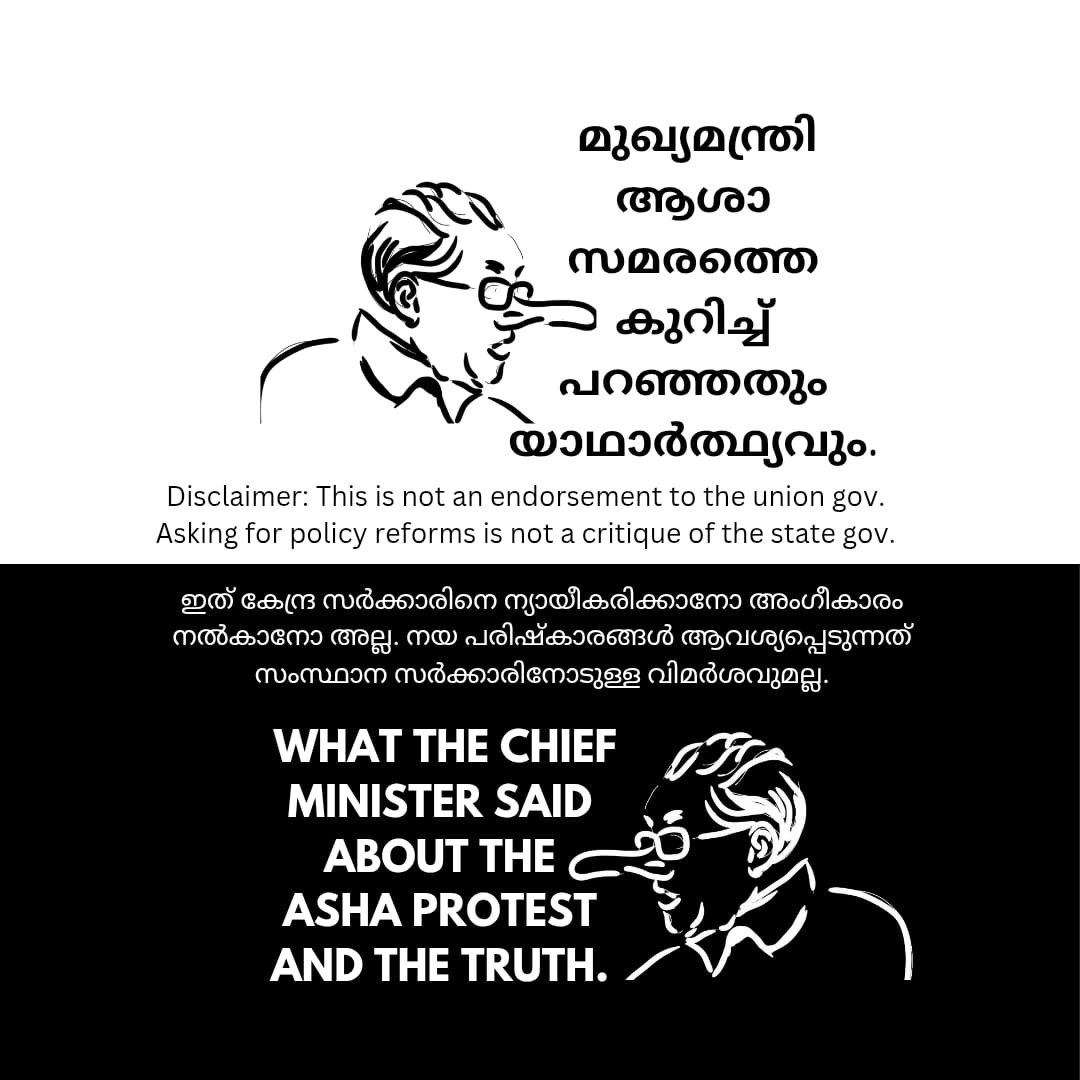
The Kerala government and the CPM have been advancing the worst-possible arguments to dismiss the strike as ‘ill-intentioned’ and ‘politically motivated’. Indeed, arguments so bad that the overall effect has been to alienate more and more supporters, on a daily basis, almost. A great many of the poets, writers, and others who have been fellow-travellers of the CPM, starting with the poet Satchidanandan, presently the Chairman of the Kerala Sahitya Akademi, and the immensely-popular K R Meera who has stood with them consistently, have been trying repeatedly to make the CPM come out of its delusional fears, but to no avail. The civil society presence of the CPM in Kerala, the Kerala Sastra Sahitya Parishat, issued a letter demanding that the government settle the strike soon and fairly, but they have been ignored. Political activists outside Kerala, notably Brinda Karat and Vijoo Krishnan, have chosen to support the Kerala CPM’s abandonment of some of the poorest women workers — by which they sacrifice their own commitment to such workers in their own places of activism (it is not going to be easy to ask for better honorarium for women health workers in other states given that the CPM here is insisting that honorariums cannot be increased by the state unless the Union government hikes incentives).
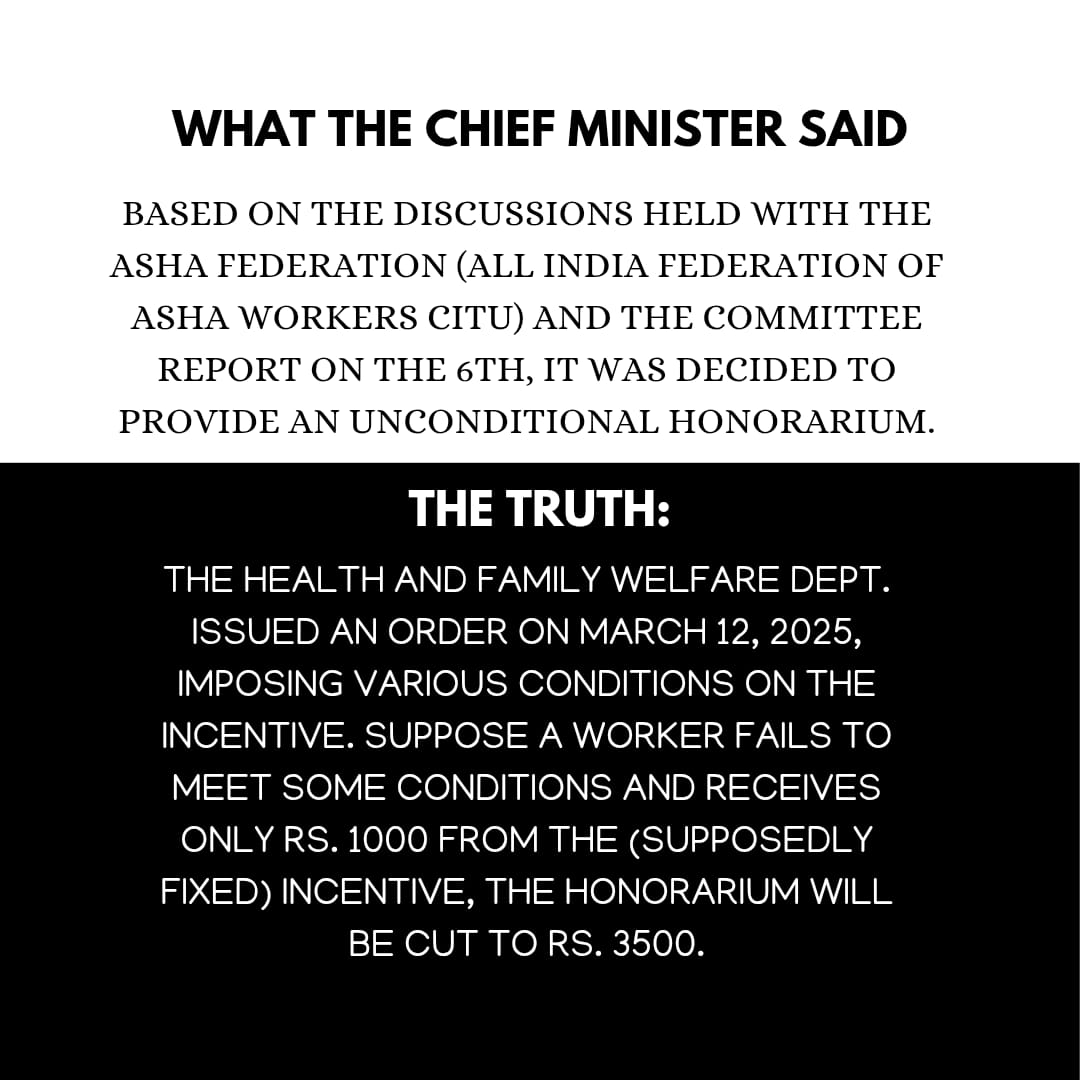
It is interesting how they don’t see that the real loser in this strike is the CPM alone. Each day, more and more intellectuals and independent progressive groups which extended full or partial support to the CPM are expressing their deep shock and condemnation at the CPM’s hateful, violent, response to women workers’ demands. It is as though the party leadership no longer feels necessary to foster such support — and so people ask, what, then, is the CPM leaning on? Adani? Since the government has been extra-generous with the Adani Ports?

A good thing that the strike has enabled is a rejuvenation of Kerala’s oppositional civil society which had almost completely capitulated to the CPM. Much energy had been spent in the past decade by the CPM in getting oppositional intellectuals, feminists, dalit scholars, intellectuals, and activists, artists, film makers, journalists and others to toe their line. CPM cyber armies have worked hard to attack, disarm, silence, and sideline dissident voices online. Academic spaces have been stuffed with beneficiaries of nepotism, reducing the academia to almost a CPM-toadie club, despite the academic achievements of individual scholars elsewhere. This was apparent even in the space of the Indian Association of Women’s Studies Conference held in Thiruvananthapuram in 2023, when dissident feminist voices were left out completely and CPM-aligned members from Kerala with scant credible scholarship took over the discussion about what gender issues counted here. This process, which seemed unrelenting, has been upset by the ongoing strike, because the sheer injustice, blatant untruths, repugnant half-truths, shocking hypocrisy, and criminal neglect of poor, evident in the government’s claims are too conspicuous. Indeed, the whole web of PR woven around the socially-developed women of Kerala has just unraveled, and the nakedness reveals nothing but the ugly misogyny of unrepentant patriarchy.

The manner in which the women workers seeking refuge in what they thought was a welfarist government — all they tried to do was to hold the CPM to its election manifesto promise of minimum wages to all scheme workers — have been shooed away, subjected to horrid patriarchal abuse and insults (including the ‘working-class-women-are-sheep’ theory which even Brinda Karat seems to hold now), is really very strange.
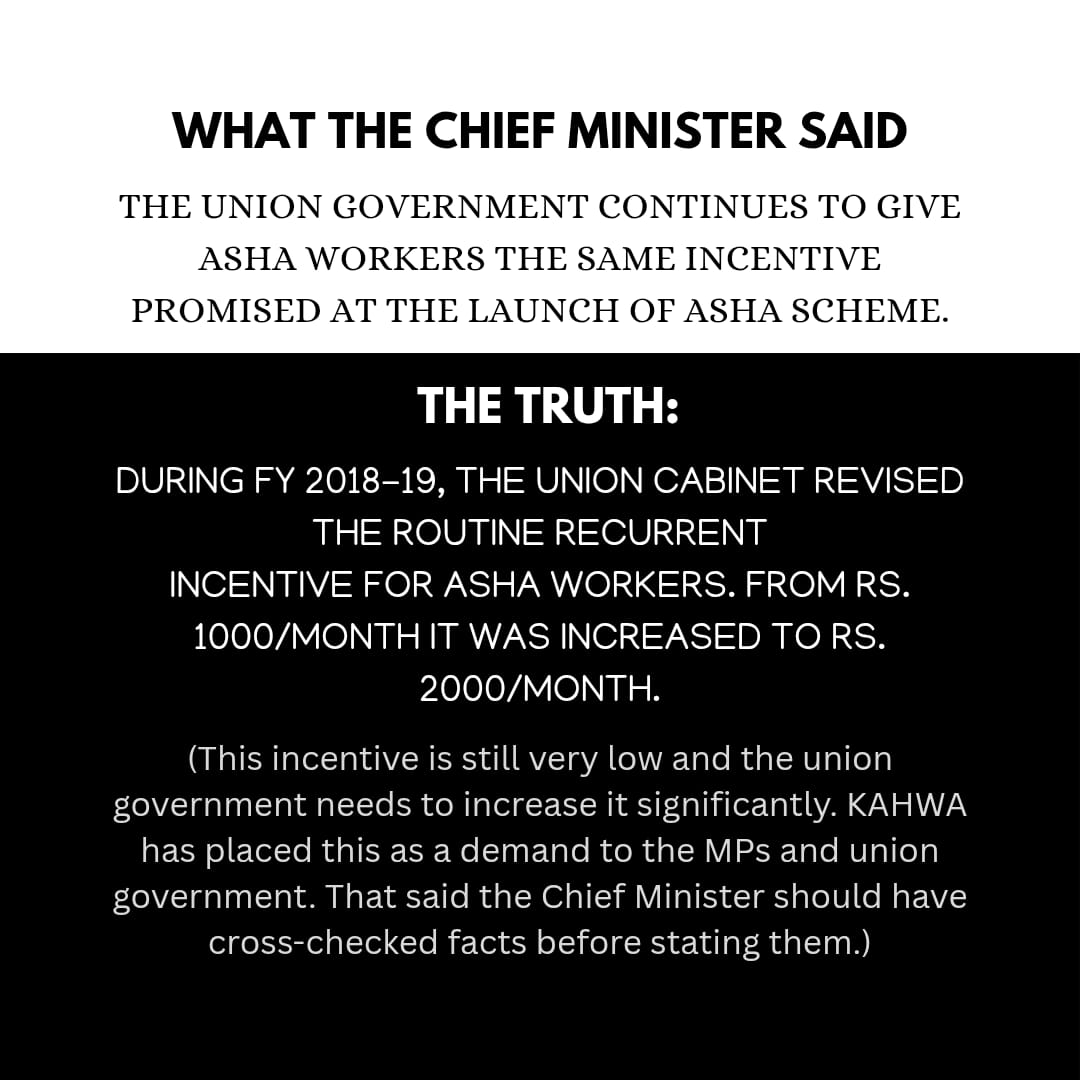
CPM supporters and leaders claim that the strike has been orchestrated to harm the CPM by the SUCI and that a victory will mean that this organisation will take all the credit. But this is such a foolish fear. The SUCI are a tiny presence in Kerala and definitely, in the past two months, it is the plight of the workers that has dominated public discourse on the strike. If the government would concede just a Rs 3000 monthly increase for now, the workers are ready to leave everything else to the committee due to submit recommendations in three months. One can only describe the CPM’s projection of the SUCI-CPM bad blood on a negotiation between the weakest of women workers in Kerala and their government for better wages and social protection as incredibly, suicidally, foolish. Citizens watching the massively-powerful CPM bully and threaten defenceless women workers are hardly noticing the SUCI; irrespective of whether the latter are present or not, the women workers speaking on TV are clearly articulating the extreme distress that they have to live with everyday. And the TRPs of those news stories have been only increasing.
M A Baby, who has just become the CPM’s National Secretary has made things worse. His opening salvo compared these peaceful strikers, these asset-less workers, with the formidable class interests behind the ‘Liberation Struggle’ of the late 1950s that brought down the first communist government in Kerala; that, understandably, pissed off many of his supporters and admirers who expected him to be sensible. His second remark seems to be a slide down from the foolish to outright idiotic — he declared that ‘identity politics’ is strengthening the sangh parivar …
Indeed, in sharp contrast to the CPM’s irresponsible blindness (irresponsible because if they continue on this course, they are going to be wiped out for sure, and Kerala is not going to be Kerala anymore), international support for the ASHA workers’ strike clearly agrees that this strike is an inspiration for progressive workers’ struggles, and not a hindrance. The solidarity letter sent by the International Trade Union Confederation (ITUC) to the Kerala ASHA Health Workers’ Association salutes the strike for its bravery, points out that it is part of the worldwide struggle of women workers to achieve recognition and formalisation for the hugely important and shamefully underpaid work that they do. It declares its determination to stand with every demand that the workers have made, including social protection, and notes that these are indeed central to the ITUC’s own goals of democracy that serves the needs of workers, and a ‘New Social Contract’ that ensures rights, equality, fair wages, and decent jobs.
Further, the letter acknowledges that the strike is not against larger worker interests, or the protests organised by the CITU-affiliated unions and others, that it cannot be falsely painted as BJP-induced, as the CPM cyberthugs have been claiming. In Kerala, the proposed 20 May strike has been projected as somehow ‘true’, while the ongoing KAHWA strike has been dubbed ‘false’. That this is the Kerala CPM’s deeply flawed, alarmingly irresponsible illusion is evident from the fact that the ITUC that clearly represents leftist politics and workers’ welfare, and which does not share in local insecurities.
The last two paragraphs of the letter read thus:
We join our colleagues in unions around the world and across India in calling on your government to recognize ASHA workers as public health workers and to meet again with your leaders to expedite a resolution that delivers for workers. Failure to do so sets a dangerous precedent at a time when far right, billionaire-backed political forces on every continent are accelerating their attacks on public health, public services, women workers, democracy and the interests of all working people.
You should not have to take these actions or endure these dangerous conditions to be heard and respected. You are entitled as workers to all that you are demanding. Even so, your courageous strike and unity of purpose will no doubt prove that collective action can shake the consciences of those in power. As our union comrades across India embark on a general strike on 20 May, and as unions across the world demand democracy that delivers what workers need, we look to your example for inspiration.

I no longer know who to turn to — the CPM is now so paranoid that anyone offering just a word of caution, even, is perceived as a dangerous enemy. Many of us — intellectuals, writers, scholars, and others — have had a love-hate relationship with the dominant Left here, and it was actually a productive relationship at least till 2014. Till then, even though the CPM had no love lost for its critics, much criticism was absorbed by the government, even if in truncated or partial form. Post Pinarayi, and post-social media, this connection has been depleting, and it is now gone, I think.
I am writing to the members of the IAWS because you have been consistently advocated for visibility, recognition, social protection, safety, and fair and equal wages for women workers in India. You have worked tirelessly to point to the significance and importance of women’s work at all levels of our economic, social, and cultural life. You have also engaged with policy and politics over these issues. I call upon you to help us to make our government and the CPM see better sense.
Actually, I am trying you like someone witnessing a suicide attempt trying a suicide helpline desperately. I hope someone will pick up at the other end, that someone will help. Please write in large numbers to the Kerala government asking it to come back to its senses soon.
[The slides in response to the CM’s alarmingly ill-informed or ‘politically motivated press conference remarks were prepared by a group of young feminists including Archana Ravi, Shraddha, Babita, and Devika.]
 KAFILA - COLLECTIVE EXPLORATIONS SINCE 2006