
Guest post by NITHIN JACOB THOMAS
Recently, the students of the University of Hyderabad were protesting the Telangana state government’s bulldozing of 400 acres of ecologically vibrant, species-rich land within the university, undertaken as a preparatory step to auction it off. The state government sought to quell the protest by force, asserting that the land does not belong to the university and that it is within its rights to auction it. However, the Supreme Court has intervened and stayed the activities for the time being. Ego-bruised by the setback they have faced at the hands of the campus community, the Telangana government has now proposed that the entire 2300 acres of the university be turned into an eco-park, uprooting the campus in toto to a hundred-acre campus on the city’s outskirts.
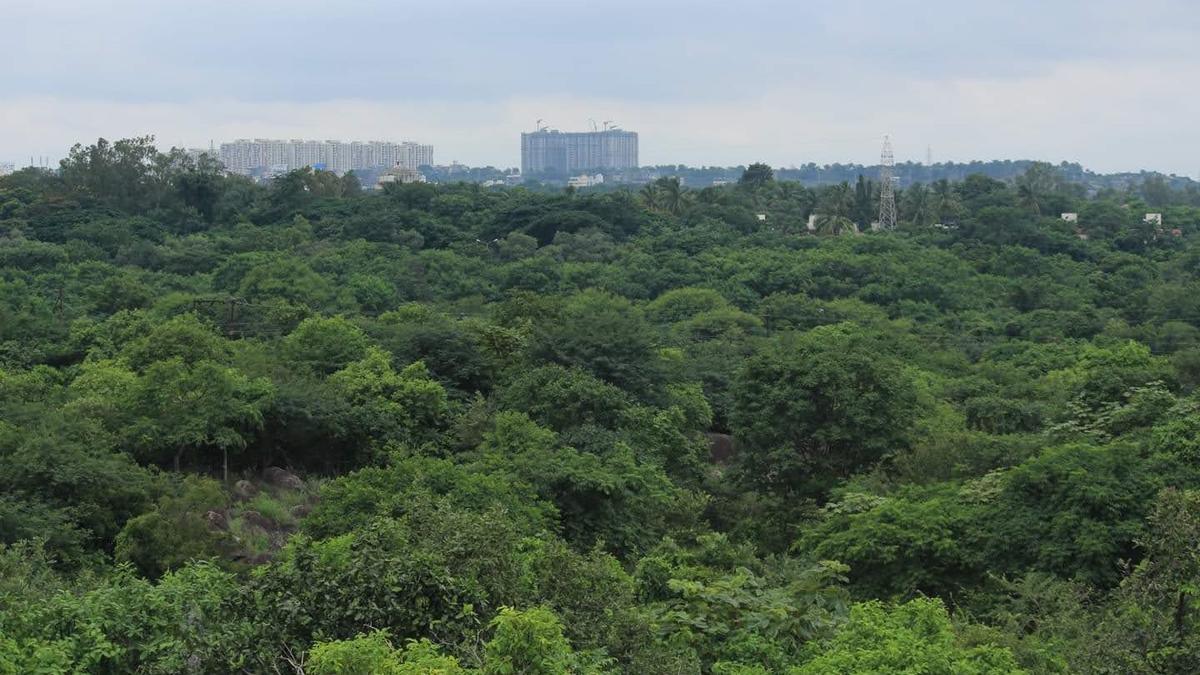
Strangely, the university has not secured legal rights for the land it has occupied for several decades. However, the emphasis in the following note is on an aspect of the protest that lies beyond the legal dispute over ownership. It rather seeks to articulate the inarticulable—why the preservation of the ecology of these 400 or 2300 acres is not a standalone question but one that co-constitutes the very question of preserving the university itself.
The students emphasise that this ‘forest-like’ area is the lung of the city that is otherwise steadily transforming into an urban jungle – with all its accompanying ailments. Numerous studies support the students’ claim that university spaces – not just UoH but across many cities in the world—often serve as the last refuges of biodiversity and greenery in urban spaces. The therapeutic and aesthetic significance of an ecologically vibrant space for an educational space itself cannot be overstated, even outside a Tagorean or an ecopedagogic view. However, to articulate the ‘benefits’ of a biodiverse space in a university within a vocabulary of utility is already a compromise. Because what students are protesting, I think, is not only the clearing of 400 acres but also the sacrificial calculus underlying that decision. In doing so, the students are torn between speaking a tongue the modern state is ill-equipped to understand and translating it in the language of utility. In other words, the students are protesting the state’s capitulation to the neoliberal idea that the sole metric of worth is that of the market. Contrary to the traditional theories that suggest sovereignty is eroded by the market, neoliberal states exercise sovereignty precisely by abetting markets – through processes of legitimisation, expropriation, and the diversion of resources, including land. For the state, therefore, an ‘under-utilised’ land in the middle of the city makes no sense.
Social science students in the university would tell you how this capitulation to the market is enabled by ‘disenchantment’—a prioritisation of efficiency and calculation over ethical, affective, and spiritual considerations. So, the state can only be baffled by students calling the rock formations, the lakes or the vulnerable species, like star tortoises, part of their ‘home’ or integral to their academic experience. This attribution of non-instrumental worth is something that evades the market. As the Canadian philosopher Michael Sandel observes, we are living in a time defined by ‘the reach of markets and market-oriented thinking into aspects of life traditionally governed by nonmarket norms’. But it is important not to miss that the ‘traditional’ domain of nonmarket norms is also a highly contested, emergent space, one in which the marginal communities assert themselves and seek to reconstitute normativity. Market as the sole, purportedly objective evaluator of worth, hence, must also be understood as a reifying force that crystallises the biases of existing normative order. This crystallisation is a masked aspect of disenchantment. Public universities in general, and University of Hyderabad in particular, have been at the forefront in resisting this crystallisation, never relenting in their efforts to reimagine the social ethic. So, an enchanted campus carries no suggestion of a closure of meaning.
I did not entirely distrust the state government’s assurance that the development of IT parks in this area will not alter rock formations or lakes in this area, for they may still possess an instrumental appeal for the aesthetics of proposed IT parks. But it is now reported that the Telangana government proposes to construct an eco-park, instead of the IT park, by sequestering not just the 400 acres but all of the 2000-plus acres of land in which the university is currently spread out. According to news reports, it proposes to relocate the university to a hundred-acre campus on the outskirts of the city. While this may, at first glance, appear to be an ego-bruised response to the resistance the government has faced, the proposal bears witness to the failure of the state to understand how the questions of the preservation of a public university and preservation of ecology co-constitute each other. As I have pointed out, floating the idea that a university could be packed off at will betrays a view of the university as a disenchanted space – populated by space-efficiently packed multi-storey buildings and human beings whose metrics of worth are that of a market.
The neoliberal market has more than proved its ability to circumvent ecological concerns with measures like the carbon-credit system and compensatory afforestation that fall well within the instrumentalist framework. Disenchantment thus permits the compensation of what cannot be compensated, trading off what cannot be traded off, and negotiating what cannot be negotiated. The latest in a series of measures born out of the state’s collusion with the market was the 2023 amendment to the Forest Conservation Act (FCA). By limiting the protection of the FCA to lands declared or notified as forests, this amendment effectively circumvents the Supreme Court’s judgement in T.N. Godavarman Thirumulpad v. Union of India and Others (1996), which had clarified that the term ‘forest’ must be understood in its broad, dictionary sense – thus extending protection to all forests, regardless of ownership or classification. This amendment may prove fatal for the land now in question.
So, I think, the students are protesting because they are intuitively aware that the state is able to do this – to appoint the market as the sole evaluator of worth – to the ecology because they know it also does the same to education. The way the state commodifies and rationalises land use mirrors how it treats education. We may try to understand this in terms of a contrast between the buzzwords ‘knowledge-economy’ and ‘knowledge-ecosystem’. The market-driven calibration of education aims at producing a skilled and standardised workforce where the metric of productivity rules the roost. This leads to the defunding of social science, humanities, and art disciplines. ‘Knowledge-ecosystem’, conversely, is more open to valuing knowledge with intrinsic or social metrics of worth. The ascendancy of the knowledge-economy over the knowledge-ecosystem is, therefore, part of market triumphalism. This triumphalism undergirds the state’s understanding of what it may do with an ecologically vibrant area within a university. For a state that looks to facilitate a knowledge-economy, 400 acres of underutilised land is far from a pedagogic need. Public universities, where students from marginalised communities – many of them first-generation learners – study, are expected to survive on the bare minimum. Meanwhile, the domain of higher education is increasingly conquered by private universities, which cultivate green spaces as commodities to be sold. This brings us to my title question: how much land does a university want? We can overcome the market’s metrics of worth only by critically blurring and effacing the distinction between want and need. To be sure, neoliberalism itself is interested in this blurring, as it wants to present many of its non-essential goods as needs. But, simultaneously, it also tries to make this distinction pronounced to cart off many of our necessities as wants, which then could be sacrificed for more tangible ‘development’. This, as I said earlier, is the process of disenchantment. A knowledge-ecosystem, in this sense, establishes education as an enchanted experience that embeds learners into a wider network that involves other human beings, open spaces, the rock formations, the lakes, and the star tortoises. The state cannot fathom what it means for students to live as neighbours to a vulnerable species because such cohabitation speaks a language unintelligible to the market. However, the students of the University of Hyderabad and their politically pulsating campus have always been shaped by that embeddedness. As difficult as it may be for the state to grasp, what is at stake for them is not 400 acres adjacent to the university but the university itself – which must remain a sanctum, unyielding to the saturating metaphor of the market.
Nithin Jacob Thomas is a PhD research scholar at the University of Hyderabad and knows the campus directly from the year 2012.
 KAFILA - COLLECTIVE EXPLORATIONS SINCE 2006