
Guest post by BONOJIT HUSSAIN
I did not come to the village to do research. I came to farm for the market—and to do it without breaking the village’s social and ecological ledger. I returned as a nephew and a neighbour. For six years I have lived inside this world of muddy fields, failed pumps, anxious harvests, and commonsense wisdom passed across haat stalls. Six years on, I am only now seeing a glimmer of hope for a workable path.
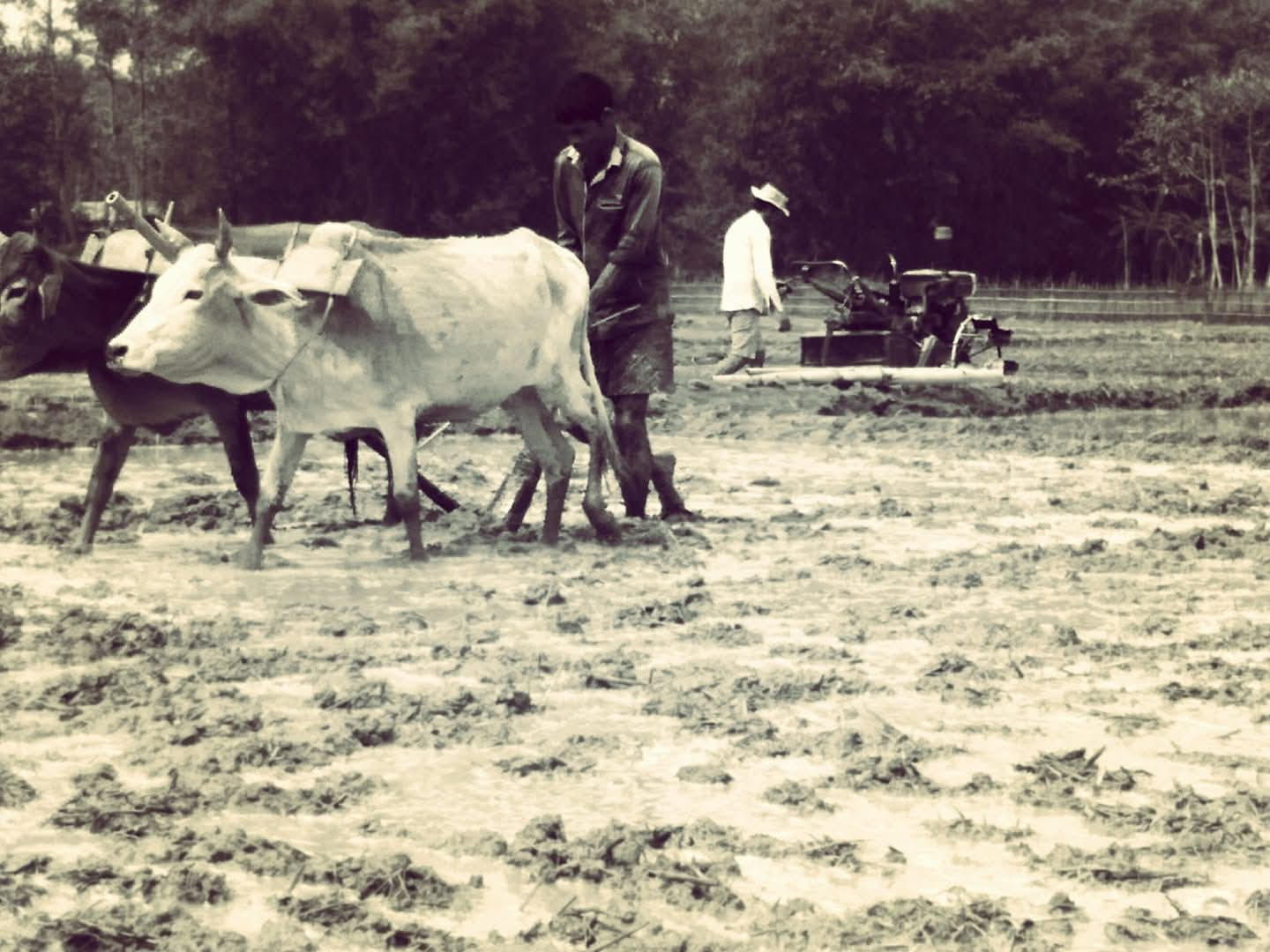
What I write here is not sociology in the professional sense, but a testimony from within the living contradictions. My focus is on the choices and constraints of the khilonjiya peasant household—native, often subsistence-oriented communities whose economic logic is deeply tied to ecological and social reproduction. This is a distinct reality from the highly commercialized production systems found in some other parts of the state.
- The teacher’s field
A quiet irony marks rural Assam: some of the most capable growers of vegetables, fish and fruit are government school teachers. They are not outsiders; they are part of peasant society. So common is this figure that regional media reach for the same filler across TV, print, and digital: the educated, economically successful farmer—often a school teacher. What sets them apart is not primarily a superior agronomic wisdom so much as the simple fact of a monthly salary, which covers household consumption while crops and fish mature, and which lets a household absorb a shock without straining relationships.
Take Camerina Rabha, a high‑school teacher from Goalpara. During the COVID‑19 lockdowns she turned a narrow strip of homestead land into an organic vanilla patch and, because she could afford to wait and tinker, made it pay. That cushion of income did not replace labour or care; it simply lowered the risk of trying something that might fail once before it succeeded.
Over six years, I’ve often posed a provocation—in conversations, and, most recently, a Facebook thread: the most economically successful figure in local homestead farming is often the teacher-peasant. While they may not out-produce dedicated peasants in gross volume, their stability allows them to consistently market a surplus. The responses always split the same way. A corporate friend, genuinely puzzled, asks where the time could possibly come from. A rural teacher simply lists his crops—ridge gourd, bitter gourd, pumpkin, banana, colocasia—as if the question were absurd. What seems impossible from a distance is, for them, daily routine.
The core insight isn’t mystical: salary behaves like low‑interest, always‑available working capital. It secures the kitchen and reduces short‑term risk, so teachers can experiment, wait out a bad price week, invest in fencing or seed, and build steady relations with the market. In short: what many khilonjiya peasants need is what teachers already have—stability.
- Credit and the Household Ledger
This gap between policy and practice echoes a question I heard recently in the lounge outside a prime‑time TV studio. A retired Deputy Director of Agriculture turned to me with a simple question: “I have seen farmers in many states farm neatly for the market. Why don’t farmers in Assam do the same?” Nearly a century earlier, Laksheswar Barthakur—then in‑charge Deputy Director of Agriculture—told the Royal Commission on Agriculture in 1926 that much official work was not suited to cultivators’ real needs or to their mentality. He also remarked that trade in the valley was largely in Marwari hands and that middlemen reaped large profits at the expense of cultivators, who saw little benefit from price movements. The question has not changed because the conditions that shape the ledger have not.
On paper, farm credit exists; in practice the Kisan Credit Card (KCC)sits behind timing, paperwork and risk. Eligibility is narrow: many with operational holdings—most peasant households—lack the papers banks ask for; patta and mutation delays stall files; many active cultivators are invisible to the system.
When households do invest a little to lift surplus, they borrow small and fast—from the village thrift/credit society or a private micro-finance line; if that falls short, from neighbours or a rotating savings group. Dealer- or trader-tied (“embedded”) loans are rare here. The money arrives on time but at a higher effective cost, often with group liability and tight weekly collections; the tempo fits the field.
Households treat KCC as shock capital rather than working capital. It moves to what cannot wait: a latrine, medical bills, a wedding, house repairs or replacing a tin roof.
I see two KCC patterns: some use it for non‑farm shocks and repay; others, plugged into wider networks, don’t—and files sometimes go dormant. In both cases the lesson is caution.
That is why the conservative strategy—eat five kg, carry ten kg to the evening or weekly haat—remains rational. Borrowing without buyers, storage, and insurance is betting the harvest. Stability first; then markets.
Without reliable credit, peasants turn to paddy not just for grain but for social and ecological security.
- Why every household must sow paddy
Whatever else a village may plant—mustard, pulses, gourds—the pressure to sow paddy remains immense. Outsiders call this “tradition,” as though it were a stubborn habit surviving from the past. Seen from inside, it is a social‑ecological enforcement mechanism that protects everyone’s crop by aligning everyone’s behaviour.
If a plot lies unsown while nurseries are raised and fields are puddled, it becomes a temptation. During transplanting, any untied herd will head for the open green; even one crossing can damage the neighbour’s seedlings. Ridicule—“they could not even sow a bigha”—is not a quirk of culture but a form of social signalling that keeps the informal contract intact: once the season starts, cattle are on a rope.
This contract is actively enforced in the haat. It is not just ridicule. More often, it is public anger and shaming. Sitting at a tea stall, you will hear a complaint launched like a formal appeal: a farmer will describe a neighbour’s straying animal that grazed on a nursery, but start the story not with a description, but with a question to everyone present—“Dekhisa ne?” (“Can you see?”). This is not a request for intervention, but a demand for collective witness. The community’s nod, their shared murmur of acknowledgment, is the verdict. It reinforces the norm.
This is moral economy in practice—a shared protocol for managing ecological risk.
- Monsoon fodder: the real crisis
Why, then, do neighbours graze those unsown plots and invite quarrels they would rather avoid? Because monsoon fodder scarcity is real. When fields sit under water or under paddy, and grazing commons have shrunk with settlement and erosion, there is nowhere close to take animals. An unsown patch, despite the social risk, is often the only immediate source of feed.
By Ahin–Kati months (mid‑September to mid‑November) cattle body condition declines; ribs are visible. Wheat bran at around Rs. 32 per kg is not a daily option for most households. Straw alone will not keep an animal thriving, yet without straw many will not make it through the autumn.
This is the second face of the paddy imperative: rice is sown for grain, but also—critically—for straw; even households without cattle cut paddy for straw because it sells (about Rs. 1,500 per bigha). Buyers are usually land‑owning families who have sharecropped out their fields (they receive grain but have no claim to straw), or salaried teachers keeping milch cows and using straw as feed and mulch.
But the ledger does not end there. Like fodder, fish are a critical ecological yield that paddy fields provide—a major source of free protein. Once the rains arrive, various types of bamboo traps and fishing nets are prepared. The fish themselves are a common‑pool resource: they belong to no one until caught, and access is open to all, irrespective of who owns the plot. The universal rule is clear: the harvest belongs to whoever placed the trap. This entire system requires no purchase of feed or fingerlings; it is a pure ecological yield. To poison the water with herbicides and pesticides is to poison this hidden, protein‑rich cache for the entire community.
This logic also explains the pragmatic refusal of blanket herbicide and pesticide advice. The “Package of Kharif Practices” published by the agricultural university urges clean bunds to deter pests; traditional wisdom often agrees. Yet resilience sometimes requires breaking both the university‑produced science and tradition: leave the grass on the bund. As the monsoon ebbs, sweet grasses grow; you scrape them with a sickle and carry home a crucial bundle of fodder for the cattle. In lean weeks that armful is often worth more, in that week, than a manual’s recommendation.
- The machine that left the village
Harvesting paddy, in practice, is about grain and straw together. Cut by sickle, one person needs five to six workdays to finish a bigha, which at village wages comes to roughly Rs. 2,000–Rs. 2,500.
Since the pandemic, a new pattern has emerged. Workers of East Bengal origin from the Mukalmua chars—mid-Brahmaputra, the southern edge of Nalbari—arrive during the 15–20-day harvest window, bringing a different farming logic. Mukalmua ghat is about 34 km from our village; many come from Siyalmari charand travel north as far as Darranga Bazar at the Bhutan border (Samdrup Jongkhar district). They charge Rs 1,600–2,000 per bigha, plus food items, firewood for three meals a day; they bring their own utensils and cook in the field. They reach the field by 5 a.m. and work late into the dark if moonlight allows.
This efficiency is born of a different agrarian reality. These are commercial farmers from the lowest‑lying chars and floodplains of the Brahmaputra. Their worldviews and rationalities are shaped by a high‑risk, high‑input calculus: they sow summer paddy or irrigated hybrid Boro (Feb/March to June) and produce around 35 maunds of paddy on average per bigha. By the time they arrive here for our harvest, they have already sown hybrid maize and rabi vegetables back on their own land, which they will harvest from January to March. Their calendar is a tightly packed sequence of commercial crops; their migration for our harvest is not a break from farming but another enterprise to increase monetary inflow within it.
Only the creamy layer in our villages can pay fully in cash, so most households negotiate payment in kind: two to three maunds of paddy per bigha. This seems like a crippling cost until you understand the rest of the ledger. Most peasant households are operational holders, not owners; they must also pay a further one to four maunds to the landowner, a share negotiated on the yield potential of the plot—common knowledge in the village.
A purely monetary calculation would suggest a huge loss. But this ignores the ecology of the household itself. From sowing onward, almost no cash is spent except for one critical input: tractor rental for tillage. Beyond that, the household relies on family labour; where extra hands are needed, they are exchanged with neighbours or paid in resources they own—I have often seen a day’s wage settled with five bhaluka bamboos (around Rs 500) to repair a house or cowshed. The paddy paid at harvest is, in effect, the conversion of a season’s non-cash investments into a settled debt. It is the final step in a long chain of non-monetary transactions.
While Assam government figures put the state’s average kharif yield at roughly 7 maunds per bigha, in our region 10–12 maunds is standard, and 15 is a celebratory harvest. Yet despite this higher yield, paying 2–3 maunds to labour and 1-4 as rent represents a substantial portion of the harvest—one that is negotiated not in cash, but in kind. This flow of paddy as wages is made visible at the end of the harvest window, when small trucks from the Bhutan border move along our market road collecting this payment and carrying it back toward Mukalmua ghat.
This logic of valuing straw above pure cash efficiency was put to the test three years ago when combine harvester arrived from Uttar Pradesh, charging Rs. 400 per bigha including threshing (normally only threshing costs Rs. 400). By the next evening, we decided to stop using it. The problem was not the grains but straw: its blades chopped the stems into several fragments that pile badly, rot quickly, and that cattle refuse to eat. In balance sheets it looked efficient; in the winter cowshed it proved problematic. Faced with that ledger, we chose straw and sent the machine away.
This rejection of the combine harvester, however, is not a rejection of technology itself. The peasant adopts technology strategically, based on a simple calculation: does it strengthen the ecological ledger, or does it break it? The embrace of the mechanical thresher provides the perfect contrast. Unlike the combine, the thresher does not shred the straw. It separates grain from stem, reducing the immense drudgery of threshing with bullocks and winnowing with kula and saloni—a task that falls largely to women. Peasants note its one flaw—some grain kernels are lost with the straw—but this is quickly remedied. After threshing, the women of the household winnow and recover at least a maund of grain. The thresher is embraced because it eases labour without threatening the winter fodder supply; it fits within the ledger.
This strategic calculus applies even to technologies with a cost. The tractor and rotavator (“rotar”) have been universally adopted for their ability to replace a month of tremendous drudgery with bullocks with a couple of days of work. Yet, in the haat, you will hear men lament with precise ecological insight: the rotar is blamed for the dwindling cache of wild fish. They explain that the machine’s rapid tilling operations coincide with the fish spawning season, crushing the eggs and juveniles. Here, adoption comes with a conscious acknowledgement of loss—a tear in the ecological ledger. The utility in reducing backbreaking labour trumps the damage, but the trade-off is known and stated. This is not ignorance; it is a calculated choice under constraint.
The key insight, therefore, is not that peasants refuse modern tools. It is that they accept them on terms that allow their core system of survival to remain intact. The ledger is not static; it is a living, adaptive system that incorporates what it can and rejects what it must.
This leads us to the fundamental lesson: peasant choices obey an ecological ledger that conventional cash flow imperatives rarely capture. Resilience precedes efficiency; dry fodder outranks per bigha savings.
- The rice‑fallow as a temporal commons
The commitment to this ecological ledger extends beyond the harvest itself, governing the life of the field once the grain is gone. From the highway it’s easy to say that fields lie idle for six or seven months and that the free rice distributed through the Public Distribution System (PDS) and other welfare schemes have made people complacent. From within the fields the story runs differently. Once the grain is in and the last paddy bundles carried home, private claims loosen and the land becomes what I call a temporal commons.
This is distinct from a “seasonal commons,” where the resource itself is common property. Here, the title remains private, but for a bounded window, the rights of access and withdrawal loosen. Exclusion relaxes: anyone may glean stubble, graze cattle, or forage greens. The field is governed by commons logic in time, not in law. When the window closes, exclusion tightens again and the field reverts to private management. This is why any attempt to farm year-round—like my zero-tillage potato experiment—collides not with a law, but with the village’s entire ecological ledger of paddy, fodder, greens, and fish.
In most khilonjiya villages, no single axis of social domination is strong enough to foreclose access to the temporal commons; access is negotiated and often conflictual around what counts as ‘proper’ use and transgression.
Much of this commons phase is gendered: women’s gleaning and greens-gathering anchor protein and fodder flows, while sanction—the “Dekhisa ne?” witness described earlier—is publicly performed by men.
In 2022, I learned how deeply this norm is enforced. I had planned for months to try zero tillage potato on a three-bigha plot. The technique involves planting seed tubers directly into the unploughed soil and covering them with freshly cut paddy stubble as mulch to trap residual moisture. Timing is everything: the grain must leave the field at once and the stubble must be laid immediately before the sun dries the soil.
On the morning we were to start harvesting the paddy, about 15–20 men from my and neighbouring villages stood waiting with bicycles, sickles and bundles of bamboo tongali. They had come to harvest my paddy collectively. Their payment would be simple: the right to cut and take the stubble home for their cattle.
I was on a tightrope. I folded my hands and explained the experiment: I needed the stubble on the field. Faces fell; they pushed their bicycles away. Since then many of them kept a cold hi‑hello. It took us three working days to harvest and move the grain. On the fourth morning, as we began cutting the stubble, two women arrived with tethered cows to graze. When I stopped them they said, “Once the harvest is home, the field no longer belongs to you alone.” I lost my temper: “Who owns the land, you or me?” The younger woman, perhaps in her mid‑twenties, stared and said, “You are breaking a seven‑generation tradition.” Only recently have we started nodding to each other again. This incident is not stubbornness; it is evidence of the commons. Residual moisture and sunlight allow herbs and leafy greens to grow in waves. Cattle graze there through the winter to late spring. From November to April people collect edible leaves, each fortnight bringing a different wave. My experiment, which treated the field as a private asset year‑round, clashed directly with this shared understanding of seasonal use.
By Bohag Bihu this seasonal abundance comes together in a ritual dish—“101 greens” cooked in one pot; among Bodo people in our neighbouring villages, it is called Gwkha–Gwkhwi. Those leaves are gathered from rice‑fallows, bund edges, bamboo groves, wetland margins and homestead patches. The dish is both a meal and a memory device: it preserves knowledge about edges—what grows where and when, which leaves a cow prefers, which weed eases a stomach. To misread this system as idleness is to guarantee the failure of any intervention designed for it.
- Against the laziness myth
After six years inside this life I am persuaded that what looks like reluctance is, more often than not, prudence. Subsistence is not backwardness but a hedge against high‑risk credit and fixed schedules; the teasing in the haat is not decorative culture but a way of coordinating behaviour in a constrained ecological system; the weeds on a bund are not ignorance so much as autumn greens and bovine calories waiting for the right week; refusing a Rs. 400 harvester is not obstinacy but a way to protect fodder; the teacher’s “success” is less an outlier than a demonstration of what stability allows ordinary households to do. Ultimately, every one of these choices is a defence of a life with dignity—the dignity of ensuring survival without falling into the wretchedness of debt and destitution that plagues so much of the Indian countryside.
Assam’s agrarian reality is not mainly a chronicle of failure. It is a complex system that runs on an ecological ledger, accounting for straw and fodder, for shame and solidarity, and for resilience in a landscape made more failure‑prone by past engineering intended to stabilise it.
The teacher’s field, in this light, shows a broader design principle: stability first, then markets.
This suggests that smallholding, sustainable farming can be highly productive without needing corporate supply chains or speculative agriculture. The teacher’s experience points toward a different possibility: a market that serves the producer, rather than the producer serving the market. In this logic, the market is a tool for exchange, not an engine of extraction. Producers, once buffered from the worst price and weather shocks, can engage with buyers on terms that also sustain their ecology and social life. Markets, after all, long predate capitalism. The central question is not whether to use the market, but how to shape it—so that its operations serve stability first, and surplus second.
To be clear, this is not an argument for the preservation of precarity. The fragility of this existence is exhausting and often brutal. The argument is rather that within this context of precarity, the choices made are not signs of ignorance but of intelligence—a form of resilience that should be understood and supported, rather than ridiculed and replaced with schemes that worsen the fragility.
So, to return to the question posed in the television studio lounge: “Why don’t farmers in Assam farm neatly for the market?” The answer is that they are farming for a different, more complex, and more vital market—one that trades not only in cash but in straw, protein, fodder, and social cohesion. They are balancing an ecological ledger that the formal market ignores. This resilience is not a separation from the market; it is a strategy for managing their integration into it on terms that prevent destitution. They are not failing to adopt a commercial model; they are succeeding, against immense odds, in sustaining a life. The question is not about their practices, but about our failure to see the logic within them.
It is crucial to remember that this subsistence system and its ecological ledger do not operate in a vacuum. They constantly interact and negotiate with other systems—state-led welfare schemes, migratory labour networks, and commercial capital—at the everyday level. But that intricate interplay is the subject of another piece.
I began with Camerina Rabha not because she is singular but because her story is legible to readers who do not live here. The deeper truth is carried by those without her cushion, who, at dusk, lift a bundle of sweet grass from a bund and take it home—not rejecting progress, but balancing a biological necessity that the market does not account for.
For Amrapali Basumatary—who kept us steady when the fields didn’t.
Acknowledgment. Early versions of these arguments were presented in a lecture at a conference on Assam’s land issues at Dibrugarh University, co-organised by ActionAid and the Department of Social Work.
Note on terms and sources. “Moral economy” follows E. P. Thompson (Past & Present, 1971) and James C. Scott (The Moral Economy of the Peasant, 1976). “Commons” is used in Elinor Ostrom’s sense (Governing the Commons, 1990); “temporal commons” is my term that names a time-bound commons phase within private title, where access/withdrawal open under village rules after harvest and re-tighten later; this is distinct from “seasonal commons,” where tenure itself is collectively held for a season. “Ecological ledger” is also my term for the household accounting that balances straw, fodder, wild-fish protein, time, labour, cash, and social sanction across seasons. It is important to note that the specific constituents of this ledger—the weight given to straw, the timing of the temporal commons, the specific norms of enforcement—will vary across the diverse ecological and social landscapes of Assam. This account is drawn from the context of Nalbari. Assam-specific points on trade, middlemen, and cultivator incentives draw on the Royal Commission on Agriculture in India, Evidence Taken by the Royal Commission on Agriculture in India: Assam (Government of India, 1927), especially L. Barthakur.
Glossary (Assamese & local terms)
Khilonjiya — native/locally rooted
Haat — weekly or evening rural market.
Tongali — bamboo shoulder yoke/carrying sling for harvest bundles.
Bigha — land area unit; in Assam ≈ 14,400 sq ft (~0.33 acre); varies by State.
Maund — grain measure; varies by market (~37–40 kg) in Assam.
Bohag Bihu — Assamese New Year (mid-April); seasonal time-marker.
Kula, saloni — bamboo winnowing tray and fan for cleaning grain.
Bhaluka (baah) — thick-walled bamboo (Bambusa balcooa) used for house/cowshed work.
Char — Brahmaputra riverine sandbar/island, often inhabited/farmed.
Ghat — river landing/crossing point.
Rabi — winter cropping season (Oct/Nov–Mar).
Boro — traditional summer rice (Nov—Jun; irrigated summer rice (Mar–Jun) in Assam.
Rotar — village shorthand for rotavator (tractor attachment).
Patta — land title deed; mutation — update of land records to reflect ownership change.
Bonojit Hussain is a farmer and independent researcher based in Baridatara village, Nalbari district, Assam.
 KAFILA - COLLECTIVE EXPLORATIONS SINCE 2006
One thought on “Teachers, Straw, and the Combine Harvester – Peasant Household’s Ecological Ledger in Assam: Bonojit Hussain”