
Guest post by S.M. FAIZAN AHMED
[The author writes about the current scenario, reflecting on the one hundred years of the communist movement as well as of the RSS. In these important reflections Ahmed recounts the great achievements of the communist Left, while at the same time speculating on where the RSS scored over it – leaving us with a number of questions to seriously ponder about. – AN]
On October 1, 2025, a day before Gandhi’s birth anniversary, long revered and associated with ahimsa and moral conscience, the government unveiled a ₹100 coin at the Dr. Ambedkar International Centre, 15 Janpath, marking a century of the Rashtriya Swayamsevak Sangh. A day earlier, as if to turn ideology into spectacle, a Shakha parade, named Path Sanchalan, traced its way through Jawaharlal Nehru University—once a fortress of dissent and the audacious poetry of thought. The rhythmic march of uniformed bodies through corridors once alive with debate did more than display ceremony; it signaled a shift in the republic’s moral conscience, where the choreography of discipline seeks to mute the dialectic of doubt, and the university—once a sanctuary of questioning minds—becomes a stage for the theatre of obedience.
The convergence of time and place was anything but accidental: the day of the Mahatma, the hall named after the architect of the Constitution, and the celebration of an organization whose vision of India has long stood in profound tension with both. In that triad of symbols—the saint of non-violence, the legislator of equality, and the so-called custodians of a majoritarian faith—one glimpses the slow redrafting of the nation’s moral script. The republic’s ethical vocabulary is being rewritten: protest is recast as disloyalty, conscience as dissent, and remembrance itself as a solemn ritual in the theatre of power.
A Century in Waiting and Celebration
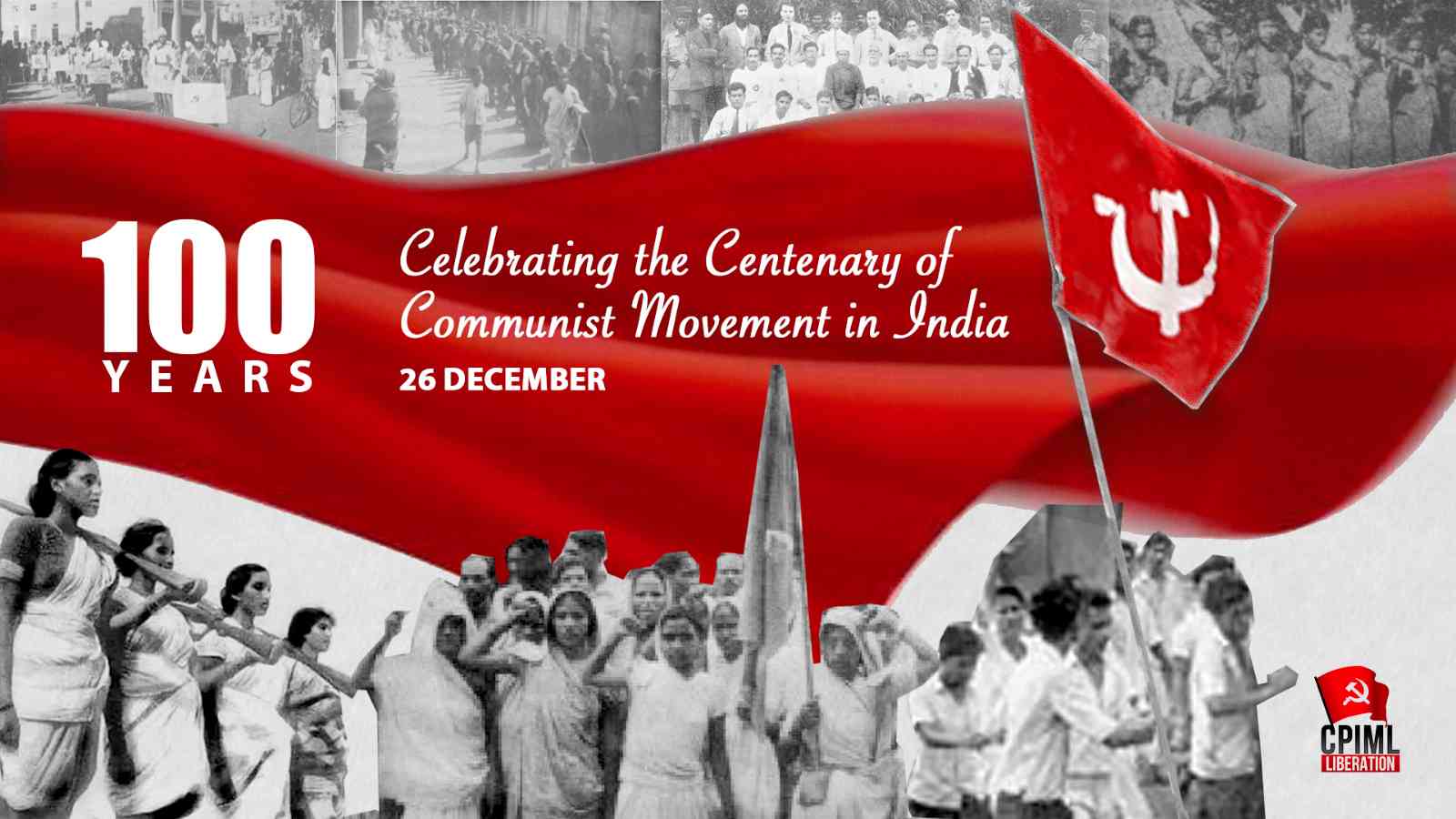
The history of the Indian Left is not a ledger of votes won or seats lost. It is a century-long epic of yearning, carved into the soil by workers, peasants, students, and dreamers who dared to imagine another India. Its essence cannot be reduced to statistics or manifestos—it lives in the rhythm of slogans that once shook the streets, in uprisings that lit forgotten villages, in patient assemblies where comrades debated the destiny of a people. The Left sought not merely power but the very essence of justice, democracy, and equality.
From Kanpur in 1925, where communists first gathered in secrecy, to farmers’ encampments along Delhi’s highways a century later, its milestones shine like constellations across a turbulent sky: Telangana, where peasants seized land and dignity; Kerala, 1957, the first ever red-flag government in the world formed through the ballot; Naxalbari, where a spark threatened to set the subcontinent ablaze; Operation Barga, where tillers reclaimed both harvest and agency. These were not remote episodes but living metaphors of what India might yet become. Each triumph carried its wound; each defeat preserved a shard of hope.
The Indian Right, too, traces a century of fervent milestones and reckonings. Both Left and Right have faced the state’s bans, yet the balance of repression has tilted sharply. The Left endured longer and harsher prohibitions—charged with sedition, subversion, and class war—its struggle seen as an existential challenge to state authority. The Right, by contrast, has faced only brief suspensions, usually after bursts of communal violence or political unrest. This contrast lays bare the republic’s shifting anxieties: a state that feared rebellion more than reaction, revolution more than riot. Yet, for all its vision, the Left often faltered where history demanded imagination, strategy, and tactical foresight.
The slogan “one step forward, two steps back” was observed with far greater discipline by the Indian Right than the Left. While the Left, even after forming the world’s first elected communist government, remained issue-driven and measured gains in isolated milestones, the Right pursued a long-term, missionary strategy. From sharing power in the Janata experiment to leading the Ayodhya movement, every setback was absorbed into a larger design. The inauguration of the Ram Mandir was never the end but a waypoint, its agenda pressing steadily onward.
Capital and Culture: Veiled Terrains of Power
All political traditions forged in struggle carry a ledger of triumphs, betrayals, and the long shadows of what might have been. A hundred years is a long time to remain at the margins, never claiming the centre with full authority, never commanding an unequivocal mandate. In my estimation, the Left understood politics—but only partially. It mastered the lexicon of revolution, the choreography of resistance, the theatre of ideological romance. From the cloistered councils of the politburo to fiery speeches on the frontlines, it spoke in verses and marched in slogans. Yet it misunderstood—or ignored—two decisive terrains: capital and culture.
The Left revered Das Kapital as scripture, yet failed to see capital as a living force, shaping relations, desires, and power. Those who did perceive it remained ensconced in their comfort, lecturing from the sidelines while comrades toiled and starved on the frontlines. Hunger shortens the march of revolution. Empty stomachs cannot carry slogans far. Whole-timers who sacrificed everything for the cause were pitied, dismissed as burdens rather than celebrated as vanguards of transformation.
The Right, by contrast, understood politics differently. They poured energy not into interpreting the world but into sanctifying it with rituals. What seemed regressive or myopic to the intellectual Left was, in fact, methodical. A tilak on the forehead, a flag raised at a festival, a chant shouted in unison—each gesture deepened belonging, each march became an opportunity to plant flags, wrap politics in faith, and turn belief into spectacle. Each ritual inscribed politics into everyday life. They grasped the ordinary mind in ways the educated Left never could.
The proof is everywhere: idols grew taller, processions swelled, and the Kanwar Yatra, once unknown in Delhi-NCR, became a state spectacle. In UP, devotees were showered with petals from state helicopters. Criminals garlanded in public, hate speech consecrated, lynch mobs shielded and then celebrated, crimes televised as carnival—all part of the same choreography of power. From the simple tilak to lynching and public intimidation, each act consolidates the ideological mission. Culture itself becomes a weapon.
In contrast, the Left offered no grammar of belonging. No festivals to bind memory, no rituals to echo through the collective psyche, no fellowship beyond the austere invocation of “comrade.” Its sole liturgy was struggle, its only theatre protest. Gatherings survived on meagre donations and debts, demanding sacrifice without reward. To bear the mission was to bear its cost—a weight that few could endure.
Meanwhile, a priest ties a sacred thread around a peepal tree, and in time, the tree becomes a temple. Few dare to question it, even amid land disputes; the saffron flag shields the enterprise. A simple thread plants not merely a temple but an economy around it. Devotion blooms into livelihood, ideology crystallizes into gain. Faith and fortune entwine. Here, belief does not demand sacrifice—it commands advantage.
Flags and Faultlines: Battle for India’s Moral Centre
Today, the Right operates through multiple cultural and organizational fronts, autonomous yet never clashing, never trampling one another. All move in unison toward a common goal—no matter how audacious or exclusionary it may appear. The Left, and the wider opposition, splinters into factions—but independence often becomes obstruction; comrades impede comrades, visions collide, coordination falters. Meanwhile, the Right moves with singular purpose, each strand of its network advancing in disciplined synchrony.
Both sides run institutions, yet the contrast is stark. The Right quietly shapes minds, cultivating generations for tomorrow through schools and grassroots networks. Its engagement is relentless, strategic, and anchored in a vision that stretches far beyond immediate power. The Left, despite its long history and some of its finest intellects, has never conceived a comparable program. Beyond electoral politics and protest culture, it lacks sustained strategies to capture the public pulse and shape the future.
Private philanthropies and educational initiatives have stepped into the vacuum, directing urgent attention to a sector in desperate need. The engagements are not only altruistic but remunerative as well. Yet those opposing right-wing politics remain unprepared, their engagement fleeting, reactive, and episodic, lacking a vision for the future. The contrast is not merely administrative—it is generational, ideological, and existential. And it is precisely here that the Right advanced. While the Left busied itself with theoretical purity and moral posturing, the Right read the pulse of the street, shaped symbols of belonging, and rewrote the grammar of power. Today, in JNU—once a bastion of red—khaki strides across campus, saffron flags unfurled without irony.
From Rupture to Reach: India at Stake
What went wrong? The list is long. If one turning point must be named, it was Babri—a tectonic rupture, not merely of a structure but of a national psyche. How did the Left respond? With familiar incantations: Indic, syncretic, composite, Ganga-Jamuni Tehzeeb, Saajhi Virasat, Bhakti tradition. All noble, all historic. But in that hour, they became alibis. Comforting myths to uphold a moral vantage, while refusing to descend into the mud and blood of realpolitik. Had the Left resolved to plant the red flag atop the most sacred citadel of its ideological adversary—not metaphorically, but through sustained cultural-political engagement—it would not find itself today bewildered, adrift, reactionary.
The adversary, by its own admission, is not even a registered organisation—yet this un/extra-constitutional body, managing a vast constellation of overt and covert affiliates, now occupies the centre of the republic’s symbolic life: on the coin, in the corridors of power, and parading through the sanctuaries of thought. Its weight speaks for itself. When the president of its political front—armed with an absolute parliamentary majority—declares an “ideological war,” it signals the conviction with which the Right holds the ground.
What then are we witnessing? A “deep state,” or something more insidious—a mission singularly bent on erasing diversity, flattening difference, and painting the nation in its own colour? And if such a force exists, then surely an equal and opposite counterforce must also stir beneath the surface—a deeper state capable of smelling the rats and daring to bell the cats on all fronts. History does not wait for the righteous. It favours those who dare to claim it. The Left’s challenge is urgent: adapt, innovate, and reclaim the moral and cultural centre—or remain spectators as history is seized by those who move relentlessly. The same holds true for all forces, determined to fight the Right, yet remaining oblivious to the predicament.
SM Faizan Ahmed is a sociologist and political observer.
 KAFILA - COLLECTIVE EXPLORATIONS SINCE 2006
One thought on “Red Dreams, Saffron Marches – Longue Durée of India’s Struggles and Strategies of Power: S. M. Faizan Ahmed”