
Guest post by SANDEEP MENON
[Earlier this year, Kerala government sought the permission of the central government to kill wild animals that “post a threat to life and property”, declaring human-wildlife conflict a state-specific disaster. As wildlife-human conflicts rage with a new intensity across different parts of India, the author underlines the need to go beyond knee-jerk reactions and put in place proper policy measures. The issue itself is highly controversial and even emotive and we present this essay here to put things in perspective and proposes some measures that are currently being debated among wildlife enthusiasts. – AN]
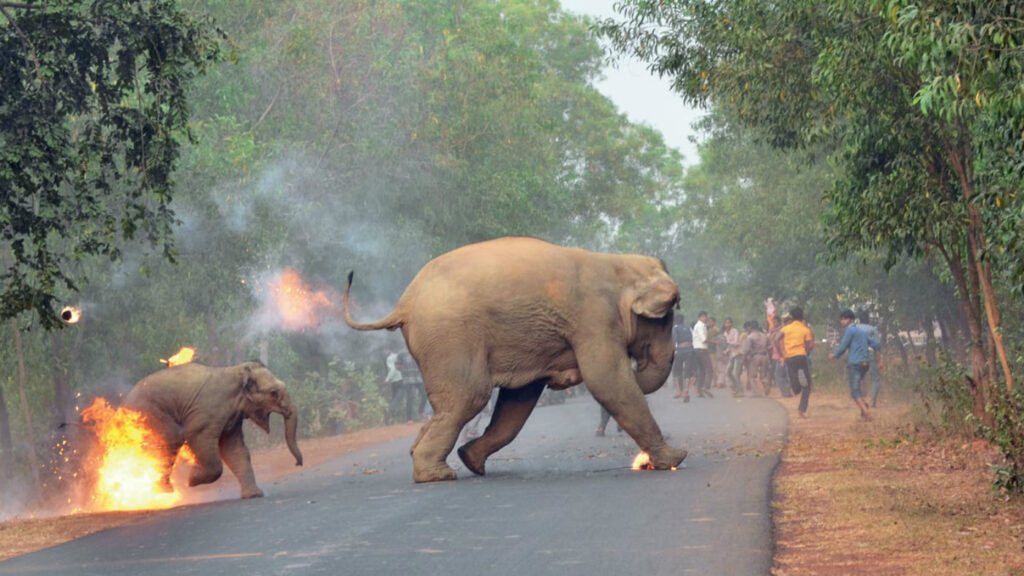
On the 24th of Nov 2025, a 70-year-old Adivasi woman was tending her goats on revenue lands near Masinagudi in Tamil Nadu, when she was killed and dragged into the bushes by a Tiger. It paid little heed to the shouts of witnesses who saw it moving the body to a nearby waterhole. Between late October and November, multiple attacks on people and livestock were reported from the Nugu region near Nagarhole in Karnataka, leaving 3 farmers dead and one critically injured. Including one farmer who had just recovered from a broken hip bone caused by an earlier elephant attack. In response to intense public pressure, over 23 tigers (including many cubs) have been captured from non-forest areas in a span of one month. A huge number for a small rural landscape around two sanctuaries. In many cases, operations were hindered by mobs, who screamed and pelted stones upon sighting the animal, leading to heightened aggression. One of the tigers was found to have a festering snare wound, while another was the mother of 5 healthy cubs. Things took an interesting turn, when experts found it hard to match one of the Tigresses to existing wildlife databases. Raising the possibility that she might have been completely raised outside protected areas. Nor were they all transitionary, weak or infirm animals. Some of them were found to be healthy individuals, simply finding new spaces to eke out a living. It is unclear what the department intends to do with all the captured tigers and cubs. If they end up in captivity, that would be a tragic outcome that serves neither the individual animal nor the species.
Wayanad in Kerala has also been seeing an upsurge of conflict with elephants and big cats. The government has been pushed into a corner and is actively considering amendment of state wildlife laws, to allow easier management of “problem animals”. Meanwhile, crop raiding and conflict elephants have become a permanent fixture in the coffee estates of Sakleshpur in Karnataka. Regular loss of human life in these estates is paired with crude and sometimes harsh capture & translocation projects. But in many cases, the radio tagged elephants have walked hundreds of kilometers to get back to the very landscape that they were removed from.
Meanwhile, up North, rural residents of Uttarakhand are witnessing a new kind of fear. While they were used to managing conflict with leopards, they now find themselves facing an unprecedented surge in attacks by Himalayan Black Bears. These animals, that were traditionally shy and wary of humans, have suddenly taken to breaking into cowsheds by ripping off roofs and doors. Leading to over 71 attacks, the loss of 6 human lives and over 60 livestock in just the last 3 months. Not being well equipped for predatory attacks, these bears end up mauling both people and cattle badly. Shoot at sight orders have now been issued for problem animals, with villagers in many areas organizing themselves and vowing to take matters into their own hands. Elsewhere, UP’s Bahraich district is witnessing a spate of wolf attacks, with nine people, including seven children killed and 32 injured since September. Maharashtra also finds itself facing an increasing problem of leopard attacks around sugarcane fields, resulting in extreme proposals from the government, such as capturing 1500 leopards and translocating them to a private industrialist’s glorified zoo.
There is a familiar pattern playing out across the country today. Wild animals are increasingly visible in human dominated landscapes and conflict seems to be spiraling out of control. On the one hand, there is a tragic loss of human life. On the other hand, animals are being killed and captured in retaliation. The Forest Department and local politicians stand exposed in the middle. One can’t help but feel sorry for the thankless task they are faced with. They are supposed to be in charge and held responsible by the public. But the reality is that they have only operational responses at their disposal, while waiting for policy makers to frame long term solutions. They can only kick the can down the road for the moment, while the situation gets increasingly intense. This was poignantly demonstrated in a recent incident in Bommalapura village, Karnataka, where ten forest staff were locked in the very cage set up to catch the animal, by irate villagers.
There are several factors at play here. One is the unintended consequence of our focus on charismatic species conservation while ignoring minor poaching. Decades of reasonable success in conservation and protection have resulted in some flagship species achieving reproductive replacement rates that now exceed demise rates. This is especially true of species where the glare of protection is intense. Meanwhile, small time poachers have increased in number, especially post Covid. Their attention has shifted to hunting less charismatic prey species, whose meat is being supplied regularly into cities. This tends to be viewed less seriously and generates regular, high value income that is consistent and lucrative over time. It could take months to track and trap a single Tiger. But wild boar and deer meat can be shipped out every weekend and reap handsome rewards. This results in an intense “double whammy”. Predator populations are rising, while prey populations are being decimated. So where else will the predators go now, if not to the fringes, then to livestock and finally to humans?
The other, ongoing issue is the serious degradation of habitat, both within and outside protected areas. Buffer areas and contiguous zones surrounding PAs are now witnessing intense human activity, due to soaring land prices. Meanwhile, within forests we are seeing the massive spread of invasive plant species such as Lantana Camara, Prosopis Juliflora and Parthenium. Years of uncontrolled growth have allowed these plants to wreak havoc on our forests, resulting in impenetrable undergrowth, loss of grassland and suffocation of fruit bearing trees and native plants. This pushes herbivores towards the edge of forests where feed is still available. And where they go, predators must follow.
Animal behavior is also evolving as a response to these new realities. Many species are now studying human behavior and learning to survive alongside us. Rural crop raiding elephants and urban macaque troops are now found to be healthier and more robust than their jungle cousins. They have acclimatized to the easy life, and they are often incapable of surviving in a true forest environment. Leopards have been living for several generations, off stray dogs and feral pigs in rural landscapes. And now it appears, so have Tigers. In fact, most communities have little idea about the amount of wildlife that co-exists with them, even in highly urbanized areas. Unfortunately, mobile phones and CCTV cameras have now started making the invisible more apparent, leading to heightened fear and knee jerk reactions. At the same time, as the confidence of animals increases, so does wildlife conflict.
One of the unintended consequences of successful conservation is also the gradual loss of fear of humans. Animals learn to fear humans through generational learning and genetic memory. Even today, most tigers or leopards will run away from humans as a first response. However, over time, that fear grows foggy. Newer and younger animals start wondering why they must fear this two-legged animal that seems to only make a lot of noise. Some of them experiment with pushing the boundaries and they start learning the wrong lessons. This has a definite impact on the nature of human wildlife interaction.
Finally, one cannot deny the visible effects of climate change. This is most apparent in the case of Himalayan Black bears in Uttarakhand. Typically, bears go into hyperphagy (eating enormous amounts) in the few weeks preceding winter and then they go into hibernation. But with winters now setting in much later, these animals are getting stuck in the hyperphagy phase for months, which is beyond their control. After remaining hungry for much longer and eating everything in sight, they finally have no choice but to start attacking the nutrient dense stores of food around human beings. While they should actually be fast asleep by then.
The battle lines are now drawn. On the one hand, animal welfare activists, who believe that an individual animals life holds more value than human life, or the welfare of the species itself. On the other hand, rural mobs whose emotions and fears are amplified rapidly through viral videos. Stuck in the middle is the forest department. When emotions run high, they have no option but to promise capture and relocation of the animal, even if it is locally habituated and not creating serious issues. Without going too deep into the topic, there is enough research now to show that the capture and removal of a locally familiar animal only results in new, nervous individuals occupying the space and ultimately results in a huge increase in conflict, for a variety of reasons.
What then, is the way out of this complex problem?
At the core of this issue is a decades old conservation philosophy that has served India well in the past but is now past it’s expiry date. This is the philosophy of “non-interventionist” conservation or the theory that if we create an island fortress, nature will simply heal itself within that area. This sounds like a very sensible and humble strategy towards conservation. And it has worked for us in the past. However, with the amount of pressure now being exerted on the fragmented conservation islands we have created, we are finding that the strategy is not working any more. We cannot weaken the balance of nature from every side and then say, “please heal yourself”. There is an urgent need to re-assess the scenario with open minds and new, perhaps unfamiliar strategies.
Now is the time for a complete rethink on our approach to conservation and to consider replacing fortress conservation with active “wildlife management”, however much we may be culturally averse to doing so. We must get actively involved in helping nature manage the mess that we created in the first place. The problem is not going to solve itself. It is only going to get worse, and politicians are going to end up taking knee jerk policy decisions that harms wildlife in the long run.
- Habitat Management – We need coordinated strategies on a war footing to reverse habitat degradation within our forests. Serious, well-funded research followed by biochemical or other means to remove invasives, if necessary. There is no point creating inviolate spaces, if the living conditions within those spaces become substandard. We introduced the invasives and now we will need to work on reducing their impact.
At the same time, we need to avoid anthropomorphic interventions that upset the original rhythm of forests. One good example is the well-intentioned but misguided activity of creating artificial waterholes during dry seasons. Every forest has an optimum carrying capacity. Populations are naturally brought down during droughts through death of the weak and infirm. When we artificially keep populations high by supplying water, while allowing fodder habitat to degrade at the same time, we end up amplifying the movement pressure on species in search of new habitations.
- Population Management – Secondly, we need to be willing to cull individual animals that present a clear and immediate threat to human life, without engaging in elaborate rituals of capture and translocation. Valuable time is lost while the forest department blunders around, trying to catch or dart the animal alive. In the meantime, local resentment towards the entire species, wildlife and the department grows and festers. Resulting in negative outcomes such as electrocution or poisoning for many more animals. It serves neither the species, nor the individual animal to spend inordinate time and effort in capturing it, only to have it spend the rest of its life in captivity.
At the same time, we need to be able to educate people about the futility of simply removing animals that have not demonstrated a clear threat to human life. A much more dangerous replacement is likely to appear sooner or later.
- Highly restricted hunting – Distasteful? Yes. Avoidable? Perhaps. But for the sake of open-minded enquiry, we also cannot avoid considering the recommendation of some experts, to allow high-cost trophy hunting licenses in specific scenarios. This idea sets off extreme emotional reactions and divides the conservation community, as it rightly should. But sport hunting is a part of wildlife management across the world. People are willing to spend crores for the opportunity of taking out individual animals that are either exceeding capacity, perhaps old and past breeding age, or representing a threat to human life. Money that can be routed back to conservation and to local populations around wildlife areas. I am personally not convinced, as it is an idea rife with possibility of misuse, but it cannot be dismissed out of hand during an objective analysis of options.
It is certainly an alternative to other impractical schemes such as capturing and shipping animals to private zoos or ideas such as running birth control projects inside forests.
- Landscape Management – Finally, we need a coordinated, national effort to restore connectivity across fragmented landscapes, by taking up the matter of wildlife corridors to create contiguous forests that were hitherto connected. We are ready to undertake highly complex and controversial river linking projects, because humans need the water. But the relatively simpler task of linking wild areas through safe corridors for animals to move, remains a pipe dream. Simply because it is viewed as the animals need, rather than that of humans. But the perspective shifts dramatically when viewed through the lens of human wildlife conflict. We would much rather have animals dispersing through corridors to other areas that have lower density, as opposed to getting pushed out into rural landscapes on the fringes.
Clearly, we urgently need a national level, coordinated strategy that addresses the above options at a landscape level. Wildlife conflict management always produces a lot of heated emotions from its stakeholders. And rightly so, since everyone is passionate about doing the right thing. One fact is clear on the ground though. We have already impacted nature so much, that we can no longer step back and expect nature to balance itself. Unfortunately, animals do not understand that they need to remain inside inviolate spaces and survive somehow, even when life outside seems more appealing. We have no option but to get involved with active wildlife management, rather than simply rely on theories of inviolate spaces and non-interventionist policies that worked in the past.
* The writer has been closely involved with conservation projects for almost two decades and is currently on the management board of one of South India’s oldest wildlife NGOs. His views represented here are purely personal.
 KAFILA - COLLECTIVE EXPLORATIONS SINCE 2006
1. Legally the subject of ‘wildlife’ now falls within the jurisdiction of Forest and Wildlife Department through the Wildlife Protection Act 1972 and Gram Sabhas having governance rights over part of forests under the Forest Rights Act 2006 under Sec.5 (a) ‘protect the wild life, forest and biodiversity’ for which the Gram Sabha is to constitute a committee under Rule 4(1)(e) ‘Constitute Committees for the protection of wildlife, forest and biodiversity, from amongst its members, in order to carry out the provisions of Section 5 of the Act’. The scope of these institutions of governance, the forest department in the forest lands under their jurisdiction and the Gram Sabhas in the forest lands under the jurisdiction need to be defined in terms of preventive measures against wildlife attack. At present the WLPA 1972 is limited to only wildlife offenses empowering the wildlife bureaucracy to prevent and take action on wildlife offenses and do not cover prevention and taking action on wildlife attack except when the concerned wildlife authorities take decision to notify a particular wildlife as a human threat to contain them or certain wildlife species are declared as ‘vermin’ thus permitting them to be hunted or when specific wildlife is deemed to be a human predator or threat for them to be darted and captured or shot to death.
2. Why is this phenomenon of ‘wildlife attack’ declared, propagated and discussed as ‘ human-wildlife conflict ‘? The use of the generic term ‘human’ neatly covers up which human category one is referring to? There are those who are threat to wildlife, and there are others who are under the threat from wildlife. The former are generally not the latter. Those who threaten wildlife are those who have been and are the prime beneficiaries of the forests and its resources – the water, timber, energy, minor and major minerals, leisure pleasure, biodiversity, minor forest produce, carbon etc knowingly and unknowingly . The main beneficiaries are the affluent city and rural folk. Then there are those who have been and are the prime losers, mostly the forest dwellers followed by the marginalised elsewhere.
3. There is a total thundering silence on the paramount role of the primary institutional mechanism that has until recently have had untrammeled exclusive power and control over the forest and all that it contains along with policing powers on whom the ruling class, the affluent class and the judiciary have untrammeled faith that is the forest and wildlife department. Their instruments are timber extraction, the forest working/management plans, forest conservation, forest diversion, wildlife clearance, afforestation (carbon sinks) and ecotourism. 4. There is this orchestrated fiction that the conservation philosophy and strategy is the ‘non-interventionist’ conservation or ‘fortress conservation’. If so, where does timber extraction, the forest working plan, forest conservation, forest diversion, wildlife clearance, afforestation (carbon sinks) and ecotourism fall under? Yes. All these interventions are taking place within the well guarded fortress, isn’t it? Aren’t these some key reasons that is fast ‘voluntarily relocating’ wildlife into human habitations resulting in wildlife attacks?
Thanks
Bijoy
LikeLike
Agree completely that policy making and enforcement is today controlled by those who do not not have to suffer the fallouts of the same. And yes, the Forest Department is archaic and colonial in its functioning. However the matter is nuanced and I do not agree with the characterisation of communities surrounding forest areas as mute sufferers. Today they have the ability to exert tremendous pressure through local politics, because of the votes they hold. And they do. There is also relentless but compounding minor forest encrochment by the elites within their ranks. Hence the proposal that the entire model needs to be rethought, and local communities certainly need to have a strong say in how it should be structured. Without their buy in, the flashpoints are just going to get more intense.
LikeLike
Rather than centralized and expert-led solutions, decentralised approaches with people’s participation are needed for a problem that has very localized manifestations. Community Forest Resource rights along with Individual Forest Rights for forest farmers under the Forest Rights Act, with support from Panchayats with devolved powers, re-oriented Forest Departments and ecological research will be needed. So will independent Environmental Impact Assessments (EIAs) to predict the impact on wildlife of projects that divert forestland. Not EIAs commissioned by the project proponents themselves.
LikeLike
Agree completely. When I say that “fortress conservation doesn’t work”, I am refering to this exclusion of local stakeholders from the policy making and implementation.
LikeLike