
[The essay below is based on a presentation at a recent workshop on Theory from the Global South and a part of a longer work. Some of its claims are therefore, necessarily tentative. – AN]
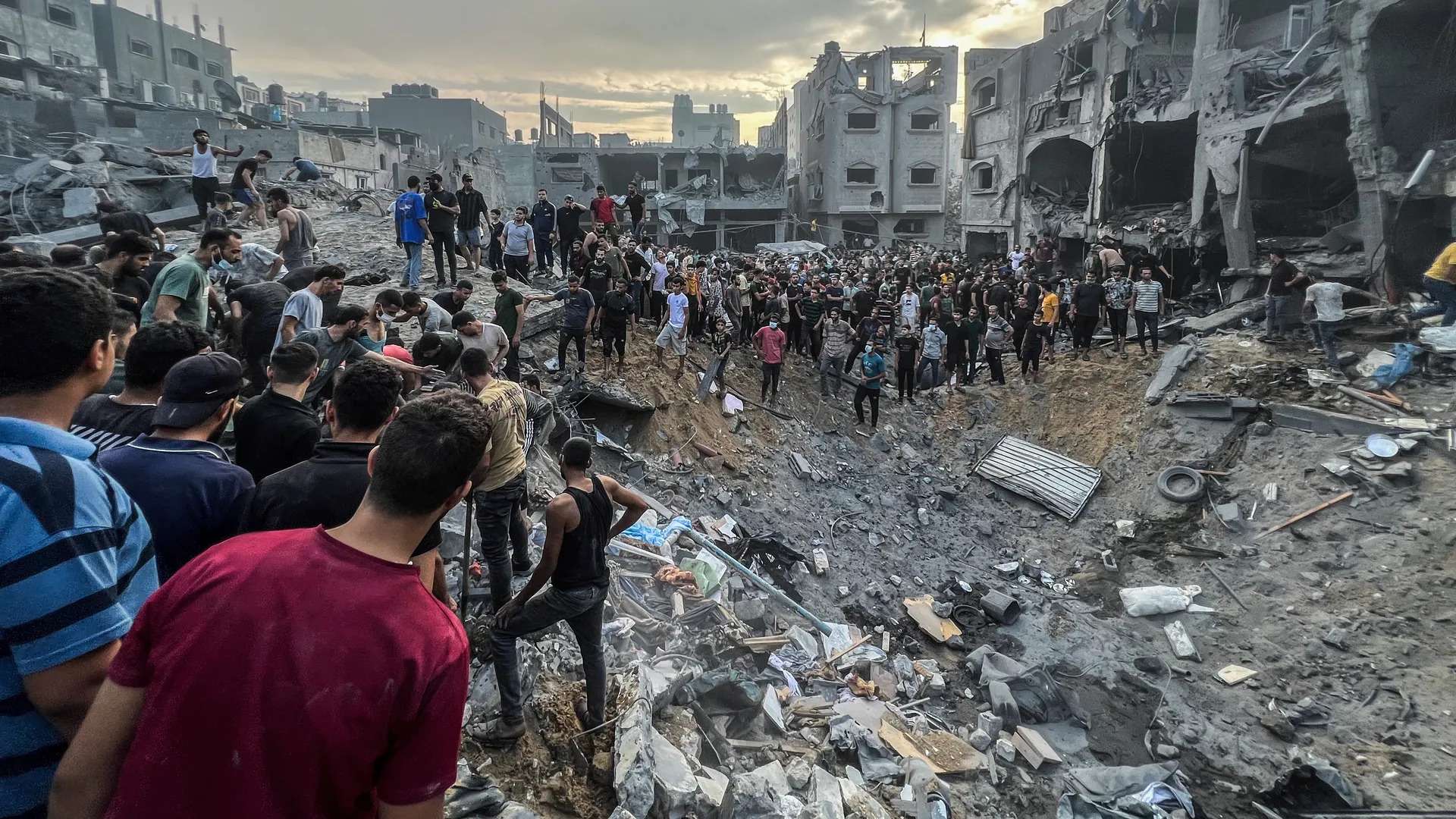
What is happening to Gaza/Palestine today is a horrible genocide, the likes of which has rarely been seen. Yet, it must be asserted that not exceptional or unique – but entirely of a piece with the history of the colonial expansion of the West over five centuries. Gaza reveals, in a flash, the long-erased histories of settler colonialism and genocides; it reminds us that that history is very much part of our living present. Gaza strips the mask of “civilization” donned by the “enlightened West” that has long portrayed us in the global South as lesser, uncivilized beings worthy of being enslaved, used as cannon fodder and ultimately, exterminated. That was what we saw in the unrepentant colonizer’s speech by US Secretary of State, Marco Rubio at the Munich Security Conference. But in stripping off the masks of “civilization” from their faces, Gaza shows up how repeatedly, over and over again, the same script has been played, regardless who was in power in the Axis of Evil countries of Europe, UK and the US.
But more importantly, Gaza forces us to retell the whole story of the past five centuries by setting aside the received mythologies of “the political” and of “Enlightenment”. Gaza demands that we put at the centre of our narrative, not states and nations but those millions of dispossessed by settler colonialism, driven to death in imperialist wars and thrown around from one part of the world to another as “stateless” people, “refugees” and “minorities”. Even though, in the interim, Palestine must have its own sovereign state to survive in this world of armed state, Gaza/Palestine demands a complete overturning of the very possibility of a repetition of another Gaza/Palestine ever again. It demands of us that we dismantle the entire theoretical edifice undergirding dominant narratives; it demands that we start telling the story from the vantage point of the people at the receiving end of that hallowed thing called “modernity” – that most people in the global South experienced as coloniality and what has been called “war capitalism” by historian Sven Beckert – which I will discuss below.
Focusing on what we can call the “coloniality of the political” (courtesy Anibal Quijano) allows us to see how “the political”, in its many avatars, emerges globally, as part of constellation of colonialism, modernity and “war capitalism”. What follows below is part of a much longer project and is still the process of being developed.
Before entering into a discussion of the coloniality of the political, it is necessary to briefly revisit the history of modernity/coloniality/capitalism from the standpoint of ordinary people across the world, especially the global South.
Such a counter-narrative calls for a radical overturning of the received wisdom about the modern world. It cannot, therefore, be an additive exercise where we simply add new details to the picture that already exists. Indeed, the picture itself has to be redrawn.
Colonialism, Modernity, “War Capitalism”
Less than a month before Marco Rubio delivered his infamous speech in Munich, the World Economic Forum in Davos ended with a sense of foreboding. Anthropologist David Wengrow described the mood there drawing from Canadian PM Mike Carney’s speech, saying that it was ending with talk of a rupture in world affairs, a collapse of international law, a descent into chaos and the rise of a new global order in which bullies rule like kings, weaker nations are property to be bought and sold by the stronger… “All this must sound extremely odd to the Indigenous people of Canada, America, Australia or Greenland, for whom that old order meant only catastrophe”, Wengrow went on to observe.
His observation captures the way in which the global order of power that emerged through the past centuries has been experienced across the colonized world, especially, though not only, by Indigenous peoples. Wengrow tells us that the rule-based order whose demise is now being mourned had actually originated “in the legal justifications for an act of piracy, motivated by profit.” He refers to “Mare Liberum (‘The Freedom of the Seas’), by the Dutch legal theorist Hugo Grotius”, commonly considered to be a foundational text of modern international relations. “The Grotian tradition,” he underlines, “has often been taken to represent humanity’s best hopes for a world order based on the principles of justice, freedom and peace among nations.”
But what is the background of this text? Wengrow explains: The Dutch East India Company, formed in 1602, was the first modern business corporation that…was also granted the rights of a “corporate sovereign”, which meant it could raise armies, wage wars, maintain garrisons, form binding treaties with rulers overseas and impose governors on defeated populations.
At the start of the 17th century, Wengrow writes, the lucrative spice trade of the Malay Peninsula was a monopoly of Portugal’s Estado da Índia. It so happened that on 25 February 1603, a Portuguese cargo ship was ambushed off Singapore by warships under the command of the Dutch admiral Jakob van Heemskerk. Once its cargo had been auctioned off in Amsterdam, the shareholders – nervous of losing their ill-gotten gains – employed Grotius, the Netherlands’ top legal mind, to write a treatise defending van Heemskerk’s actions. It was perhaps just a coincidence that Grotius happened to be the admiral’s cousin. (Ibid)
“Grotius argued that wars between nations may be legally justified if they advance the ‘natural’ rights of those nations to engage freely in commerce,” and this argument became the basis of violent wars of domination and control of trade in the Malay-Indonesia region which put an end to the free trade that had actually existed before the “Grotian moment”.
With this began, in what is now Indonesia, a violent implantation of politico-economic domination. “Most indigenous growers of mace and nutmeg were killed, the survivors were sold into slavery and their lands were resettled with plantation workers from elsewhere.”
In the context of what he calls the “empire of cotton” Sven Beckert in his magisterial study, talks of what he calls “war capitalism”, to refer precisely to this phenomenon of trading companies that were simultaneously quasi-states, indulging in the most violent acts in order to plant the seeds of capitalism. (Beckert 2014, Empire of Cotton: A New History of Global Capitalism. Great Britain: Allen Lane, Penguin Random House)
“The first momentous event in the recasting of global connections” came with the arrival of Columbus in the Americas in 1492, setting off the world’s greatest land grab with Hernán Cortés attacking the Aztec Empire in 1518 and establishing vast territorial claims for the Spaniards in America…” The rest, as they say, is history.
Expansion to grab land and seize mineral and other wealth from these colonies was one part of the story. But Beckert also tells us that European capitalists and rulers altered global networks through a variety of means, the most important among them, being “the muscle of armed trade [that] enabled the creation of a complex, Eurocentric maritime trade web” and “the forging of a military-fiscal state [that] allowed for the projection of power into the far-flung corners of the world.” (Beckert 2014: 30, emphasis added)
Beckert calls this war capitalism. We know from our own history in the Indian subcontinent that the East India Company did not come as a trading company for commerce. It was a quasi-state, that fought wars and established colonial power long before the British state formally stepped in.
It is pertinent to make a more general point here about what we call “capitalism” as such. In the course of the above discussion, Beckert refers to the way in which “war capitalism” was characterized not by “secure property rights” but by a wave of expropriation of labor and land,” which, he says, “testifies to capitalism’s illiberal origins.” (Beckert 2014: 37) As we shall see below, this violence has been integral to capitalism right through the centuries of its existence, down to the present. We must recognize that all capitalism is war capitalism. This story of the birth of capitalism cannot co-exist easily with the narrative/s of the various “transition debates” that draw on Marx to understand the development of capitalism as an internal moment of transformation in European feudalism. In fact, it can even be argued that “petty commodity production” and commerce in general do not really constitute the prehistory of capitalism. Everywhere, for capitalism to be implanted, small commodity production had to be violently uprooted. Indeed, it is the military-fiscal state that constitutes the prehistory of capital.
As it happens, 1492 is also the year of the Reconquista and Mahmood Mamdani has recently argued that that event ought to be considered “the founding moment of the modern state.” In fact, Mamdani goes further to claim that it was the year of the beginning of the nation-state and was defined by two key developments in Iberia – ethnic cleansing within and the taking of overseas colonies in the Americas. (Mamdani, Neither Settler Nor Native: The Making and Unmaking of Permanent Minorities. Cambridge, Massachusetts: The Belknap press of Harvard University Press, 2020: 1) Mamdani is right in taking these as key features of the nation-state but we should perhaps add a third feature here – “internal colonialism”. Anibal Quijano sees this feature to be equally in operation within what became nation-states in Europe as in colonial expansion without – as does Eugen Weber in his classic study, Peasants into Frenchmen. I am not entirely convinced that what came into being in 1492 was the nation-state, but we could perhaps see it as that moment when the processes that would then get formalized and congealed in the nation-state later, came into being. Nonetheless, looking at the scholarship on the birth of capitalism, modern state and nation-state, it is difficult to escape the conclusion that colonialism, capitalism and modernity were emerging as part of the same constellation of processes.
The Coloniality of the Political
Drawing on his studies of colonialism in Latin America, Quijano suggests that “that specific colonial structure of power produced the specific social discriminations which later were codified as ‘racial’, ‘ethnic’, ‘anthropological’ or ‘national’, according to the times, agents, and populations involved.” (Quijano, ‘Coloniality and Modernity/Rationality’, Cultural Studies, Vol. 21, Nos 2-3, March/May 2007: 168) His argument about the “coloniality of power” considers contemporary racial and ethnic divisions as encoding a certain grammar of power, as something that outlasts the actual rule of colonialism in Latin America. Quijano sees the structuring of power along these lines as a global phenomenon. But the coloniality of power isn’t simply about race or ethnicity. The larger structures of power set in place by colonialism that continue to exist between the ex-colonized and the colonizing powers are quite integral to it. No less important is the relation of the rise of the nation-state with “internal colonialism” as the other side of the colonial project itself. Quijano argues that the nation-state began as a process of colonization of some peoples over others that were, in this sense, foreigners. Therefore, “the nation-state depended on the organization of one centralized state over a conquered space of domination.” (Quijano, ‘Coloniality of Power, Eurocentrism and Latin America’, Nepantla: Views from South, Vol. 1, Issue 3, 2000: 558) It is important to recognize this in order to be able to appreciate the fact that these states were as violent and vicious to “their own” [European] populations as they were to those inhabiting lands outside their frontiers.
There was something else that happened as the world entered the twentieth century, which culminated in the First World War. This process begun in the 19th century “Scramble for Africa”, was given concrete shape in the 1884 Conference of Berlin that formalized the partition of the African continent between seven European powers – without the consent of participation of the Africans themselves, of course. Where in 1970 about 10 percent of Africa was under European control, by the eve of the World War I, 90 percent was controlled by Africa.
“The first World War exploded the European comity of nations beyond repair, something which no other war had ever done,” argues Hannah Arendt in her Origins of Totalitarianism (Arendt 1951: 349). Arendt reads into the rise of imperialism of this period, a parallel decline of the nation-state system of Europe. Thus, she argues, apart from inflation and unemployment all but destroying the social fabric “civil wars which ushered in and spread over the twenty years of uneasy peace… were followed by migrations of groups who, unlike their happier predecessors in the religious wars, were welcomed nowhere and could be assimilated nowhere.” (Arendt 1951: 349) “Once they had left their homeland they remained homeless, once they had left their state they became stateless; once they had been deprived of their human rights they were rightless, scum of the earth.
In retrospect, however, this seems to be not a symptom of the decline but rather the fructification of the inevitable logic of nation-states but Arendt’s point needs to be understood. What she was arguing here related to the rise of imperialism in this period. With it, national sovereignty became a mockery, except for a few giant states. (Arendt 1951: 352) Arendt discusses how, with the liquidation of the two “multinational states” – Russia and Austro-Hungary – there emerged two groups of people who had lost those rights “which had been thought of and even defined as inalienable, the Rights of Man.” These were the “stateless” and the “minorities”, who had no governments to represent them and “therefore were forced to live either under the law of exception of the Minority Treaties, which all governments (except Czechoslovakia) had signed under protest and never recognized as law, or under condition of absolute lawlessness.” (Arendt 1951: 351) Of course, both the mockery of national sovereignty and the production of stateless people, are discussed by Arendt in the context of Europe. Both had been already very much part of the experience of colonized societies, at least for a few centuries before World War I. But what Arendt’s discussion brings home powerfully, is the fact that by the beginning of the twentieth century, even within Europe, a logic similar to that which existed in the colonial world was now playing out as far as ordinary people were concerned.
States in colonized societies, of course, had never been sovereign but the situation of ordinary people in these societies was far worse insofar as they had either been dispossessed and made slaves, transported across the seas, or as the native populations in the Americas and Africa, they were subjected to genocides.
American Indigenous scholar Roxanne Dunbar-Ortiz in her book (Not a Nation of Immigrants: Settler Colonialism, White Supremacy, and a History of Erasure and Exclusion. Boston: Beacon Press, 2021) details the genocide of the “Indian” population from the very beginnings of settler colonialism in what is now the United States of America. She devotes an entire chapter to Alexander Hamilton, considered the founding father of the USA. Dunbar-Ortiz discusses Hamilton’s role in creating a Constitution that has been characterized as establishing the first “fiscal-military state” – that is a state created for making war. (Dunbar-Ortiz 2021: 11) “The United States was thus founded as the first constitutionalist state and an empire on conquered land, with capital in the form of slaves and land (real estate).” (Dunbar-Ortiz 2021: 11) Notice that Dunbar-Ortiz too describes the US state as a fiscal-military state. She cites Stanford law professor and historian Gregory Ablavsky, whose work “emphasizes the centrality of Indian affairs in creating the Constitution, particularly provisions concerning federalism and the fiscal-military state.” Ablavsky’s work highlights, she says, “how ratification created a Constitution committed to the violent expropriation of the Indigenous territories bordering the thirteen states. The Constitution created a people empowered to sustain a powerful military to carry out conquest of the continent with the full participation of the settlers. This was what the war of independence was fought for, with great sacrifices…” (Dunbar-Ortiz 2021: 12, emphasis added)
I should also mention here that this is precisely why historian Gerald Horne calls the American War of Independence “the counter-revolution of 1776”. (Horne, The Counter-Revolution of 1776: Slave Resistance and the Origins of the United States of America. New York and London: New York University Press, 2014) Horne makes the strong claim that “to the extent that 1776 gave slavery a renewed lease of life, it was truly a lineal ancestor of 1861 [the Civil War and the formation of the Confederacy] and, thus a counter-revolution of slavery.” (Horne 2014: xi)
It is necessary to understand that the entire undertaking of settler colonialism – and of colonialism at large – was undergirded by law. The constitution of the modern political, regardless of where it was being instituted, at the “national” and the global level, was given a legal form. Dunbar-Ortiz observes that from the mid-fifteenth century to the mid-twentieth century, most non-European world was colonized under the “Doctrine of Discovery”, which was “one of the first principles of international law that Christian European monarchies promulgated to legitimize investigating, mapping, and claiming lands belonging to non-Christian peoples outside Europe.” “It originated in a papal bull issued in 1455 that permitted the Portuguese monarchy to seize West Africa and enslave the inhabitants, the beginning of the transatlantic slave trade.” (Dunbar-Ortiz 2021: 32)
In the 1820s, says Dunbar-Ortiz, “the Doctrine of Discovery was engraved in constitutional law by the US Supreme Court under John Marshall in decisions regarding the Cherokee Nation.” In so defining the property rights acquired via discovery, “the court further held that Indigenous ‘rights to complete sovereignty, as independent nations, were necessarily diminished. Their status was defined as ‘domestic, dependent nations’, which means captive colonies.” (Ibid: 33)
It is this fiscal-military state that later morphed into what Dwight Eisenhower called the “military-industrial complex”. Over the twentieth century, this military-industrial has directly intervened in “regime change operations”, overthrowing democratically elected popular governments. Scholars have documented almost a hundred instances of proven US interventions that range from directly supporting military coups to interfering in determining electoral outcomes, not to mention sponsoring armed militias in different parts of the so-called “developing world”. The really important thing to understand is that today we need to understand “the military-industrial complex” not as something linked to the US state alone but as a military-industrial-financial complex that has tentacles spread across the globe. We cannot really even understand how Hitler’s war machine could take off in a Germany whose back had been broken in the Great Depression, without the role of American corporations like Rockefeller’s Standard Oil/Exxon/ Mobil, IBM, Ford, General Motors and banks like JP Morgan.
Decolonizing the Political
Mahmood Mamdani has recently argued in favour of what he calls the need to “decolonize the political”. Decolonizing the political, in his view, is fundamentally about dismantling the imagination of the nation-state that seeks to homogenize national cultures and, in the process, constitutes the political community that is the legitimate bearer of rights and citizenship. But this project of homogenizing national cultures also produces, inevitably, permanent majorities and minorities. It is through the nation-state that the political is constituted as such, as the centre-piece of political modernity itself. Decolonizing the political, therefore, “means upsetting the permanent majority and minority identities that define the contours of the nation-state.” (Mamdani 2020: 19)
The project of “decolonizing the polity,” he argues, must be at once an epistemic and political, for it is not simply a matter of formulating policies but also more importantly about “how we see ourselves in the world.” (Mamdani 2020: 19)
Mamdani’s discussion is largely framed by his studies of the constitutive role played by colonialism, especially in the form of “indirect rule”, which defines and reconstitutes cultural/ ethnic communities and “tribes” across the African continent. He argues that anticolonial elites who rejected European attempts to foist their idea of the nation-states on African countries, during their liberation struggles, eventually returned to the very definitions of indigenous culture and ethnicity produced by colonizers, as they embarked on their path of nation-building. The only contrary example, he argues, that attempts to decolonize the political is in post-apartheid South Africa, which seeks to constitute a non-racial state. Mamdani draws important and significant connections between the “political technologies of indirect rule” first developed in the United States of America and then applied with some modifications in South Africa and Nazi Germany. This is especially true of the Indian reservations in the USA, which became the model, not just for the Bantustans in apartheid South Africa but also for Hitler’s concentration camps.
It is interesting, in this context, to refer to the work of James Whitman (Hitler’s American Model: The United States and the Making of Nazi Race Law. Princeton and Oxford: Princeton University Press, 2017), where he tracks the influence of American race laws on the Nazis.
Nazi interest in the American race laws was no passing curiosity. Indeed, Whitman documents in great detail, how in the run up to the enactment of the notorious Nuremburg Laws in in 1935, important Nazi jurists were seriously studying and discussing American race laws. Hitler’s interest in the USA wasn’t suddenly awakened in 1933-34 but had already been already expressed in Mein Kampf, where “he praised America as nothing less than ‘the one state’ that had made progress toward the creation of a healthy racist order of the kind the Nuremberg Laws were intended to establish.” (Whitman 2017)
Most of the discussions among these jurists, Whitman tells us, were regarding racial segregation in general and miscegenation laws in particular. In more recent scholarship, says Whitman, “historians have also tracked down American influence on some of the most unambiguously criminal Nazi programs—in particular on Nazi eugenics and the murderous Nazi conquests in Eastern Europe.” (Whitman 2017) Indeed, historians have argued that the US influence went deeper, into the 1940s, to the Holocaust itself.
“Indeed as early as 1928, Hitler was speechifying admiringly about the way Americans had ‘gunned down the millions of Redskins to a few hundred thousand, and now keep the modest remnant under observation in a cage’; and during the years of genocide in the early 1940s Nazi leaders made repeated reference to the American conquest of the West when speaking of their own murderous conquests to their east.” (Whitman 2017)
Even more interestingly, as with immigration and citizenship law, German lawyers and policy makers’ “interest in American anti-miscegenation law that long predated the Nazi period.” In fact, it is tied closely to pre–World War I German imperialism, when “beginning in 1905, German colonial administrators in South-West Africa and elsewhere instituted anti-miscegenation measures, intended to safeguard the ‘purity’ of the German settler population against mixing with the natives.
It should be clear by now how the history of colonialism is deeply entangled with the emergence of “the political” in Europe and America itself and how it is not something that can be understood within the enclosed boundaries of the nation-state. Not the least by pointing to their “democratic” internal political structures.
In conclusion, therefore, while agreeing with the main lines of Mamdani’s argument regarding the decolonization of the political, I want to register two points of divergence. First, Mamdani’s focus is on technologies of indirect rule and the ways in which definitions of self in the postcolonial era replicate colonial constructions of culture and ethnicity. His focus therefore, remains on the “denationalizing” the postcolonial states by institution of federal structures and insistence on residence-based citizenship rather than identity-based ones. (Mamdani 2020: 36) While this is very important, the state nevertheless remains at the centre of this proposal. My effort on the other hand, has been to tell the story of modernity and politics from the vantage point of the people at the receiving end, ordinary people caught in the vortex of politics. What emerges from the story that I want to tell is that the state and quasi-state elites, and their centrality in modern politics is itself a product of coloniality/ modernity, which suggests that the very enterprise of trying the resuscitate the political could be flawed. Second, related to the first, while Mamdani’s focus throughout remains on the political as something confined within the territorial bounds of the nation-state, my interest here, in foregrounding Gaza/Palestine, has centered on the real global structures of power that despite the different institutional forms that it may have acquired from the 1648 Treaty of Versailles to the 1884 Conference of Berlin to the League of Nations and the United Nations Organizations, has remained under the control of leading European powers and in recent times, an invisible cabal of the Euro-American powers and the Zionists. It should, therefore, be clear by now that while it is essential to dismantle the structure of the nation-state, where my argument takes a different route from Mamdani’s is that I do not believe this can be done either at the level of a single territorial state or at a purely political level. What decolonization of the political (if that is what we decide to call it) requires is the dismantling of the military-industrial-financial complex and in fact, a very different vision of the economy from the one controlled by corporations and billionaires.
 KAFILA - COLLECTIVE EXPLORATIONS SINCE 2006