
Clarification: These documents did not reach us through any member of the Committee.
We have re-ordered the first document to place the Executive Summary at the beginning. Otherwise, no changes have been made. We have also linked to the sites from which you can download the actual text-books so that you can see what has been recommended for deletion/change.
MSS Pandian’s Note of Dissent follows the report of the Committee.
A Report of the Committee constituted for Reviewing the Textbooks of Social Sciences / Political sciences, for Classes IX-XII constituted by NCERT
EXECUTIVE SUMMARY
a) The Committee’s terms of reference were to identify the educationally inappropriate materials and provide alternative suggestions for the six textbooks in Political Science.
b) Since six textbooks covered different themes such as Political Theory, Indian Constitutions, Indian Politics and World Politics, the Committee requested the subject experts from Political Science, to give their opinion using the NCERT guidelines for the textbooks preparation. The opinion expressed by the experts was used as resource material to arrive at the final view by the Committee .The Committee also made use of some literature, particularly on the use of cartoons in teaching.
c) The Committee used the guidelines developed by the NCERT to prepare the textbooks for the review of educational material including the cartoons. Since the NCERT did not provide specific guidelines for the inclusion of cartoons (and used the general NCF guidelines for selection and use of cartoon), the Committee made use of general guidelines and also suggestions of some eminent researchers who have worked on the use of cartoons in teaching, to review the inclusion of cartoons in six textbooks on Political Science.
d) The Committee has made recommendations for each of the six textbooks for changes in the current year. The Committee recommended (a) removal of some cartoons, (b) change in the “Note “below the cartoons Unni and Munni to bring clarity and improvement in the message and (c) removal of some cartoons on Unni and Munni.
e) The Committee has also made suggestions for modification in material which can be considered at the time of the general review of the textbooks in future. Continue reading Report of Committee to Review NCERT Textbooks and Note of Dissent by MSS Pandian
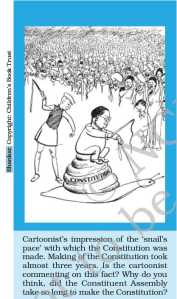 The uproar over what is being referred to as the ‘Ambedkar cartoon’ in the class XI textbook prepared by NCERT first began over a month ago, that is to say, almost six years after the books have been in circulation, been taught and received high praise for their lively style and a critical pedagogical approach (more on this below). It was a political party – one of the factions of the Republican Party of India – that decided to kick up a ruckus over ‘the issue’ – that is, the ‘affront’ to Dr Ambedkar that the cartoon in question supposedly constitutes, and the resultant ‘hurt sentiments’ that it has caused. Very soon everyone began to fall in line, and practically every member of our august Parliament was vying with one other to prove that they were indeed more hurt than their colleagues. One of them, Shri Ram Vilas Paswan has even demanded that the
 KAFILA - COLLECTIVE EXPLORATIONS SINCE 2006