
[A shorter version of this article was published in The Wire on 18 December. I thank K. Satyanarayana, P. Sanal Mohan and Jangam Chinnaiah for their very helpful comments on it, which have helped me to clarify and elaborate on certain points.]
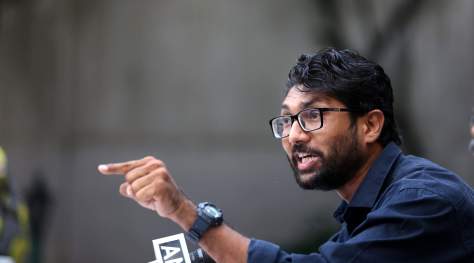
The rise of Jignesh Mevani constitutes a significant landmark in the political configuration in which the Congress has risen, despite itself, from a state of utter disarray to become the point of articulation for a possible political realignment in the near future. The process of political reconfiguration had already begun as a very significant section of the powerful patidar community, long understood to be the bedrock of the BJP’s social base in the state, had broken away from it. But alongside this, the rise of the young leaders Hardik Patel, Alpesh Thakore and Jignesh Mevani together produced the new young face of emergent Gujarat.
There is no doubt that the vacuum that characterized the space where the opposition should have been, no longer exists. The masthead of a new opposition formation is evident on the horizon. This turnaround in the fortunes of the Congress would not have been possible without the re-alignments in the non-electoral arena, facilitated in no small measure by the rise of this young leadership.
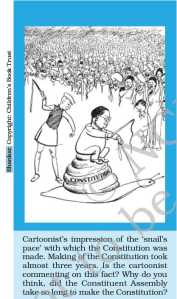 The uproar over what is being referred to as the ‘Ambedkar cartoon’ in the class XI textbook prepared by NCERT first began over a month ago, that is to say, almost six years after the books have been in circulation, been taught and received high praise for their lively style and a critical pedagogical approach (more on this below). It was a political party – one of the factions of the Republican Party of India – that decided to kick up a ruckus over ‘the issue’ – that is, the ‘affront’ to Dr Ambedkar that the cartoon in question supposedly constitutes, and the resultant ‘hurt sentiments’ that it has caused. Very soon everyone began to fall in line, and practically every member of our august Parliament was vying with one other to prove that they were indeed more hurt than their colleagues. One of them, Shri Ram Vilas Paswan has even demanded that the
 KAFILA - COLLECTIVE EXPLORATIONS SINCE 2006