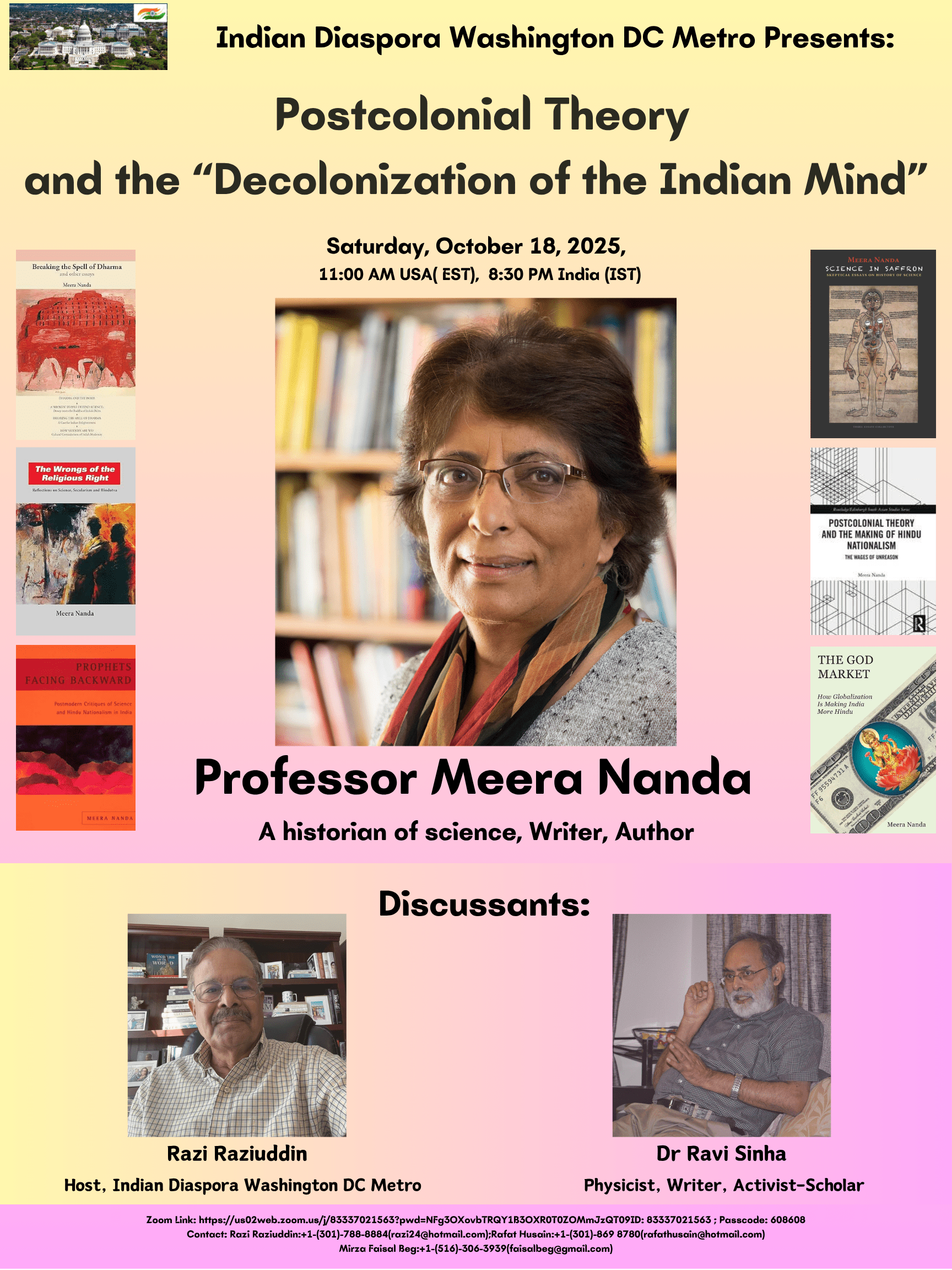
Indian Diaspora Washington DC lecture series
Topic: Postcolonial Theory and the “Decolonization of the Indian Mind”
Speaker: Professor Meera Nanda

Indian Diaspora Washington DC lecture series
Topic: Postcolonial Theory and the “Decolonization of the Indian Mind”
Speaker: Professor Meera Nanda

[This post is the seventh essay of the series in Kafila titled Decolonial Imaginations. Links to the previous essays are given at the end.
The terms ‘decolonization’ or ‘decolonial’ have become quite critical now, given that the impulse of justice lies at the core of these concepts. Neither postcolonial nor decolonial perspectives are compatible with right-wing ideologies but the fact that Hindutva ideologues in India and the rightwing globally are now trying to appropriate that language makes it seem to some that the very idea of the postcolonial or decolonial is suspect. We believe that this demonizing of decolonial theory from a position defensive of the European Enlightenment needs to be unpacked in the interests of a mutually productive debate. Kafila will be publishing a series of interventions on what the idea of the decolonial imagination involves, locating decolonial theory as speaking from the margins, drawing attention to identities which the orthodox Left subsumed under ‘class’ and which the rightwing in India seeks to assimilate into Brahminism. Additionally the orthodox left’s rejection of spiritual beliefs and inability to engage with them is also a factor that may have produced the space for right wing appropriations of a field marked “religion”.
We hope that these interventions will clear the ground for productive conversations on the left rather than polarised and accusatory claims.]
It is impossible to think of modernity and colonialism, without thinking of their third sibling – science. They are not just siblings, in fact, but a set of triplets which took birth within the same western context and period – and hence, the adjectives ‘modern’ and ‘western’ are used to qualify science, often by the colonizers themselves. Just as the notion of ‘savage native’ was a part of colonial construction, so was the idea of ‘modern science’. Not only did the colonial powers conquer people and knowledge systems across the world, but they also established hegemony within their own societies, colonizing them from within. This was done using complex mechanisms of power, control and appropriation. Continue reading Colonialism, Modernity and Science: K. Sridhar
At the recent Historical Materialism conference held in Delhi from April 3-5, a panel was organized with great fanfare – an official panel by the HM editors – around Vivek Chibber’s new book Postcolonial Theory and the Spectre of Capital. This panel was billed to be a decisive refutation of Subaltern Studies and Postcolonial theory, not only by the chief theorists and organizers of Historical Materialism but by many other Indians – most of whom in any case have little more than a religious faith in ‘Marxism’ and understand little of Marxism and its history. There was glee all around and one came across the hurried announcement of a Centre for Marxist Studies that was to host further events around this book against the demon that Chibber had apparently slain. After all, Chibber was backed by the likes of Slavoj Zizek, Robert Brenner and Noam Chomsky, all of whom had endorsed his book as the death knell to Subaltern Studies and Postcolonial theory. The glee was to be short-lived.
On April 28, at the New York conference of Historical Materialism, the organizers made the mistake of inviting Partha Chatterjee (a representative of a spent force, already buried at the Delhi HM Conference!) to debate the new star on their horizon. The meticulous demolition of Chibber that followed, embarrassed even his most ardent supporters, who had hoped to see the redoubtable Partha vanquished in person. And Chhibber, let our marxist brethren note, is reduced to finally accepting that he is more inclined towards contract theory than towards Marxism!
Partha, whose years of meticulous engagement with Marxism can hardly be taken on cavalierly by any upstart on the horizon, calmly tore Chibber’s claims to shreds. Many supporters of Chibber’s book have, in social media, glumly described the 28 April event as a great setback to their cause…
Here is Partha in debate…
 KAFILA - COLLECTIVE EXPLORATIONS SINCE 2006