
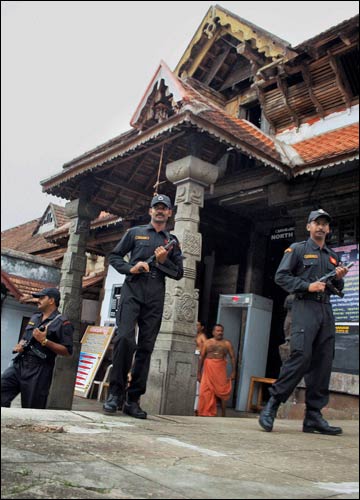
Giving a historical background of why the Sree Ananta Padmanabha Swamy temple in Thiruvananthapuram came to have these riches, Malavika Velayanikal writes in DNA:
True, the bags of gold coins, diamonds, precious stones, 18-feet-long gold necklaces, jewellery weighing many kilograms, and solid-gold statues of gods and goddesses landed in the vault via the king. But in reality, the temple treasury was nourished by the sweat and blood of the masses as well.
One of the main sources of the royal income was taxes. They were incredibly high for the lower castes, with marriages, childbirth and even death being taxed. Country boats, ploughs, carts, umbrellas, headscarves, why, even a moustache, were taxed. Mothers were allowed to breastfeed their newborns only after they paid the ‘mulakaram’ (breast-tax) to the local lord, who would then grant permission. [Must read]
But you won’t hear this said too often because, as Appu Esthose Suresh reports in Mint:
“If the government makes any move, then the believers will protest and BJP will support the people,” he (a temple staff member) was quoted as saying by news agency PTI.
It is precisely the fear of antagonizing a section of the Hindus that is forcing the state government to be cautious.
“This government does not have the courage to go against Hindu sentiments,” said P.R.P. Bhaskar, a political observer. “It will move in a direction which will accommodate the royal palace.”
“The Left Front gained Hindu votes for two reasons. Firstly, its traditional vote base consists of Hindus and a perception that Christian and Muslim votes are moving towards the Congress and its allies had led to a consolidation of Hindu votes. This might help the government change that perception a bit,” he added. [Link]
Hindu appeasement. That’s what will come in the way of a just, fair, pro-people decision about what should be done wit the temple wealth.
 KAFILA - COLLECTIVE EXPLORATIONS SINCE 2006
The I.N.Congress is the only pan-kerala party in the government which lost more than half the seats it contested in the last assembly election.
This anlaysis hold certain ground in kerala >>
“The Left Front gained Hindu votes for two reasons. Firstly, its traditional vote base consists of Hindus and a perception that Christian and Muslim votes are moving towards the Congress and its allies had led to a consolidation of Hindu votes. This might help the government change that perception a bit”
This thought particularly gained ground from 2003 during the rule of the then Congress lead UDF government and attributed to certain incidents.
>> Purge of A.K Antony from the chief ministership as well as state politics in kerala, the reason being the stand taken by Antony on the wake of the Marad communal riots as well as the controversial decision regarding the Self financing institutions. It was apparent that Antony was pushed out due to the overwhelmng pressure from the two constituents of UDF 1. Muslim league and 2. Kerala
congress . In fact after his contreversial statements on the wake of these two happenings garnered him adjectives such as
‘strict seccular gandhian’, ‘soft Hindutvavadi’ etc. The same Antony is now no where in kerala politics.
The only difference you can see in the last election is
1. The movement of upper caste Hindus towards Left (who otherwise aligned with UDF)
2. The tepid response to the calls by Fundementalist groups such as Jamaat e Islami and SDPI by the muslim constituency of Malabar. This was a decisive factor during the 2004 and 2006 elections as these groups held certain ground on harnessing the emotive issues of mulslims such as Iraq occupation, Palestine etc(there is sizable expatriate community in mid east from malabar)
this used to favour the LDF as it helps in splitting the Mulslim votebank of malabar.
3. The in ability of various Christian denominations to take a common political stand
LikeLike
I’m not sure that you want to argue in this manner. You seem to think that the products of unjust taxes should be returned to the people, via appropriation by the GOI. But if that’s the principle you’re working with, then only the proportion of temple wealth due to unjust taxes ought to be appropriated and redistributed by the state. It looks like an empirical question what proportion of temple wealth that will turn out to be — it might even be quite small, since one might reasonably imagine that the tax revenues due to trade and merchant activity would yield the bulk of state revenues (I have no idea).
But let’s look at the principle a bit more closely. You might think that given the prevalence of indirect taxes on salt, matches, etc — the effective marginal tax rate levied on the masses by the GOI today are unjust. Why would you trust the GOI to effectively appropriate and redistribute the wealth of the temple when it itself prosecutes an unjust tax regime?!
LikeLike
The temple ornaments are historical artifacts that should be studied and kept in a museum. I respect the Govt for trying to preserve it instead of selling it away to build roads that anyway would not survive more than one monsoon. It might also serve as vote winning Hindu appeasement for the party. But how does that make the decision to preserve historically important artifacts wrong?
LikeLike
That’s what will come in the way of a just, fair, pro-people decision about what should be done wit the temple wealth.
Sorry: what exactly is a just, fair, pro-people decision regarding the use of the temple wealth?
Please note that Malavika Velayanikal’s point about the temple treasury being nourished by the sweat and blood of the masses applies to all states, past and present. Was the Taj Mahal not nourished by the sweat and blood of the masses who lived at the time it was built? Where exactly did Shahjahan get the money for this monument if not through tax revenues? For that matter, how about the many useless monuments built by the current Indian state (using tax payer revenue) like Rajghat, Shantivan…?
Surely, there needs to be a debate about what is to be done with the temple treasury. I would rather this be decided through the political system rather than by the Supreme Court. I am not sure throwing around phrases like “Hindu appeasement” contributes to this end but then, this is simply my opinion.
LikeLike
This Gold is accumulated by exploiting/killing BC/SC/ST/Minority communities in useless/clueless wars.
Govt must distribute this temple wealth to BC/SC/ST/Minority communities.
Otherwise we’ll seek autonomy from India by invoking the 1932 Round Table Conference Resolution via a Bill in Indian Parliament.
90% of corrupt/illegal/black money is with the Forward caste.
Bofors scam = 64 crores(FC)
Urea scam = 133 crores(FC)
Stock market scam = 4000 crores(FC)
Satyam scam = 7000 crores(FC)
Sahara scam = 40,000 crores(FC)
Common weath games scam = 70,000 crores(FC)
Civil food supplies scam = 200,000 crores(FC)
KG Gas scam = 200,000 crores(FC)
Fodder scam = 900 crores(BC)
2G scam = 30,985 crores(BC)
LikeLike
Feel free not to believe all your email forwards. And please don’t create any on sensible forums.
LikeLike
The riches of the Padmanabha temple was originally the people’s private property, which was confiscated by the royal government through confiscatory taxation and other means. Much like our public sector banks, coal mines, Air India and other industries, not to mention the 5.32 Lakh crores in direct tax – that is 5 Padmanabha temples every year.
The only problem is how to return it to its rightful owners. Through the socialist government’s ditch-digging-and-filling-in-again make work schemes and such ‘welfare programs’? Gimme a friggin’ break!
LikeLike
How about redistributing the land owned by chruch and christian organizations in prime locations in major cities to build flats for poor. These lands were given by the British to them. How about converting the posh hotel at hyderabad the erstwhile palace of the ruler of hyderabad into a educational complex for the poor. How about resdistributing the wealth owned by christian and muslim charities to the poor among christians and muslims. If you are comfortable with this then the idea of using the new found treasure for common good makes sense.Otherwise it is another example of sickularism
LikeLike
Where exactly are you guys getting this info about mulakaram being tax to breast feed? Is it from the history of Travancore written in the last week? Sheer nonsense. One guy said that nonsense online and all the others are quoting that. Also, that tax was limited to a small region of travancore,
LikeLike
Lets do away with all such accumulations of wealth that were built on the toil of the common people. Lets sell the Rashtrapati Bhavan first. The president can be housed in any normal residence in Delhi. And 360 acres in the heart of Delhi is going to yield a lot of money.
LikeLike
If the premise is that we should go back 200 years, identify the victims of excessive taxation and redistribute the temple wealth to their heirs, then using the same premise, we should go back 50 to 75 years and redistribute the various tea, coffee, rubber estates back to the adivasis….
LikeLike
Upper caste Hindu crooks, politicians, and their cronies will try to steal the money.
Collected from the poor, it will be lining the pockets whoever is in power. And ultimately, it will come to USA in the form of IMF load and WTO interests that had to be paid.
The lower castes will continue to suffer while the upeer caste Hindus will squabble over the spoils and how to best devide the loot amongst themselves.
Anyone who follows the story of scams, knows that ultimately all the wealth of exchequer is drained by false companies and is spent in giving it away as a price of hefty bribes by foreign companies. The state is busy stealing and is the biggest theif in Inida
LikeLike
Dear all,
What about the heavy loot carried out the tyrant Tipu Sultan who took all the riches of Malabar which is presently with his descendants (who were shifted to Kolkata by the British), which is the richest Waqaf Board in the country, any takers.
pl discurss
essen
LikeLike