
This guest post by ALIA ALLANA is an account of polling day in Tunisia
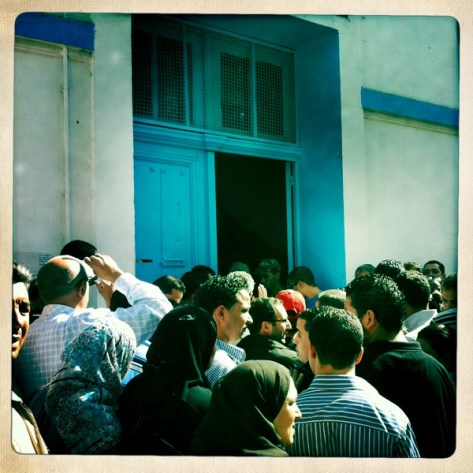
They had already waited so long, what was a few more hours?
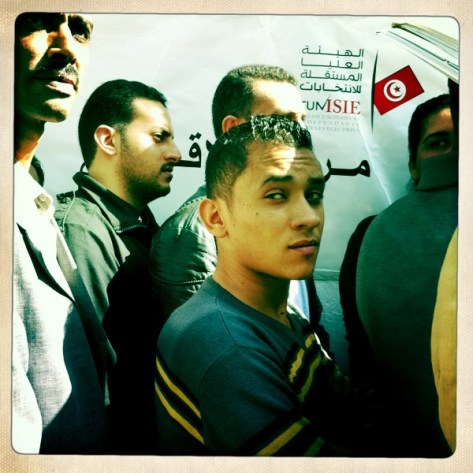
So as hundreds queued to vote for the first time in their lives in Tunisia’s first genuinely free election, a group of men were sat in a small bar in Tunis center, kicking back beers. Two of them had already voted and conversation was rampant. Should the Islamists come to victory in Tunisia, would the secular set-up – one that allows for such luxuries as alcohol consumption – be shaken and stirred?
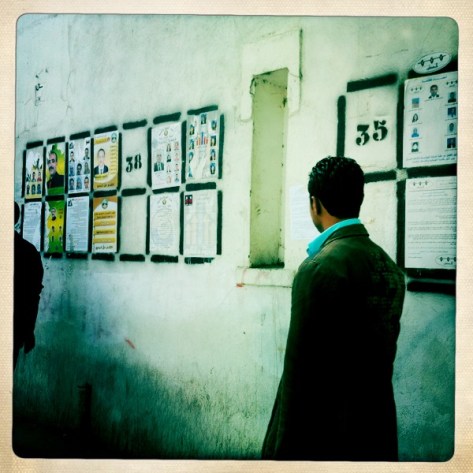
In the first of the Arab Spring elections, Tunisia has come out as a role model for a peaceful transition from an authoritarian regime to a democratic pluralist society. There are over a hundred parties that are contesting the poll.

Once again, like on December 17 when Ben Ali, in power for 23 years fled the country, Tunisians again feel all eyes are on them. Today they have gathered to vote members to a 217 seat assembly that will draft a constitution and appoint the interim government.
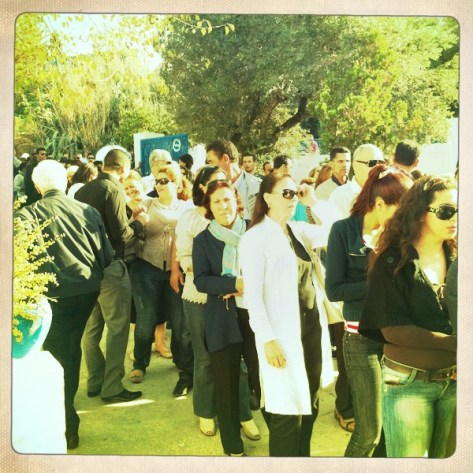
On the central boulevard, Avenue Habib Bourghiba, leafy and green, men and women gathered at the pavement cafes. Two men stood outside a bookstore with blue-inked index fingers. They discussed the ramifications of their votes. Hamed was worried: Tunisians never had the opportunity to choose their political fate and in the race between the plethora of parties are three that have gripped the people’s minds. Ennahda, Takatul and the Progressive Democratic Party had legions of followers. Both men were weary: power has for so long been centralised and the question was whether the victorious party would be willing to form a coalition.
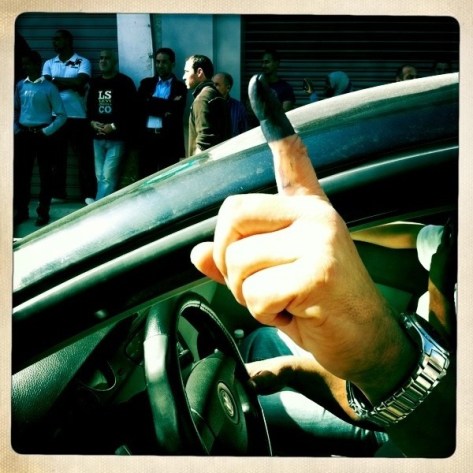
Hamed also feared that the voting public was apathetic. He looked at the streets where people sat idly, sipped Turkish coffee and puffed away on the shisha.
“Have they forgotten about the revolution,” he asked.
He hadn’t. The bookstore had been transformed into a museum for revolutionary paraphernalia. Postcards at the entrance were not of sights of Tunis but of people and their struggle: 11 out of 16 postcards were of the Tunisian Revolution. There were no classics or books on Berber history at the front but rather books on revolution.
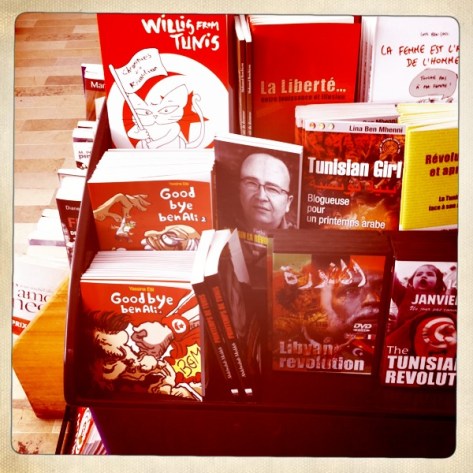
One slim book, Revolution et apres? found its place in the corner. This was indeed the next step, agreed Anwar, but he did not know what to expect but he knew what was needed. The store anticipated the arrival of more books to keep the revolution fresh and alive in the minds of the people.
But voting day in Tunis looked like any other day.
Stores were open, there was no special arrangement for those who wanted to exercise their suffrage and so Ali, at the popular Paris Café had organized to take turns: one waiter tended to to the customers as the other voted.
Along the roads that were once white washed, almost virginal, are posters of candidates. The walls now have graffiti on them, the white is barely visible as posters have been glued and pulled off. There are photographs of men and women, characters of all ages with affiliation to all parties.

Nadia was afraid of the outcome and so wouldn’t vote. She sat at the shawarmaa shop and refused to exercise her suffrage. For some there are fears that the most modern yet also the most draconian of the North African, Levant countries will fall victim to Islamists. It was these very Islamists that Ben Ali had hunted and imprisoned. Parties that were once banned, leaders that used to organise from exile now stand a genuine chance of winning.
But Rami wanted to set the facts straight, he pulled on his beard, spent a lot of time thinking and finally spoke.
“We are not like Iran here,” he said. Tunisia was a Muslim country and that the emergence of a Islamic party could do no harm. Ennahda was not a conservative party, it did not want to return women to households and put in place the law that allowed polygamy. It was merely an Islamist party that advocated reforms for the poor. He cited Turkey as a role model and Erdogan hadn’t hurt Turkey. For a country with nothing but aspirations to run, Turkey seemed like a successful role model to emulate.
He fixed his long flowing thob: he asked whether being dressed in the garment made him a terrorist, instilled fear in the hearts of others? A group of boys joined in and hooted, freedom and Ennahada.
But not all are certain of the party, some are fearful of consequences. Salma, a resident of Sidi Bouzid, the small town where the first anti-regime protests started, was weary. She had been out on the streets from the second day, she had seen the revolution gather momentum and acquire a life of its own. For her the future was, at best, uncertain. The dominance of the election by pro-Islamic parties could mean an infringement on the rights she had enjoyed and come to value as a given. First, Salma wanted peace and second, she wanted mature people to lead the government. For her a coalition government was most suitable and the only answer to balance competing desires for power.
Laila interrupted; she had no time for the debate. She was voting PDP into power and had a message for those who would vote the Islamists in: “We will take your husband,” she said. Tunisia has barred polygamy, allowed by Islam, and the unclear Islamist mandate has meant that fears are high about what the Islamists will bring into the country.
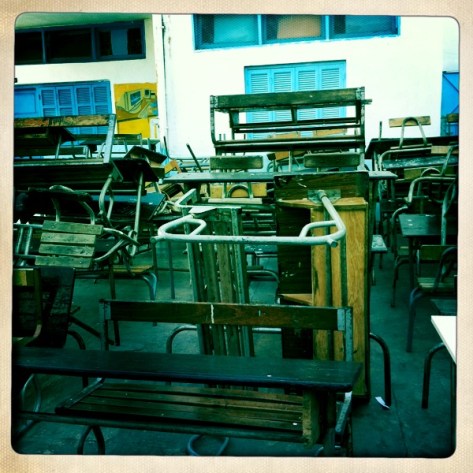
Inside the polling station on Rue Marseilles, the largest polling station in Tunis, chairs have been emptied from classrooms. Together, they lie mangled on top of each other rising like a small hill of wood and metal. Foreign journalists scurry about but voters are patient. Occasionally a scuffle breaks out, some are in a hurry. The Tunisian sun is strong.
Amna, 62, never thought this day would come, she was confused about the procedure. She took the slip and stood behind a white cardboard box. She ticked her choice and proceeded to the clear white ballot box. She closed her eyes and dropped the ticket in. This was a personal victory not just for her but for the idea of freedom. For her this was enough, but outside, a woman with big blonde hair and big red lips was on the edge. She had stood in the queue for four hours, had spent time getting ready and was disallowed from voting for she didn’t have the right paper proof. She hadn’t been properly informed, she said.
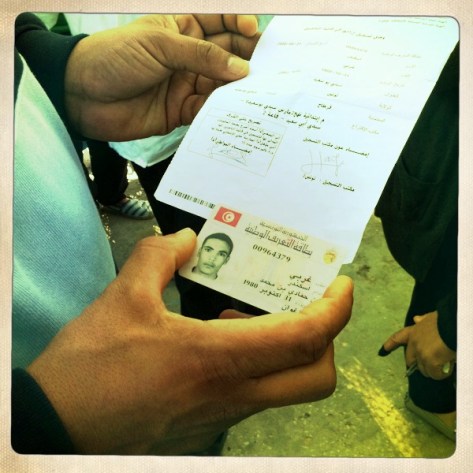
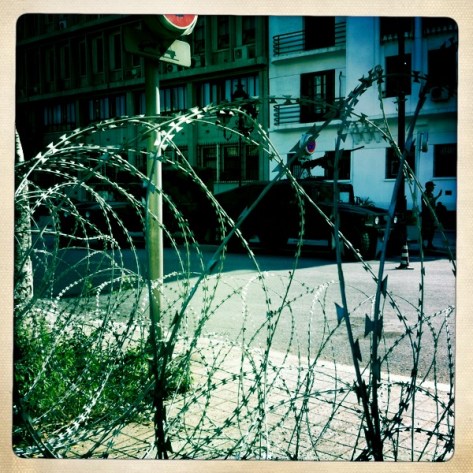
As morning turned into afternoon, cars continued to drive along the central street. More people sipped Turkish coffee and munched on shawarmaas. The scent of shisha carried through the air. There were extra police officers on duty and tanks stood idly outside the Ministry of Interior, once the site of massive protests. No one anticipated violence. Today was a day for celebration.
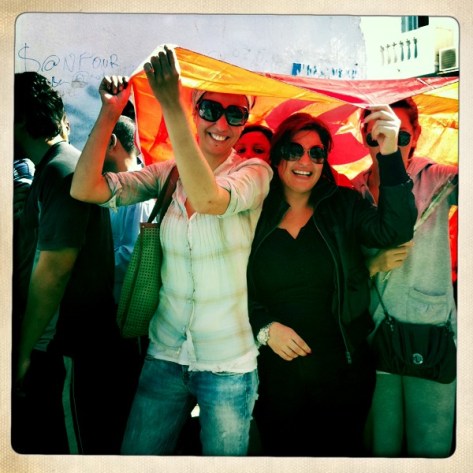
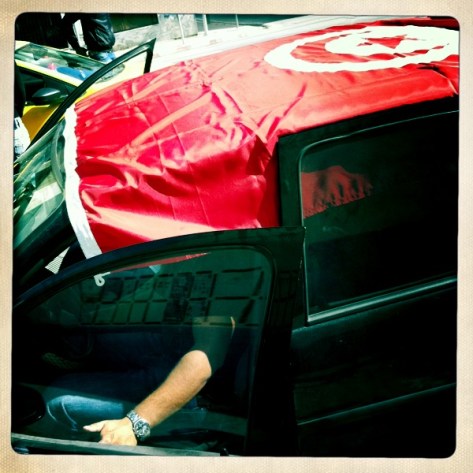
Two boys jumped out of their car and removed a large white and red Tunisian flag. They unfolded it and put it on top of their Peugeot. It looked like a headscarf for the car. The tucked bits of the flag inside and were ready to go. They hadn’t voted but they didn’t care. The day called for celebration anyway. They zoomed off beeping their horn. The flag filled with air underneath flapped in the wind.
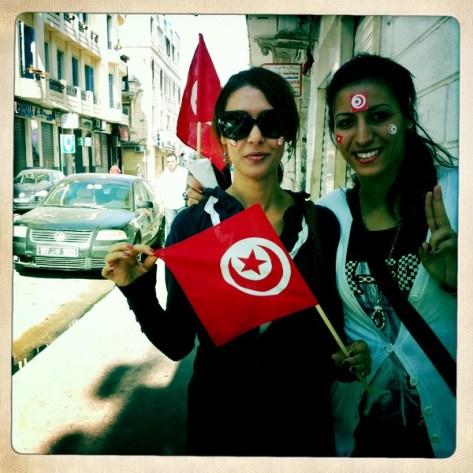
Two girls who had voted for the centrist secular party had come out fully decked up and ready to support the state. They had small flags that they wave giddily and their face was covered in paint with the Tunisian crescent and star. They were ready for a new day and a new system.
Strangers became friends as a young boy helped an 83-year-old lady get her cards together. He escorted her to the small school in Sidi Bou Said and she stood in line to vote. She had grown old and hunched in this town, the hometown of Ben Ali. She had once seen him driving his car down this very road and she wondered if he thought this day would come. When she, a poor woman, would have a right to say in what should happen in matters of the state.
Previously in this series by our lady of the Arab Spring:
- Sidi Bou Said, Tunisia: Mickey wants to be the first one to vote
- Damascus, Syria: The Minister for Information maintains that there is no revolution
- Homs, Syria: A day in the rebel stronghold
- Arabist.net: A Personal Note on the Tunisian Elections
 KAFILA - COLLECTIVE EXPLORATIONS SINCE 2006
Here’s hoping that they remain a secular democracy and follow as a role model Turkey rather than Iran.
LikeLike
summarise highlights of Muslim party’s manifesto. that would be more interesting bala
LikeLike
this is just the beginning for Tunisia. All depends on which party wins the elections and the regime that follows
LikeLike
http://www.siawi.org/article2624.html
LikeLike