
This guest post by ALIA ALLANA is part of a Kafila series of despatches from the Arab Spring
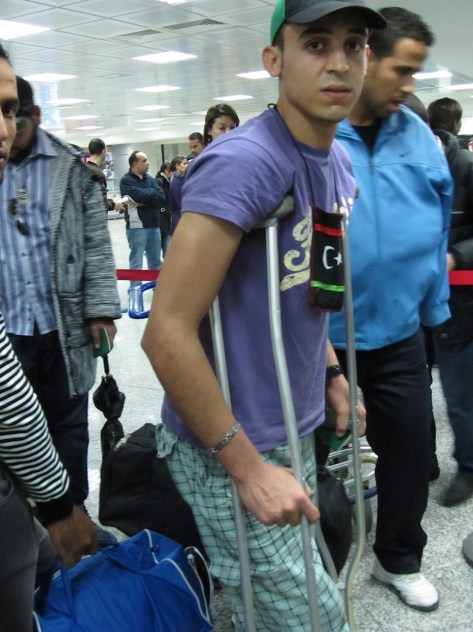
When does a boy become a shabaab?
Literally, in Arabic, shabaab means young men. Before the fever of the Arab Spring raged in the minds of the youth, back when boys used to gather in squares aimlessly, girls eyeing them would call them shabaab.
But that was then; before the political architecture of the Arab world was reconstructed.
Today the shabaab are the disenchanted youth, the angry boys of Benghazi with deathly toys devoid of opportunity, angry at their condition, aware of the world through the Internet and their mobiles, acting out their rebellion. Today the shabaab, the rebels of Libya, want what they think is theirs: the right to self-determination, a say in politics and freedom.
I went looking out for these men and here is what I found.
We had been driving for four days, the Tunisian sun had started to wreak havoc on the eyes. But a feel-good sentiment was in the air. Tunisia, home to the Arab Spring, had just voted and the blue ink from the election booth still stained the fingernails. Tariq didn’t want to wash his finger — the ink was a memento, a story of success, he said.
He worked in a small coffee shop in Gabes, a Southern Tunisian town. Gabes was a no-nonsense deadbeat sort of place. Slow-paced and quiet, even the busiest thoroughfare, the cornice, was lacklustre, devoid of activity. The only people selling wares were cigarette men. Tariq, like the other few on the street, wore a badge or pin with a Free Libya logo. Some wore the new Libyan flag t-shirts and others sported baseball hats with the red, black and green flag.
“We support the rebels – the shabaab – because they followed our route,” he said.
 Tripoli was a mere 350 kilometers away. The revolutions were a common good for the neighboring countries and were a unifying factor in these chaotic times. The romanticism of the revolution had possessed a cigarette-seller; for he could hear the gunfire of freedom in his dreams.
9 months have passed since the despot Ben Ali boarded his jet and whizzed out of Tunisia to Saudi Arabia; two weeks have passed since Qaddafi was killed – his turban yanked off to reveal a bald patch, his body dragged in the dirt, poked, probed and photographed. His tragic last words, “Don’t shoot, don’t shoot!” are mimicked in Tunisia’s small towns.
With both strongmen evicted, the links between the two countries have begun to thrive. Lorries en route to Libya keep running, the gas stations with Oil Libya continue to be refilled. The revolution has brought no bureaucratic change, no sudden overhaul of the system. Only, anger towards the past has been painted on the streets. Defiance against the system is obvious: vandalism and graffiti are on the rise. The police, once the eyes and ears of the state, are now watchful, almost scared.
Jamal, a police officer pulled us over as we entered a small town en route to the Libyan border. He had no reason to ask for our papers but he still did. Maybe he just wanted to talk. Police reform in Tunisia had begun – but stalled – and the men in uniform were the focus of much resentment, obvious targets of anger.
“Nobody respects us anymore,” Jamal said.
Some just pass him by as he waves his hands and gestures for them to stop. They don’t. Instead they swear at the police because they, the people, could perhaps smell the stench of the former bureaucracy on these men. Jamal wanted to know where we were going and why we were driving in this nothingness.
To head to the border, I said.
Just go from here, why travel all the way. “Not many follow laws these days,” he said.
 He meant to say we should go to the legal border crossing, three hours away, even though the nearest border point was only an hour away.
The Arab Spring in North Africa sees the Libyan flag flying on Tunisian soil. Borders, created by states to impose control, to demarcate between the laws of one country and another, have blurred. Who decides what is legal now; who runs the show, when the government is yet to be formed? The Arab Spring has at once deposed the ancient regime and triggered a collapse in law and order.
The graffiti is testament to that. Almost every roundabout, on almost every street corner, on road signs that are high enough for a man, for a boy to reach, something intelligible has been scribbled. Initials of people have gone up, crosses across the sign make them incoherent, spellings changed.
Why is this happening, I asked the police officer. Who would stop them, “there are more of them than us”, he retorted. Was it the shabaab; was it because of solidarity with Libya?
 Again he laughed. Who isn’t a shabaab these days?
Everyone is a rebel today. Many don’t have a cause because the changes that prompted the revolutions will not be felt for years, according to Jamal.
It gets more chaotic as you drive towards Libya, he said. And it does. Fuel prices are all over the place. Petrol stations have competition with men standing on the highway, selling cheaper petrol, identifying themselves with a Libyan flag flying over their heads. Libya has oil and in this lawless specter of land, everyone is a rebel. They are the nationals of the revolutions, out to make money.
We edged towards Libya; 350 kilometers, money became an issue. We had 2 dinars left. The towns I passed were so small that ATM and credit cards meant nothing. I had dollars, euros and currency from other Arab countries but only Tunisian or Libyan currency would work, for Tunisia had become another home for Libyans.
As the fighting in Libya captivated audience around the world, a mass exodus out of Libya took place. Thousands fled to neighboring countries with bags on their heads, ducking away from rapid gunfire. Tunisia opened its doors to over 100,000 refugees from Libya and many entered from Ras Jedir. That’s where we were headed, in the Golden Peugeot.
The first town with an ATM was Ben Guerdane. Along the way at a small roadside coffee shop I was told that Ben Guerdane would offer answers. I went inside a cake shop that was run by three women. Are there any Libyans here I asked; the border was less than 2 hours away. Nourhan nodded yes and took me by the hand. We stood outside the shop and she squinted to see who was driving.
Nourhan pointed to every fourth car. I said it couldn’t be. Those are Libyans, she said, again and again. I waved a car down. Two boys sat inside. Here is the conversation:
Me: Are you Libyan?
Boy: Yes.
Me: What are you doing here?
Boy: Living. We are all now one country, one ruler. Us. We have thrown away our dictators and now we are the rulers.
He sped off.
After another hour of driving we were headed towards the border. The Tripoli sign had been replaced by one that read Libye and check points were a constant. Army men pull over almost every car; they check the backseats and often ask to open the boot. I was told they are checking for arms. (Yesterday on the BBC, I heard that the UN is concerned over the massive stockpile of weapons in Libya.)
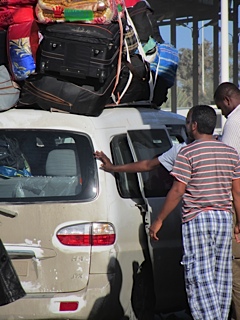
Large trucks traverse the highway, trade between Tunisia and Libya is continuing. The Ras Jedir border has ambulances that drive by frequently. On the back window is a Free Libya sticker. There is one canteen at the border and at the peak of the crisis, when refugees came flooding in, the canteen ran out of water and Boga (the popular lime drink). Hamburgers were in constant demand and the canteen was flourishing. It’s much quieter now as the cars get ready to head back into Libya. Suitcase are piled as high as the height of the car, one car had 17 bags on it.
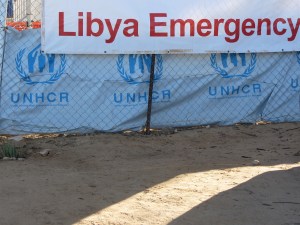
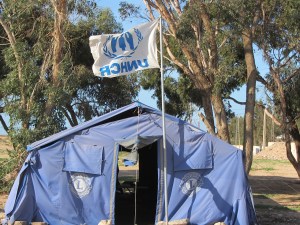 Opposite the canteen is a small tent where the UNCHR flag flies. Next to the UNHCR office is an abandoned UNICEF building.
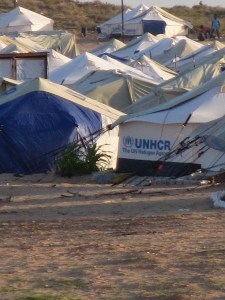
We drove around the vicinity and up and down the highway. Then, like a tragic mirage, off the tarmac as the earth turns into brown sand, is Sousha Refugee Camp. It is camouflaged against the desert landscape, the tents are different shades of brown. Shousha is a sprawling network of tents – the only infusion of color is the blue UNHCR logo on the tents.
Children are playing football in two grounds. The grounds are contained by wire. The message is simple: nobody can get out. There are army-sighting towers on all four corners and in the distance, the sound of the djembe (drum) floats and carries.
The Shousha Refugee camp was set up in March. Back then there were at least 100,000 people living there. Today there are only 3,500 left.
But no Libyan, no Tunisian flag flies here.
Abutting the refugee camp is the Islamic Relief Worldwide Tent. Behind a laptop is Nanag Sorija. He arrived in Sousha in March; his NGO tried to help the Libyans that crossed over but didn’t have much luck. The desert heat meant that the Libyans wanted to cross into Ben Guerdane where they had contacts, some stayed in the Qatari and the UAE refugee camps but none wanted to stay off the highway, he said.
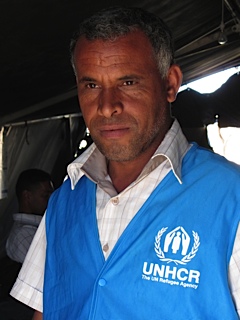 We drove further along to the UNHCR settlement. Outside a UN Medical Counselor was in conversation with a Libyan man. The Libyan was looking for his family, the Counselor didn’t have any answers. No Libyans here, he said. The Libyan held on to the wire that separated the camp from the outside world – he wasn’t allowed in, neither was I.
A curious situation has developed at Shousha.
When Qaddafi was still in power, Libya was an importer of foreign labour. Thousands of people from all over Africa – from Somalia, Sudan, Darfur, Eritrea, Ethiopia, Nigeria, Chad, Senegal, Ivory Coast – worked in Libya. Many of them have lived in Libya for years. Sorija has been involved in aiding some refugees who have called Libya home for over 20 years. These people are educated; they are engineers and lawyers and doctors and have no way of returning home, to the Libya they call home.
I spoke with a gentleman who requested his name be withheld. He is from Sudan and is a doctor. He fled Libya in March from where he worked in Misrata and walked to the border with Tunisia. He has lived in Libya for 17 years and calls it his home. But he cannot return. As Libya now stands somewhat liberated, the shabaab are putting the final touches to their freedom and purging themselves of the last vestiges of Qaddafi’s rule: anyone who was formerly associated with the government is being targeted, the doctor explained. (Friends of his who remain in Libya are now required to wear a badge that carries information about their allegiance. You are either with the rebels or you face death.)
Sousha is a third country refugee camp. The camp has been divided into zones and the zones mirror the map of Africa. The Libyans have returned home but the inhabitants of Shousha now have nowhere to go. The UNHCR is predicting a longer-term engagement as their compound off the highway has a constant sound of drilling and tents are being replaced with pre fab buildings. When I asked if the inhabitants of Shousha would return back, the question was ducked.

After much probing I was asked a question. Where to? And to whom? The bloodied image of Qaddafi, his familiar face rubbed in the dirt, his toupee yanked off his forehead, has changed the lives of these people forever. As the rebels look for enemies, as they change the system and attempt to morph into a unified body the future is uncertain and angry men with guns are looking for people to punish.
I met with no formal shabaab at the refugee camp but oddly enough I met 23 of them at Tunis International airport. Here is one shabaab’s story. Sidiq Bashir Hanga had never picked up a gun in his life. He was given one. Unemployed and without a future he left his village and made way with 11 men to Misrata. He left his wife and three children behind.
Misrata was a scene of heavy fighting and the shabaab were centered around the Al Qalaa area. Al Qalaa had been all but reduced to rubble. Urban warfare had taken its toll and the stench of death permeated the air. Hanga stood behind a building when two pro-government bullets were lodged into his back. They entered his spine and he fell on the ground. He remembers the gun falling out of his hand but not who picked him up. He doesn’t know whom to thank for saving his life.
Those two bullets took both his legs away; he is paralysed waist down.
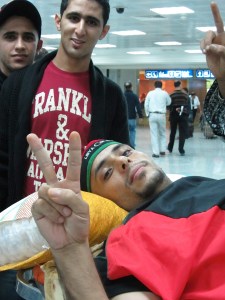 I met him at Tunis International Airport. The airport is small and chaotic. There was no order until the 23 rebels arrived. They were all injured and had made their way down to Tunis from Ras Jedir. Treatment in Libya produced no results; Tunis was a fail as well. Dr. Mohammed Ibrahim, a Libyan doctor in Tunisia was organizing for the movement of rebels from Tunis to Rome.
Hanga was the first one to enter the airport. The disorder morphed into queues to make way for the rebels. Hanga was on a stretcher. No blanket covered his body or his mangled legs, instead a pre-Qaddafi flag, the red-black-green cloth covered his body. Passengers at the airport flocked to Hanga; they took pictures of him. This was their memorabilia of the Arab Spring.
Hanga raised his hand, flashed the peace sign. He would get help in Rome. I asked him if it had been worth it? Yes he nodded. Then feebly he said, “I would lose these legs again to kick Qaddafi out.” He showed me his mobile and the screen saver was the bloodied picture of Qaddafi we have all seen by now.
The future is good, said Dr. Mohammed Ibrahim. Money would come because these men were the heroes of the Arab Spring.
The shabaabs, the rebels, were now heroes.
(Alia Allana is our lady of the Arab Spring.)
Previously in this series:
- Jerba, Tunisia: The Synagogue and the Jihadi
- Tunis, Tunisia: “We are not like Iran here”
- Sidi Bou Said, Tunisia: Mickey wants to be the first one to vote
- Damascus, Syria: The Minister for Information maintains that there is no revolution
- Homs, Syria: A day in the rebel stronghold
 KAFILA - COLLECTIVE EXPLORATIONS SINCE 2006
good piece of reporting.our papers have no such inputs even about our own states. What a pity. Carry on Allana ! bala
LikeLike
good one!
LikeLike