

The Establishment’s desperation is becoming clearer by the day. And by ‘Establishment’ here, I do not mean simply the ruling duo in power today but a constellation of forces, many of whom congregated at a mega-wedding event in Mumbai recently. The embryonic New Congress thankfully stayed out of it – though the Old Congress is pretty much part of the Establishment, as we will see below.
Popular Delhi chief minister, Arvind Kejriwal has finally got bail from the Supreme Court – both interim and regular – in the totally fictitious Enforcement Directorate (ED) case in which he has been framed. Yet he must remain in jail because on the eve of his release by a Delhi court and Additional Sessions Judge Nyay Bindu, the Central Bureau of Investigation (CBI) went and arrested him while he was still in jail!
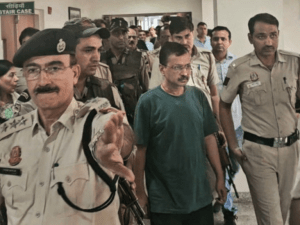
This arrest-within-arrest shows a desperation of the Establishment that has rarely ever been seen before. The desperation was even more evident in the fact that the High court judge, Justice Sudhir Kumar Jain went ahead to uphold the ED plea against the bail order by Judge Nyay Bindu, even before the order had been uploaded to their website. 157 lawyers wrote to the CJI alleging that the brother of the Judge, Anurag Jain is one of the counsels for the ED, which showed a clear conflict of interest. More importantly, referring to the urgent listing, hearing and stay of the trial court’s bail order by the high court, the lawyers’ letter said,
“Something like this has never been seen in the history of the Indian judiciary before this and this has raised deep concerns in the mind of the legal fraternity.”
Equally significant from the point of view of gauging the Establishment’s desperation, raised in the lawyers’ representation, was the reference to another unprecedented development – that of “a purported internal communication from a district judge here asking vacation judges of trial courts to not pass a final order in pending cases during a court recess“,
Let us pause and focus on this scenario: The ED is about to lose its plea against the bail to Kejriwal, so just before that happens, another central agency, the CBI comes and arrests him while in jail. The ED moves High Court to stay the Additional Sessions Court order. The HC judge obliges, without even waiting to see the order. It just so happens that his own brother is a counsel for the ED. And in the meanwhile a district judge takes it upon himself to tell vacation judges to leave pending cases hanging, during court vacations. All these characters and institutions are working in tandem to stop one man, a sitting chief minister, from getting bail. So, is there a single puppeteer who is making all of them dance in tandem? Or is just coincidence? We leave that to the reader to judge.
And just in case we forget, let us remember that two senior ministers of the Delhi government, including Deputy Chief Minister Manish Sisodia – continue to be in jail, without even bail – despite no evidence having been produced against them. Another top leader, Sanjay Singh too came out on bail after spending a few months in jail.
So what is the desperation all about?
A Flashback to February 2014 and After
The 49-day AAP government (supported by the Congress in a strange turn of events) fell on 14 February 2014, after the Jan Lokpal Bill piloted by it was defeated. “On 11 February, it [the govt] directed Delhi’s anti-corruption branch to file an FIR against Mukesh Ambani and former Union Petroleum Minister Veerappa Moily among others. The charge: conspiracy to double gas prices in order to benefit, among others, Reliance Industries at the cost of the exchequer.” (Saba Naqvi, Capital Conquest: How the AAP’s Incredible Victory has Redefined Indian Elections, p. 41) Let us remember that Mukesh Ambani had claimed in one of the leaked Radia Tapes conversations (regarding precisely the fixing of the Petroleum Ministry) “Congress to apni dukan Hai”.
After the Old Congress lost the elections that year and the Modi government took control, Kejriwal and AAP returned with a thumping majority, winning 67 out of 70 seats in February 2015. It is certainly not an accident that one of the first things that the Modi government did after AAP came to power, was to take away the Anti Corruption Branch (ACB) from the Delhi government and place it under its own direct jurisdiction, via an order by the Lieutenant-Governor, who just happened to be a former Reliance employee. The Old Congress (Ambanis’ dukan), the new Modi government of the BJP and the LG – all were in the service of the same forces. Perhaps more accurately, their interests converged – the other Gujarati industrialist was to soon displace this gentleman from his Number One position but that is another matter. In some respects, both Ambani and Adani now became the wielders of power to whose tune every politician worth his or her salt, danced and continue to dance.
Rahul Gandhi refused to join the marriage mega-event despite Mukesh Ambani himself having gone and delivered the invitation at 10 Janpath, according to reports. But AAP might have been the only party whose leaders were, of course, understandably, not just not invited but happen to be in jail.
All the above dots can be easily connected to see the faces that emerge who constitute the core of the Establishment. The threat from an AAP, whose country-wide popularity was evident even during the 2014 Lok Sabha elections, had to be urgently met. The campaign against AAP and Kejriwal started right after the FIR against Ambani (referred to above) was filed and the entire Ambani-owned media (which was most of the media) was thereafter, under strict instructions not to cover AAP and Kejriwal, so say journalist friends who went through that phase while still in the media. If they had to cover Kejriwal, it had to be only be a negative coverage.
The threat had to be nipped in the bud – it could not be allowed to grow, It became clear that AAP in power in 2015 was rolling out a different vision – not focused exclusively on the Jan Lokpal Bill but rather on providing free health and education to Delhi’s residents apart from free water and electricity. Hence within three months of the government assuming power, on 21 May 2015, the Union Home Ministry issued a notification that further clipped the wings of the government: Already the Delhi government had no control over “Public Order, Police and Land” as they were under the jurisdiction of the Centre and the notification now included “Services” in that list. This was obviously used to control the officers working with the Delhi government, who were recalled or transferred by the Central government at will, often leaving the government with no effective powers to intervene. This situation was only overturned after a long legal battle, by a five member bench of the Supreme Court in July 2018.
Once again, the Government of National Capital Territory of Delhi (Amendment) Act 2023 overturned the SC’s decision (also known as the Delhi Services Act), extended the Central government’s control of services and once again, placed the LG above the elected government.
The Challenge to Neoliberalism
One can understand why a direct attack on the Ambanis and other crony capitalists aroused such anger among sections of the media directly owned by them and politicians directly in their pay. But what exactly is the Establishment’s problem with the measures undertaken by the AAP government for the well being of the common people? Here lies the rub. At this point another part of the faceless Establishment becomes visible.
Long before the Anna Hazare movement, in 2005, Arvind Kejriwal had, through relentless RTI activism, exposed the World Bank sponsored Delhi Govt plan (then headed by Sheila Dikshit) to privatize Delhi’s water supply and hand it over to Price Waterhouse Coopers. After collecting thousands of pages of evidence, Kejriwal went around campaigning against it and stalled the move towards privatization of water. If we did not have to go through Cochabamba type “water wars” in Delhi, it was thanks to that move. It is thanks to that move that their government is able to provide free water to its inhabitants, especially in poorer colonies. Kejriwal’s thinking on this issue, elaborated in six pages of the AAP manifesto, comes from cutting edge thinking that sees water as the non-commodifiable lifeline, on which no price can be placed. This is anathema to neoliberal theology, which sees virtue in privatizing everything.
And it is not just water. Kejriwal and AAP have called the neoliberal bluff year after year, in the last ten years by providing free and quality education, health, water and electricity (against the neoliberal drive against “subsidies”) and has moreover done it through the state (against the neoliberal mantra of “privatize, privatize, privatize”). They have done all this and still come up with a surplus budget without having to raise tax rates.
All this directly challenges the neoliberal common sense that sees corporate capital (especially crony capital) as the only God that can deliver the world from its miseries. It is interesting that on this one issue, the Old Congress and the BJP, even segments of the Left (think of Singur, Nandigram, Vizhinjam), stand together. They are either part of the Establishment or hegemonized by it.
Kejriwal is not a Leftist and he does not use chic radical jargon to make his arguments and he understands that the needs of ordinary people’s everyday lives cannot be addressed through large abstractions of either the neoliberal variety or that of the Left. His stance on all these issues, nevertheless, is what the Left ought to have been fighting for.
 KAFILA - COLLECTIVE EXPLORATIONS SINCE 2006
Very much revealing and informative; Thanks Aditya Nigam
LikeLike