
Guest post by AMAN DEDHIA
It has been a while since my time in Rajasthan. It took a while to collate and make sense of everything I saw, understood and documented during my time there. I have tried to write down the major parts of it in this not-so-short document. To set some context, in the two weeks I was there, I met the people from the Oran padh yatra, people from KRAPAVIS and other organisations and, most importantly, stayed in a few villages in Jaisalmer where the people were kind enough to show me around. What started with an urge to understand orans, conservation and their problems with solar projects, took me on a journey that at its core was about understanding wastelands and autonomy.
Orans
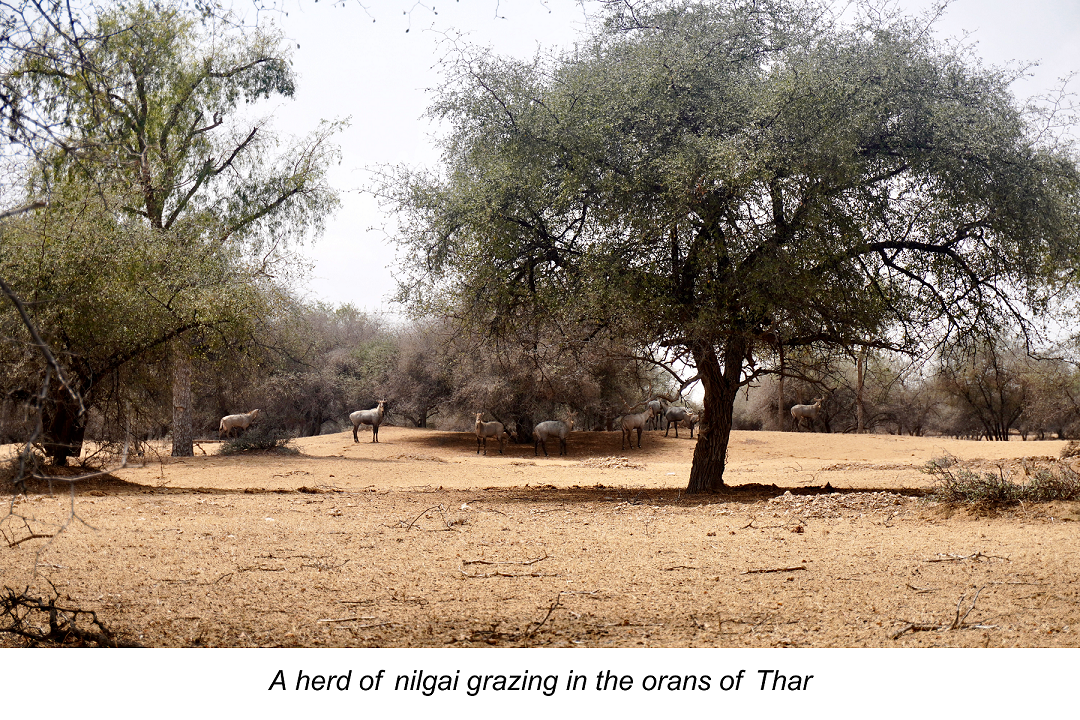
I’d like to begin by shedding some more light on what orans (also known as deobani or rundhs) are, since they’ve been at the centre in the attempts to protect the region. Orans are sacred groves that belong to the temples of the villages and are protected ecosystems spread out across Rajasthan in every village you go. They’re basically community conserved desert forests holding a significant religious value. I came across herds of neelgai, peacocks, gazelles, huge herds of cows and goats, all grazing in these orans. They are protected in the sense, they are not used for agriculture and are mostly community conserved, being used as grazing grounds and for non-timber forest products. That is not to say that there are no encroachments on these lands. Many villagers have encroached on the boundaries of these orans for farming, borewells, shops and other establishments. A lot of people, especially in western Rajasthan do depend on these orans for livelihood. Regions that are mostly dry and on the fringes, which is a huge part of Jaisalmer, only have seasonal farmlands, if any, dependent on the short monsoon rains. A decent amount of people here are primarily dependent on pastoralism. Orans are a major part of the grazing lands supporting their pastoralism and in turn, their livelihood. There are roughly 25,000 orans across Rajasthan, accounting for roughly 6 lakh hectares of land.[1] Another important thing to note is that all of these orans have some sort of water body, mostly made and maintained by the people, that plays a key role in making the ecosystem thrive, providing an oasis for the fauna and flora of the region.
Classifying Orans into Unregistered (सिवायचक) and Registered (गैर मुमकिन) Orans
One important thing to look into is whether these orans are registered in the land records. This one single factor tremendously affects how safe the orans are from future encroachment and even complete eradication. A good chunk of orans were registered as गैर मुमकिन (gair mumkin) orans during the land settlement acts in the revenue records. During my time in Rajasthan, I was told by multiple people that the registered orans have till now been safe from large projects, although they do witness small scale local community encroachments. The picture changes when it comes to orans that are सिवायचक (siwaichak) and not registered in the revenue records. These orans are technically classified as wastelands / vacant lands and do not have the protections that registered orans have. It is not uncommon to see these lands being allotted to industries for mining, factories, wind and solar projects.
Another important thing to look at is agors (catchment) and gauchars (grazing area for cows). Especially when it comes to agors not being protected within or outside the orans, it is quite common to see degradation of waterbodies, orans, gauchars and farmlands in the region.
What’s being done?
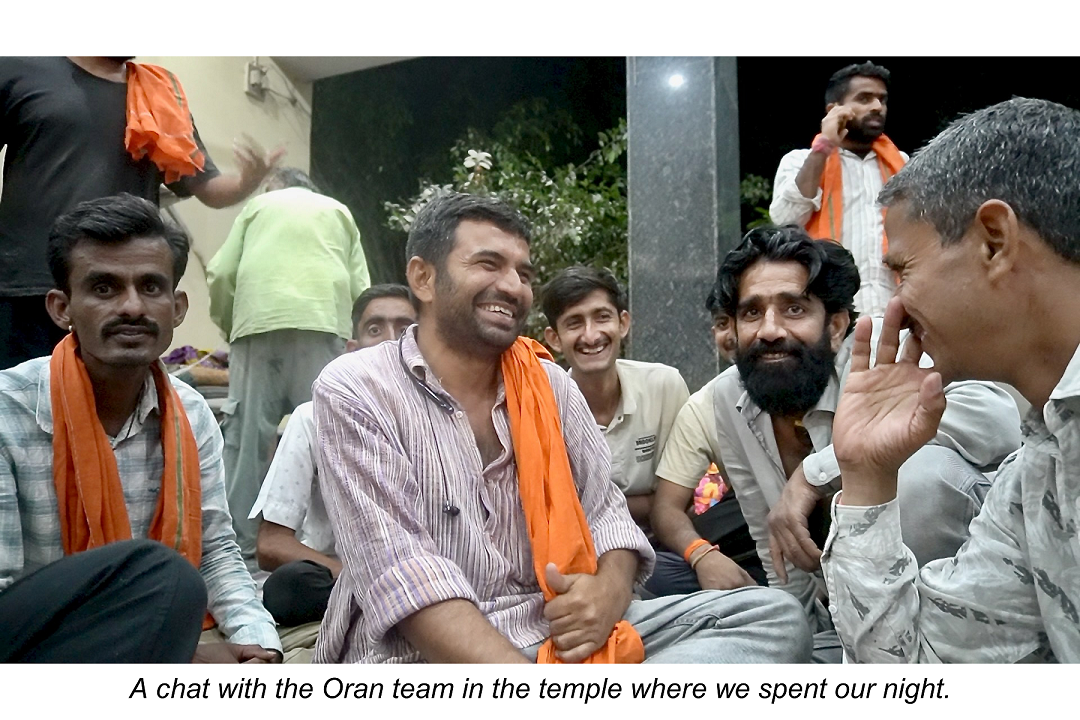
Now, there definitely is a big effort going on in order to conserve the orans of Rajasthan. There was this 700km long padh yatra from Jaisalmer to Jaipur, mostly driven by the people of Jaisalmer. I stayed with them for two days during their leg from Ajmer to Jaipur. They were systematic and clear about what they wanted:
- First, the entire region of Sodhan (Myajlar) and Khadal (Ramgarh) regions should be officially protected, with no future project allotments allowed in the region, including the cancellation of any current allotments like the ones in Raghwa, Seuwa and Parewar. This is primarily because the entire region is heavily dependent on cattle herding and rain-fed agriculture, harboring the highest concentration of cattle, sheep, goats, and camels in the entire district. Owing to this, the dependance of the people in the region on vast grazing lands and orans is very high but the land ownership is quite negligible, as usually is the case in nomadic regions. It also serves as the habitat of various desert species, including rare species like the Great Indian Bustard and Caracal cat.
- They want all the water bodies and their catchments (agors) to be officially documented and protected from any project allotments.
- There should be no project within 3km of a village (which is usually not the case right now), and there should be space left for the village to grow.
- And most importantly, all the orans in the region be documented in the revenue records and protected from any project allotments.
The people of the padh yatra were focused on visiting the villages along the way, trying to raise awareness about the threats orans face. It was not just a walk. It was planned, methodical and with clear intentions. And to be honest, it was also quite fun. The people were super friendly and accommodating. A lot of people I spoke to in the yatra were not just followers. Everyone had their own connection with the orans and their own belief of what’s more important. I’d be walking for 10 minutes with someone and I’d know so much more about the trees growing next to the road, the vines crawling up a random wall, the water bodies that would come along the way. I’d also be transported to their orans back home and how they interact with it daily. I’d know more about the birds in their region and how they travel. I’d know more about the wildlife that I’d later get to see while I’d be in these orans of Jaisalmer. I’d receive vivid descriptions of kair and sangri, their taste and how they are prepared that I’d later get to try for myself in Jaisalmer (10/10 would recommend). I’d receive history lessons. About the 363 Bishnoi women who gave up their lives to protect the Khejri trees. About their customs surrounding their orans that date back centuries. I also got a glimpse of how close they are to their livestock. A thing that I’ll elaborate below. The padh yatra reached Jaipur on 16th April. What they received was yet again just an assurance that their demands will be met. As of now they do resemble false promises. They’re continuing their work of going from village to village to build awareness and call to action.
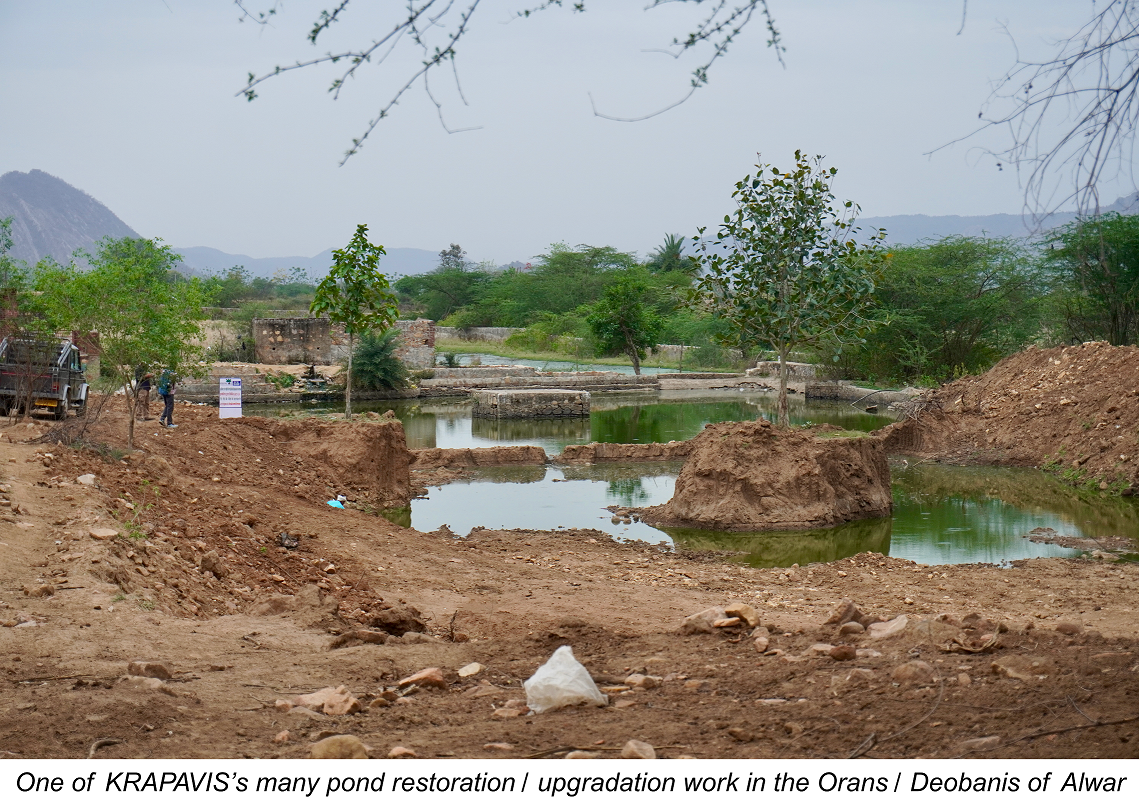
Another very important work that’s being done is what led to the Supreme Court’s judgement of 2024, that directed the Forest Department of the State of Rajasthan to carry out detailed on-ground and satellite mapping of each sacred grove and mark them as community conserved forests. I met with Aman Singh, and the rest of the team from KRAPAVIS, who took this case to the Supreme Court. I was with them for two days where they told me about the case, their work on mapping the orans, how things progressed over the last three decades and about this judgement. They also took me around the orans (referred to as deobani) in Alwar. They’ve been mapping the orans around Rajasthan, using the patwari maps available on Apna Khata and Bhunaksha and on-ground mapping with the community. They’ve been assessing and documenting the state and degradation of the waterbodies, flora and fauna of these orans. They’ve been working with the community to restore these waterbodies and finding ways to restore the flora and fauna by fixing the grazing pattern, cross breeding, controlling invasive plants and propagating the native ones. Their work on mapping these sacred groves formed the basis of this SC judgement, where their mapping of 100 orans in Jaisalmer has been used as the primary reference to get the future mapping of these sacred groves underway. The SC has formed a five people committee that is putting pressure on the local district officials to get these sacred groves mapped as quickly as possible. There definitely also seems to be a good pressure from the opposite end to slow down this mapping so lands can be allotted to different industries. There is progress but it’s complicated, as I find more about when I travel to Jaisalmer.
What did I see?
What I see in Jaisalmer puts the entire idea of land ownership, progress and how we measure wealth into question. It is hard not to see the colonial legacy everywhere I go. Not in infrastructure or exploitations from the past, but from how we view every part of the region with the myopic lens of extraction. We’re so dead stuck in trying to look at everything from what value it holds rather than what life it nurtures. First I’d like to profess by saying that I’d never be the right person to truly ever be able to convey the thoughts, actions and the understanding of the people of that region. But I also believe that no one can ever do that other than the individuals speaking for themselves. Things will always be lost in translation. I also won’t claim that I got a holistic picture about the region as it proves to be much more difficult to be able to reach the people who seem to be the most vulnerable to the entire ordeal. I also would like to make it clear that I got a very male perspective about everything, because it is very difficult for a random twenty-something guy in Rajasthan to be able to get a female perspective. I’d also like to note that the religious demographics of Thar is vast and in the short time I had, I could not find the links to be able to get a detailed perspective of all these demographics. That is something I would like to understand better. I just currently don’t know how.
Now I mostly travelled to some villages and orans in the Ramgarh district with the kind recommendations and help from the people in the padh yatra, few orans enroute Jaisalmer to Phalodi with Suresh Chaudhary from the KRAPAVIS team in Jaisalmer, and a few places near Devikot (enroute Jaisalmer to Barmer) with people from GRAVIS’s Jaisalmer team.
The first leg of this journey was the one enroute Jaisalmer to Phalodi. Afterall, it was important to understand what orans really are on the ground. A few things got very clear very quickly. The desert ecology of Rajasthan is not desolate. It is rich, it is varied, it is intricate and it definitely is fragile; and orans are the epicentre to witness these flourishing ecosystems. In most areas the juxtaposition is quite evident. You are driving down the road and suddenly everything around you fills up with life. The khejri, bordi and kair trees extend to as far as your eyes can see. You see herds of neelgai grazing on these trees. You start seeing peacocks meandering about. Occasionally you’d see gazelles running away because they saw you way before you saw them. There would be large herds of cows and goats just grazing on the grass and bushes spread all across the orans. It was also very easy to notice the difference between the orans that are cared for by the communities and the ones that are neglected. When they’re not conserved by the community, you see degraded life, more invasive plants like vilayati babul, encroachments around the borders of the orans and less wildlife activity. On the other end, the ones that are taken care of by the community are rich and beaming with life. You’ll see wildlife all around. The orans will be filled with native trees. When you drive across the oran of Bhadariya, it will be very hard for you to imagine that this region is classified as a desert. I’ll speak more about Bhadariya later.
The next, and probably the most important, was my time in Ramgarh. You may remember it from the padh yatra section. Ramgarh is one of the main regions that you’d think of when you try to imagine the Thar desert. It’s extremely arid and remote (not to be confused as desolate, for the region is beaming with life in the most special and intricate way). It’s mostly sparsely populated with tiny villages spread across, most of which you’d miss as they’d be hidden behind a massive sand dune or would be a few kilometres in through a sandy path that the locals have mastered to drive through. I have no shame in admitting that I fell down quite a few times trying to get a hold of my bike while the locals would just drift through. The trick apparently is to keep the tyre pressure low. Oh and yes, this region is filled with windmills. And what’s slowly cropping up are massive solar projects.
Parewar
I first met a few people in a village called Parewar through the recommendations of a member from the padh yatra. Parewar is this small village, some 9km in through a bypass from the Jaisalmer – Tanot highway. They have part of their orans registered in the southern part of the village, while a good chunk of their orans and agors are not. One would assume that the area that is not registered would actually just be wasteland. That is also how it is considered in the documents. But it has all the features of the orans. You’ll see a rich biodiversity with khejri trees, abundance of grass, herds of goats and a temple in between all of it. But it also has one not so common feature of orans. Right next to the walls of the temple, there’s a huge (~4 sq km) Wonder cement factory, with an additional few acres of land allotted for their mining. Now, there are two cement factories near this village, Wonder and JK, and the land has been allotted for UltraTech right in the middle of the two. The villagers don’t really have any problem with the JK factory, as it is quite far from their farmlands and grazing lands. But the Wonder cement factory is less than a kilometre away from their village. It is the most imposing structure when you’re standing in the village. It is large, it is filled with lights, it is not even functional yet, and it is already creating many problems. The factory sits in the “siwaichak” land, right in between the village, their farmlands and a small hamlet. The villagers I met are visibly pissed with the factory. Because one thing became very clear when the factory came. The land and region is going to prioritise the factory first and the people who lived there for generations later.
Now, the problems that this Wonder cement factory creates ranges from disruption of access, resource constraints, destruction of ecology and access to water. This is because the entire region is demarcated into khasra (blocks), and as ownership of land is seen in parts through this khasra, it fails to take into account how the entire region feeds, sustains and thrives the village.
Now, the agriculture in the village region is purely dependent on rain. There is no usable groundwater, nor a canal. As we all know about the Thar desert, this rain is not plentiful. But even in this very short burst of rain, the villagers are able to get an entire crop yield, and in some parts of the village, two yields. What you find here is that all the fields are located in a relatively low-lying region. While the entire region looks relatively flat, all the water that falls in the area rushes into these farmlands, saturating the soil enough to allow their agricultural practices. Not only that, but these fields are then also used by the cattle herders to herd their livestock after the crop cycle is over. You will find a network of checkdams that will ensure that all farmlands are irrigated according to their needs. It is a work of art that probably developed over generations of labour. Now, the mining region of Wonder cement lies right in between this watershed. What they’ve done is created bunds and checkdams of their own which have now completely disrupted this flow of water to the farmlands. A good portion of these fields were left barren this year because of this. The difference between the fields that were cropped and the ones that were left barren is like night and day. And obviously, the people are pissed. Water does not know boundaries. If we keep looking at land as absolute, not seeing how it changes and depends on everything around it, we risk disrupting centuries of ecosystem designs. The people living here understood that for time immemorial. Then how is this loss, that is obvious to the local community, not a colonial legacy?
Another way in which this factory disrupted their flow of water is by disrupting their upcoming jal jeevan project. A series of HDPE pipes were to be laid down underground from a water source far away to supply a constant flow of soft water to the village. The path of these pipelines was to pass through the factory lands. The factory stopped the laying of these pipes as they now owned the land. It has been two years since the pipes are just lying there, piled up, in plain sight. And the village still does not have soft running water. Ironically, at the same time, there was a transmission line running from the village to the small hamlet. The land allotted to the cement factory included the path of this transmission line. But the factory did not have to compensate for the transmission line. It was cut down. The pillars of the transmission line still run through the factory. You can see it across the wall. But there are no cables running through. It took one and a half years to restore electricity back to that hamlet. A new longer path of transmission line was laid down. The factory was not made to wait for their profits. But the local community had to wait for their needs.
The problems don’t end there. The factory, the mining area and corresponding rail line for the factory lies in between the roads that connect the village to the hamlet and to the farmlands. The factory has now more than doubled this distance. This affected the children who would travel from the hamlet to the school in the main Parewar village. It also made it difficult for the villagers to access their farmland. The factory area was also home to a significant population of native trees. The factory removed all of these plants and planted it outside on the barrier of their mining area promising that they will make this area more green than it has ever been. The plantation is laughable at best. I don’t think I saw any surviving trees. They are a ghost of the region around.
And I feel like it is not even the Wonder Cement that is entirely at fault here. They were allotted a land that, when we assess on the ground, is evidently wrongly classified as wastelands. It is not in their interest to carry that impact assessment. It is the responsibility of the state and probably the legal system to classify it correctly. But it is not to say that there is no malice from the company’s side. The people of the village were also pissed because most, if not all of the workers working in the factory were not locals. They said that there were instructions that anyone working in the factory must be from a place that is at least 50km away from the site. Although the contractors, especially truck owners, from the village were given contracts in the building of the factory. That is another dynamic that needs to be studied. The people of Parewar are currently trying to get some of their siwaichak orans registered. But the ones that are already allotted to the cement companies seemed to be gone forever.
Seuwa Kuva (Seuwa Well)
Seuwa Kuva is the most remote village I have been to in Rajasthan. It is surrounded by sand dunes and acres and acres of desert forests. It is very easy to miss if you don’t have the exact GPS coordinates. I’d say it is easy to miss even with it, as it is almost completely hidden by a large sand dune. It lies roughly 12 km in through a bypass from the Jaisalmer – Tanot highway. It is one of the villages that lie right next to the national border. Everything that lies within the roughly 20 kilometres between the village and the border has been their grazing grounds for generations. They have been instrumental in the surveillance of the border all this while. It is a small village of 10 households and there are multiple such villages in that region. When I was in Jaisalmer, someone told me that many of these villages are so remote, that there are people, especially women, who have not even seen Jaisalmer all their life, which is the closest city. I got to see what that meant first hand. When I walked into the village, I saw three men, a small girl and a camel near a large water tank. One of them, an old man, was filling water in two large leather pouches strapped on the camel. The other two, a young 20 year old and a deaf man, were making a long rope.
When I got there, I did not know who to speak to. Luckily, Nepal, the young 20 year old who was the son of the old man was quick to greet me and indulge me with a conversation. They were preparing for a journey that the old man and the young girl were about to make, 10 km in the grazing lands to a small water body where they live in the winters where many of their cattle and goats were currently grazing. The old man makes this journey quite often to fill this water body for their livestock. It was now just a few hours before sunset. He’d go there and stay the night and come back again the next day. I asked them if I could come along. They said you won’t be able to keep up and would get lost. It is too risky. I tried to convince them but honestly they were correct, because the next morning when I followed their goats just a hundred metres into their grazing land, it became abundantly clear that if it was not for the sun rising, I’d easily lose my sense of direction here. Luckily, Nepal was staying in the village and was ready to talk to me and show me around. The idea was to stay the night in the village. I was recommended to visit here and stay the night by Kundan Singh, a young man from Seuwa village that I visited earlier. Seuwa was the larger sister village of Seuwa Kuva where a lot of their relatives lived. Nepal took me to his home, where we sat outside and had a cup of chai. While we were sitting here, talking, I could hear a few women, particularly his mom, in a nearby shelter, shouting at Nepal. From the little marwardi I had picked up from my friends, it was clear to me that they were angry that I was here and they wanted me gone. Nepal tried to explain to them that Kundan sent me here but they were having none of it. The mom probably also feared that I was a ghost. I didn’t want to intrude in their life and I told Nepal that it is okay and that I will leave right away. But Nepal kept insisting that I stayed the night. He said he would explain it to her mom and she would be okay. She is skeptical as no outsiders ever come here. Seeing how sure Nepal was, I decided to stay. He explained to me how Seuwa Kuva and the neighbouring villages were settled after finding these perennial wells that sustained life here in these pasturelands centuries ago.
After talking for a while he pointed at this large sand dune next to the village. He told me that I can stay the night at the top of the dune. We will go and talk more over there. He will get me dinner and a blanket there so I am comfortable for the night. Turns out, his mom was not comfortable with my presence after all. I asked him if it would be easier for everyone that I leave but he kept insisting that I stay. Besides, he said that the top of the sand dune is the only place where I will have any network. To be honest, the idea of staying at the top of the sand dune overlooking the village and the vast grazing grounds did sound exciting. Turns out, it is not that difficult for someone to convince me to do that after all.
So Nepal and I climbed atop the sand dune. The view from there was beautiful. I could see for kilometres on end from all sides. Nepal showed me their grazing grounds from here. He showed me the various grazing paths that they take. He showed me how they change with the seasons. How they move around. How their livestocks move around. How they coordinate with the neighbouring villages throughout the season. He showed me where his father was headed. How does one navigate through this region, I’d never be able to understand. They’ve spent all their life here. They know this place like the back of their hand. In many ways, this has been their whole life. This is what they know best. He spoke dearly about their cattle and especially their cows. He educated me about the history of this region, the small temples in their grazing lands dedicated to people who fought for their livestock. A lot of people in the region, including him, say they are gau-rakshaks. (Gau-rakshak has been so weaponised in our country as a symbol of hate. And it’s a shame because when you speak to the people from this region, you understand what it actually means to them. Many of their generations have depended on their cattle for their livelihood. Dairy is such a big part of their everyday life and trade. For them, it genuinely did come from the fact that their cattle made their generations survive and flourish. When you see that, it hurts more to know that their genuine ancestral link to an animal is now being used in hate speeches and mob lynches by touching that same honest sentiment and turning it into something so ugly and hateful.)
As the sun got closer to the horizon, the soft light spread all across the vast pastureland in front of us. It was beautiful. “This entire land is going to be covered with a solar farm”, Nepal said as we sat there. “Not just this, but everything around Raghwa Kuva, Seuwa and Raghwa as well. It was told to us and shown on the patwari maps.” “What then?” I asked. He said he does not know. He is worried. He says he’ll probably have to migrate somewhere to find work. He said some of us have tiny rain-fed farmlands in Seuwa. Some of our family will move there. But even that is not documented so he’s worried he will lose that too. I asked him about the SC judgement and if they are trying to get this region registered. He said they have sent all the information they have. People from Seuwa are trying to do that through someone. But it does not seem likely. It is most likely already allotted. This was something that I saw universally in this region. People of Seuwa also showed me the lands that are allotted to the solar project in and around their village. It includes a water body (talab), seasonal farmland, orans and more. It is not like orans and gauchars are being registered. They are. But the tools and the resources that the people have are so minuscule compared to the people opposite to them. People here don’t have a team of lawyers like the industries or governments do. For the most part, they have to reach out to someone else from another village who will reach out to someone else for even the most basic requirements. And all of these people in between would have their own troubles to deal with first.
There is already a functional Powergrid station to evacuate solar power from Ramgarh through the Ramgarh-Bhadla Transmission Line.[2] The planned evacuation from Ramgarh is at least 20GW. How are such large extents of land open for extraction and the people who inhabit it expected to protect this land by using the legal system when even the most basic application forms are so hard for them to reach. We never provided them with the instruments available to the more powerful; and we treat their land that they inhabited for centuries and know better than anyone else in the world as our own. Nepal said that he is the only educated person in his family, and he is a 12th graduate. I could barely manage the application process of JEE (Joint Entrance Exam) during my 12th. Now what it has come to is that the people from this region would quite likely have to leave everything that they have known. Everything that they are the best at. Something that no other person in this world can challenge them in. And migrate to a place that they have no idea about and expected to flourish for all the opportunities it holds. When Ambedkar said, “Why has no attempt been made to civilize these aborigines and to lead them to take to a more honourable way of making a living?”, I wonder if this is what he meant. And I wonder what honour lies in the civilized world that is all about extraction and barely about nurture.
Now, many of these people are by many accounts considered poor. But it also makes me wonder what money and wealth means in a world where most of the people live paycheck to paycheck anyway. The basics of food, clothing and shelter are all covered by these communities’ way of life. Everything that they earn on top of that is an addition to that. On my way to Seuwa Kuva, I came across a small home with a tiny farmland in the middle of nowhere where I met a few kids, all under the age of twelve. They were so happy-go-lucky, showing me around, playing with my camera, joking and just having a good time in a world where most kids their age are unbearably annoying. When we treat their land as ours, as wastelands, that we use as we deem fit, we are taking away this autonomy over their own life that we do not measure in absolute monetary terms.
Now, I am not trying to glorify their lives. Their daily life is much harder and laborious than an average person. There are also customs and hierarchies that many people would consider troublesome. And many of them do feel they benefit by interacting with or moving to the more modernised parts of Rajasthan or outside. But there’s a difference between giving them the resources and the tools to navigate the rest of the world and them then making a choice to move to something else or somewhere else; as opposed to them being forced to move out by taking away their access from the lands that they’ve always used because technically the state owns it and it is officially underutilised so the state can use and allot it as they deem fit.
It would be a shame not to notice what it does to them psychologically too. During our conversation, Nepal quite frequently would comment on how he is the only educated person in the family. And he said it with an undertone of anger towards his own kin. By seeing the helplessness that this ordeal brings, it seems like Nepal undervalues and almost foregoes his ancestral prowess to survive and, in some sense of the word, flourish in the most harsh environments. In the dominance of the outside world, he almost looks down in shame towards this intricate web of knowledge. And in that sense of anger towards his own kin, you see a sense of alienation creep in that many of us might resonate with.
All hope’s not lost
Sorry for being so morbid in the last few passages. I tend to do that and I am sorry. I will be honest. I actually left Rajasthan much more hopeful than I was before I got there. It is because a lot of things are also being done that I feel has benefited the people there and also laid the groundwork to protect the region.
It is hard not to understate the importance of the mapping and community led conservation work that KRAPAVIS did in many of the orans and the subsequent SC judgement that followed. Pre-draft notification Objections have been invited for 4,691 Orans (1.75 lakh ha.) and 151 ecosystems (20,541 ha) in 32 districts. Directions have been issued to all District Collectors to restore Oran status in revenue records and to restrict change of land use. Satellite mapping is under process in three districts, for the rest process is on and wider public awareness has been created regarding continuation of traditional community rights.[3]
It has provided the communities with a tool to get their orans protected as community reserves so they are no longer considered as wastelands. For the orans that are getting registered through this effort, this is a huge layer of protection. And in this entire process, a lot of their indigenous knowledge systems are also being documented that a lot of us find so fascinating, but for many of the locals, is quite intuitive. And with all the documentation and all the awareness campaigns by various groups and movements, more and more communities are developing an additional vocabulary to protect their region and its ecology that is more palatable for the broader legal, academic and media circle. Quite a few people, especially landowners and contractors, are also benefiting from the industrialisation of the region, at least in the short term (solar farms are notorious in providing jobs and contracts during set up, and almost none after that. The accounts of exploitation of labour that I heard about in some of the largest solar farms is something that I am not even getting into right now.) But in this industrialisation the native ecology and wildlife suffers across the blanket. These community-led conservation efforts and oran registrations play a huge role in protecting this ecology. There is quite a lot of conservation work being done by KRAPAVIS, GRAVIS, Tarun Bharat Sangh to name a few, along with the community that has clearly and tangibly benefited the people. The canal running from the Harrike Barrage from Punjab all the way to Western Rajasthan seems to be benefitting a lot of people. It is supporting a significant amount of people for agriculture as well as domestic use. To me, that’s a fine example of bringing resources to the communities rather than pushing them out of their habitat to find resources themselves. From the reports I could find, there were no notable ill-effects upstream. I can be wrong.
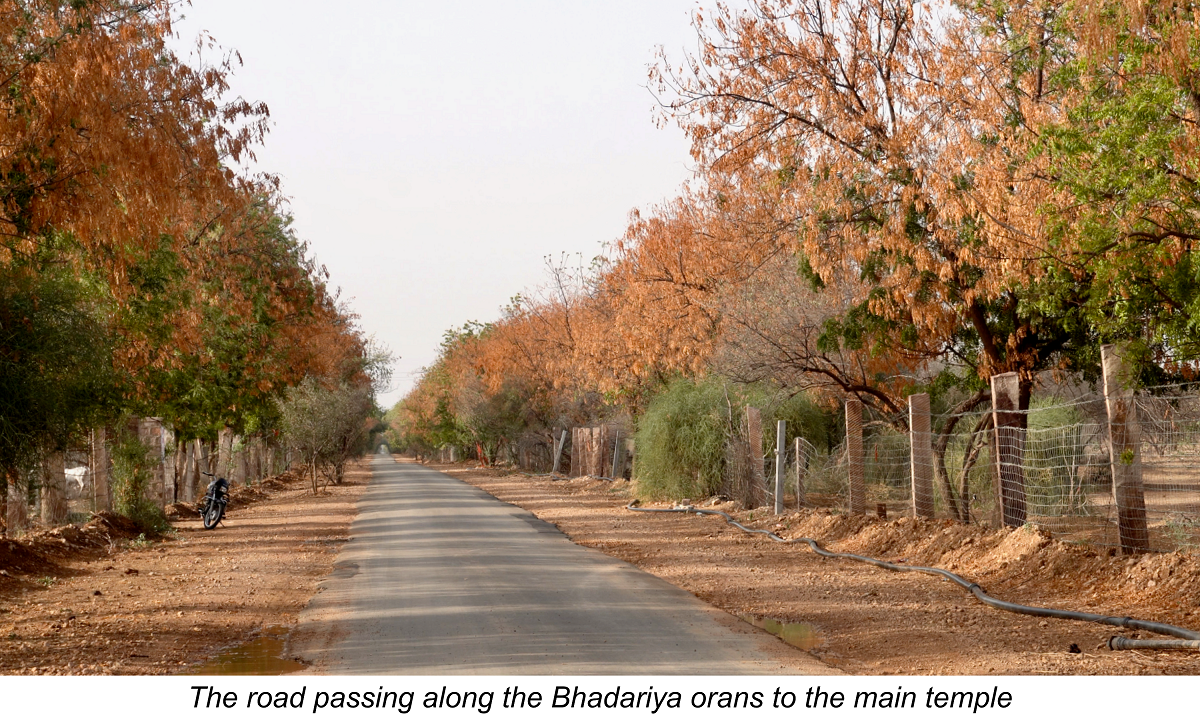
And finally I want to talk about Bhadariya Rai Oran. Everyone in Jaisalmer probably knows about this place. Many people from the padh yatra kept recommending that I visit Bhadariya. The moment I entered the road passing through the oran, it was clear why this place was so special. Now, Bhadariya oran is the quintessential example of what happens when the community comes together to preserve and nurture their common land. It is probably the most rich and biodiverse oran in all of Thar. There are moments when it is hard to imagine that you are actually still in Thar. The oran is managed by the Shri Jagadamba Seva Samiti (committee) formed by the community. The committee manages the livestock, temple and the oran. They have a goshala in the oran that houses around 40,000 cattle with additional 20,000 cattle from Bhadariya and adjacent villages, along with 5,000 goats, 10,000 sheep, 150 camels and a few horses and donkeys.[4] They were growing fodder within the oran, amongst the native flora, without the felling or degradation of any native trees or bushes. These fodder supported the large amount of livestock that the oran houses that the oran itself would not be able to and would have caused overgrazing. The road passing through the oran was well shaded by the trees growing all around the border of the road. It was so peaceful and comforting that I could sleep there in the afternoon. Meanwhile, the rest of Jaisalmer had picked the summer heat. I saw many animals doing just that in the many trees that stretched throughout the oran. I came across peacocks. Oh so many peacocks. Everywhere throughout the oran. They were not just meandering about in the orans, they were thriving here. There were neelgais in the distance, indulging themselves on the branches of the native trees. This oran is home to gazelles, boars, rabbits, desert fox, titar, Great Indian Bustard and many more. I don’t see how this level of conservation can be achieved without the community being in the forefront. Bhadariya shows how rich and abundant any place can be with the right efforts.
I would like to reiterate that for everything I saw in Rajasthan, no matter how disheartening it might have been at times, I left the place more hopeful than ever before. Rajasthan showed me what the problem exactly is and how to tackle it. It erased whatever notion I had about good versus bad and made me focus on the systemic issues that have created the situation we are in. And it showed me how it can be changed, not from a hero-savior complex techno-optimist perspective that our world has come to rely upon. But by simply calling everything by its right name.
Wastelands Orans of Rajasthan
A tiny personal note in the end
I have tried to ensure above that I only write about things that I saw and understood in Rajasthan that I have video and audio recordings of. I tried to make sense of everything to the best of my abilities. And I tried to be as open minded as I could. In passages where I am sharing my own thoughts and opinions, please take it as just that. A twenty-something year old’s thoughts and opinions; and I am always open to the idea that I might just be wrong about every opinion I form.
Aman Dedhia grew up in Bombay and moved to Ladakh when at the age of 25 to work on water conservation projects. Ladakh opened him to the relationship that people share with their land, and to questions of belonging.
—————————-
[1] In Re: T.N. Godavarman Thirumulpad v. Union of India & Ors. (In Re: Orans in Rajasthan), Writ Petition (Civil) No. 202/1995, I.A. No. 41723/2022 (Supreme Court of India, Dec. 18, 2024).
[2] Central Electricity Authority, Ministry of Power. (2024). Draft National Electricity Plan (Volume II: Transmission). Government of India, New Delhi.
[3] State Oran Committee, Rajasthan, Status and Conservation of Orans in Rajasthan, Press Note dated 09 March 2026.
[4] Orans of Thar: A Passage to Jaisalmer by Aman Singh & J. P. Singh, KRAPAVIS

