
Category Archives: Knowledge

Theory After Gaza: Decolonizing the Political

[The essay below is based on a presentation at a recent workshop on Theory from the Global South and a part of a longer work. Some of its claims are therefore, necessarily tentative. – AN]
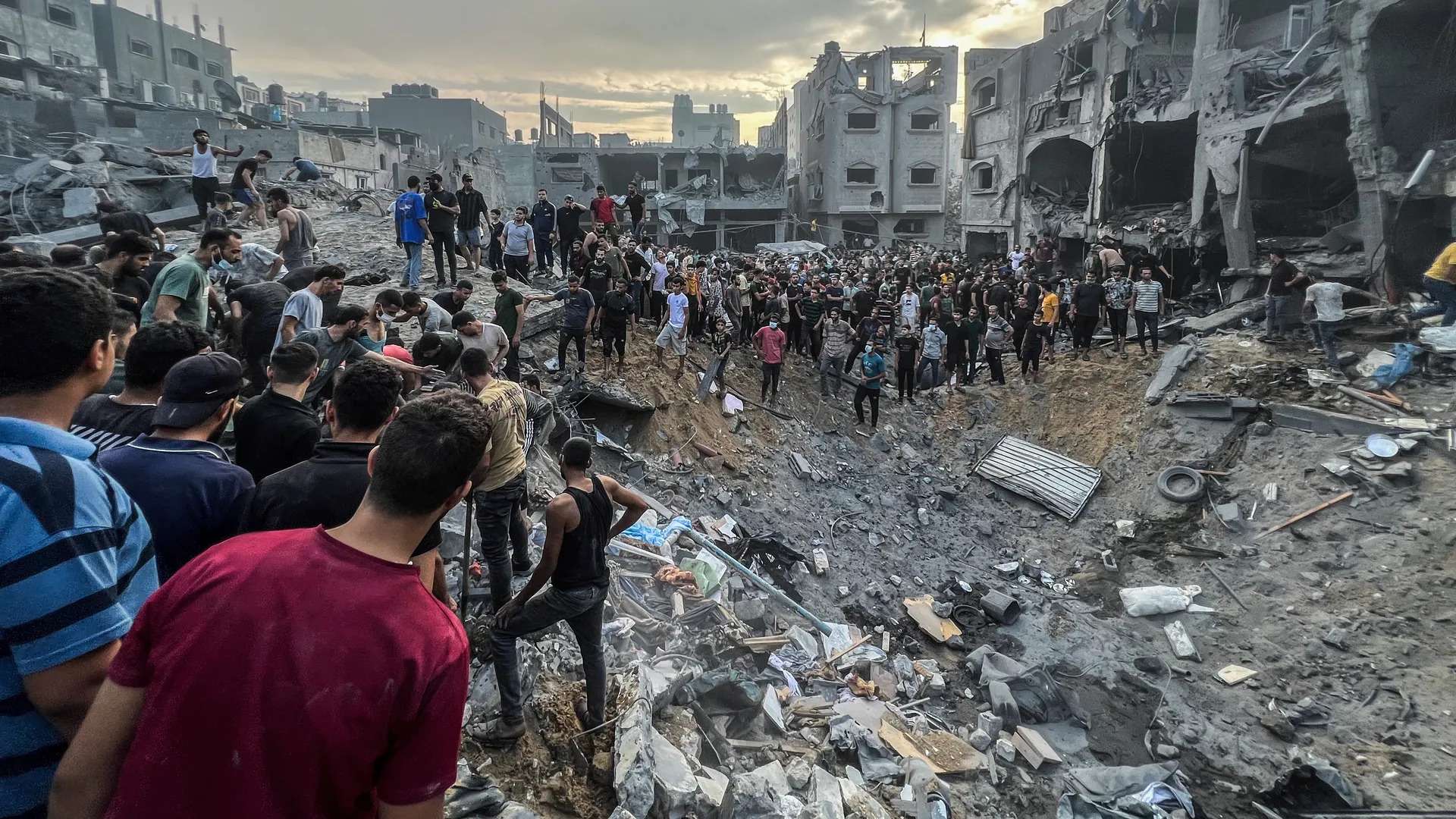
Gaza, December 2024, Courtesy Euro-Med Human Rights Monitor

What is happening to Gaza/Palestine today is a horrible genocide, the likes of which has rarely been seen. Yet, it must be asserted that not exceptional or unique – but entirely of a piece with the history of the colonial expansion of the West over five centuries. Gaza reveals, in a flash, the long-erased histories of settler colonialism and genocides; it reminds us that that history is very much part of our living present. Gaza strips the mask of “civilization” donned by the “enlightened West” that has long portrayed us in the global South as lesser, uncivilized beings worthy of being enslaved, used as cannon fodder and ultimately, exterminated. That was what we saw in the unrepentant colonizer’s speech by US Secretary of State, Marco Rubio at the Munich Security Conference. But in stripping off the masks of “civilization” from their faces, Gaza shows up how repeatedly, over and over again, the same script has been played, regardless who was in power in the Axis of Evil countries of Europe, UK and the US.

But more importantly, Gaza forces us to retell the whole story of the past five centuries by setting aside the received mythologies of “the political” and of “Enlightenment”. Gaza demands that we put at the centre of our narrative, not states and nations but those millions of dispossessed by settler colonialism, driven to death in imperialist wars and thrown around from one part of the world to another as “stateless” people, “refugees” and “minorities”.  Even though, in the interim, Palestine must have its own sovereign state to survive in this world of armed state, Gaza/Palestine demands a complete overturning of the very possibility of a repetition of another Gaza/Palestine ever again. It demands of us that we dismantle the entire theoretical edifice undergirding dominant narratives; it demands that we start telling the story from the vantage point of the people at the receiving end of that hallowed thing called “modernity” – that most people in the global South experienced as coloniality and what has been called “war capitalism” by historian Sven Beckert – which I will discuss below. Continue reading Theory After Gaza: Decolonizing the Political

Pedagogical Reflections on Silence in the Classroom: Rekha* and Rahul*

Guest post by  Rekha and Rahul (pseudonyms).

Two early-career teachers in private universities in India reflect on what has quietly transformed in their classrooms over the last few years, as they trace the rise of a new norm of ‘silence’. Their reflections ask what it means to teach in the intimate classroom space as it begins to mirror the shrinking democratic space and what forms of care, courage and pedagogy might keep the classroom thinking in these changing times. 

I

In the last half a decade, i’ve felt my classroom in a private Indian university change in ways that are hard to capture through the usual metrics. The checklist  is enviable: i retain full freedom to design courses, assign authors i want and structure electives around questions that matter to me.  And yet, in one of the courses while teaching Margaret Canovan’s piece on ‘Two Faces of Democracy’, i realised what had changed. There is a subtle paradox: the formal freedoms of the private university remain in place, but the informal ecology of the classrooms has altered. 

Continue reading Pedagogical Reflections on Silence in the Classroom: Rekha* and Rahul*

The Day the Colloquium Fell Silent – Bureaucratic Diktat and the Fate of Thought: S. M. Faizan Ahmed

Guest post by S. M.  FAIZAN AHMED

Image courtesy The India Forum

The resignation of Professor Nandini Sundar from the convenorship of the seminar colloquium at the Department of Sociology, Delhi School of Economics, has left an emptiness that language struggles to fill and words can barely cover. The seminar she was to host, titled Land, Property and Democratic Rights, was to be delivered by Dr. Namita Wahi, a senior fellow at the Centre for Policy Research and one of India’s most thoughtful legal scholars on land rights.

The event formed part of the department’s long-standing Friday Colloquium series—among the oldest and most cherished intellectual traditions in Indian academia. Over the decades, nearly every major figure in the social sciences has presented a paper here at least once. More than a seminar, it has been a ritual of conversation—one that has weathered political shifts, personal rifts, intellectual disagreements, and institutional flux, sustaining across generations a living legacy of thought, dialogue, and learning. Continue reading The Day the Colloquium Fell Silent – Bureaucratic Diktat and the Fate of Thought: S. M. Faizan Ahmed