
Tag Archives: biodiversity

L’affaire UoH – How much land does a university want? Nithin Jacob Thomas

Guest post by NITHIN JACOB THOMAS

Recently, the students of the University of Hyderabad were protesting the Telangana state government’s bulldozing of 400 acres of ecologically vibrant, species-rich land within the university, undertaken as a preparatory step to auction it off. The state government sought to quell the protest by force, asserting that the land does not belong to the university and that it is within its rights to auction it. However, the Supreme Court has intervened and stayed the activities for the time being. Ego-bruised by the setback they have faced at the hands of the campus community, the Telangana government has now proposed that the entire 2300 acres of the university be turned into an eco-park, uprooting the campus in toto to a hundred-acre campus on the city’s outskirts.
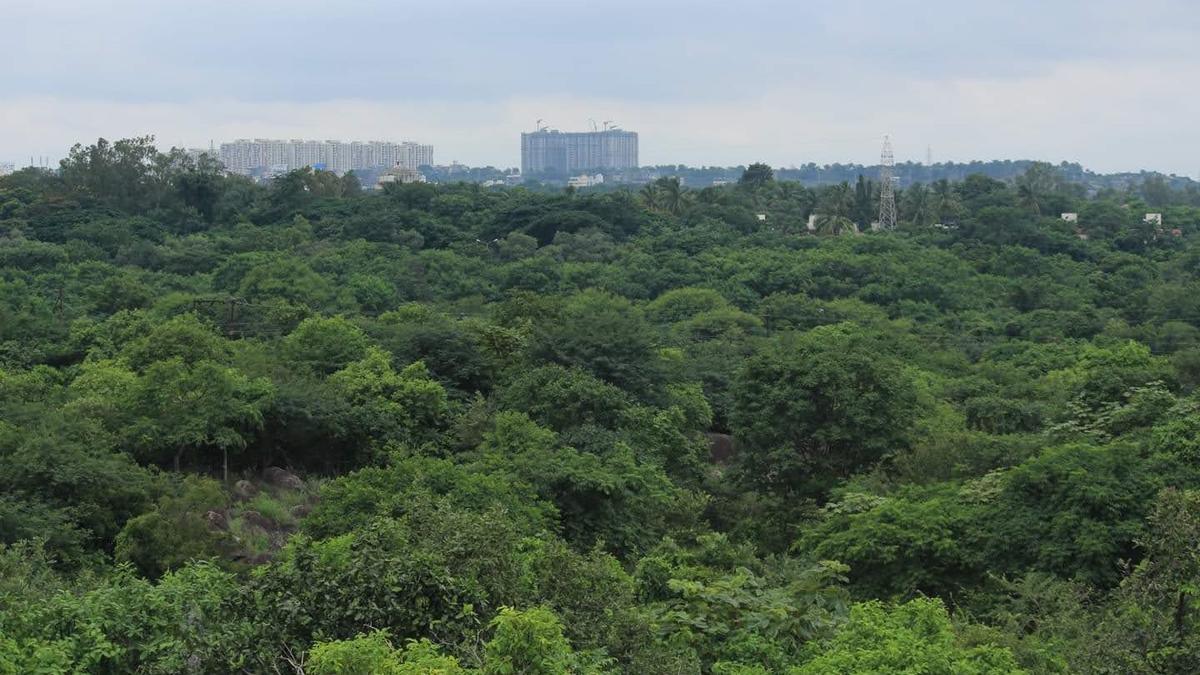
Kancha Gachibowli forest, image courtesy The Hindu

Strangely, the university has not secured legal rights for the land it has occupied for several decades. However, the emphasis in the following note is on an aspect of the protest that lies beyond the legal dispute over ownership. It rather seeks to articulate the inarticulable—why the preservation of the ecology of these 400 or 2300 acres is not a standalone question but one that co-constitutes the very question of preserving the university itself.

Continue reading L’affaire UoH – How much land does a university want? Nithin Jacob Thomas

Attacks on the Kancha Gachibowli Forest (KGF) – Capitalist Exploitation of the Human-Nature Relationship: Suddhabrata Deb Roy

Guest post by SUDDHABRATA DEB ROY

Land forms one of the most important planks of private property, because the appropriation of land (or ‘soil’ if one is to follow Karl Marx’s usage) forms the core of capitalist development, and since capitalism cannot sustain without the creation of class antagonisms and the appropriation of productive capacities of workers,[1] capital further uses the appropriation of land as a tool to exploit the non-capitalist classes. This results in the gradual separation of the worker from nature and thus eventually from the society itself, resulting in a state of alienation, which is used to create a ‘certain quantity of labour stocked and stored up’.[2] This stocked up/stored-up labour, as Marx explains, becomes capital. The relationship between manufacturing – the foundation of industrial capitalism – and nature – reflected in Marx’s usage of ‘soil’ – was an integral part of Marx’s definition of ‘capital’ under advanced capitalism. For example, in the discussion on ‘Bonds, or stock’, Marx had quite explicitly put up the relationship that capitalist development shares with the ecological world: ‘Bonds, or stock, is any accumulation of the products of the soil or of manufacture. [This] Stock is only called capital when it yields its owner a revenue or profit’.[3] The struggle for ecological justice thus constitutes an important aspect of the broader social justice movement because land relations constitute an integral part of the social relations, which in turn constitute the basis of not only capital but also the working class itself.[4] It is interesting to view the recent agitation against the auctioning of land within the campus of the University of Hyderabad (UOH), or the Hyderabad Central University (HCU), surrounding the proposed construction of IT parks by deforesting the Kancha Gachibowli Forest (KGF) in this context.

Continue reading Attacks on the Kancha Gachibowli Forest (KGF) – Capitalist Exploitation of the Human-Nature Relationship: Suddhabrata Deb Roy