
Tag Archives: Constituent Assembly

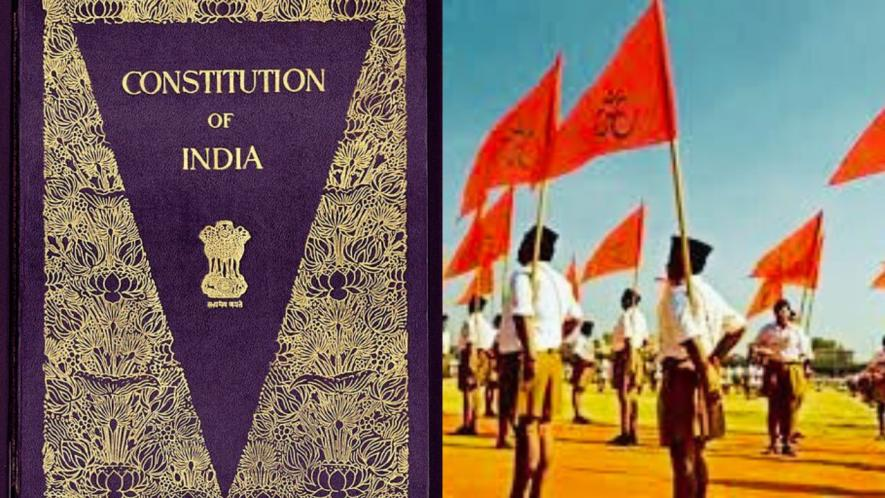
The Unending Discomfort of RSS With the Constitution

The Vajpayee government tried to change the Constitution, but lost in 2004. We must be vigilant, as a similar chorus is being raised again by Hindutva Supremacist forces.
..make India an independent sovereign republic and guarantee and secure for all the people of India social, economic and political justice; equality of status and  opportunities and equality before law; and fundamental freedoms—of speech,  expression, belief, faith, worship, vocation, association and action—subject to law and public morality;

and also ensure that

adequate safeguards shall be provided for minorities, backward and tribal areas, and depressed and other backward classes.

(Excerpts of Objectives Resolution in the Constituent Assembly, moved by Pandit Nehru on December 13, 1946 and adopted unanimously by the Constituent Assembly on January 22, 1947)

It was just another press conference in the national capital.

The only difference was that it was held at the house of a member of Parliament belonging to Bharatiya Janata Party (BJP), the main opposition party then…

This was on December 25, 1992. Less than three weeks before India had witnessed one of its deeply troubling, disturbing moment in its history where a mosque, which stood for more than 500 years, had been demolished by a horde of people who had gathered there from different parts of the Country, mobilised by the forces of Hindutva supremacism.

..Swami Muktanand and Vamdeo Maharaj, who were closely associated with the Ram Mandir movement (India Today, January 31, 1993) addressed the press meet.

This Constitution is anti Hindu‘ and needs to be rejected.”We have no faith in country’s laws‘ and ‘Sadhus are above the law of the land‘.’

..The press meet ended rather abruptly.

Journalists, who had gathered there to hear something about the movement, felt cheated that what unfolded there was an anti-climax.

Little did they have a premonition that the press meet was just an opening shot and more was coming. ( Read the full text here : https://www.newsclick.in/unending-discomfort-rss-constitution)

The Constitution as the ‘Social Contract’ of Modern India


The  Constitution of India should be seen as a work-in-progress – not because it has been amended ever so often by different governments but because it has been taken over by ‘we, the people’, repeatedly, especially since the 1990s. The ‘authorized’ interpreters of the Constitution and Law are no longer its sole interpreters. The continuous battles over its interpretation in the courts of law are only one way in which meaning is contested. But from the dalits reclaiming it as “Babasaheb’s Constitution” to the pathalgadi movement  of the Jharkhand adivasis and finally as the banner of citizenship movement today, its meaning has been contested time and again in the streets and in villages.

It is customary, in most secular-nationalist and left-wing circles, to invoke the “great values of the national movement”, which is seen as synonymous with the “freedom struggle”, which in turn is reduced to the “anticolonial struggle”. On 15 August 1947, India attained Independence from colonial rule and on 26 January 1950, “we, the people of India” gave to ourselves the Constitution of India. The anticolonial struggle came to an end in August 1947 but that did not mean that all the currents that  comprised the larger “freedom struggle” – the jang-e-azadi – got their freedom. We perhaps need to make a distinction today between the “freedom struggle” (that is still ongoing) and the “anticolonial nationalist” movement.

We need to state emphatically that the “freedom struggle” of different social groups is not – and never was – reducible to the “anticolonial struggle”. There were many different strands and currents that  either functioned at a distance from mainstream nationalism , or even worked in opposition to it.

Continue reading The Constitution as the ‘Social Contract’ of Modern India

How Sedition crept into the constitution: Siddharth Narrain

Part 2 of a 3 part series by SIDDHARTH NARRAIN. First published on The Hoot

While in their Draft Constitution, the Constitutional Framers included ‘sedition’ and the term ‘public order’ as a basis on which laws could be framed limiting the fundamental right to speech (Article 13), in the final draft of the Constitution though, both ‘public order’ and sedition were eliminated from the exceptions to the right to freedom of speech and expression (Article 19 (2)).Commenting on this omission many years later, Justice Fazl Ali said: 

The framers of the Constitution must have therefore found themselves face to face with the dilemma as to whether the word “sedition” should be used in article 19(2) and if it was to be used in what sense it was to be used. On the one hand, they must have had before their mind the very widely accepted view supported by numerous authorities that sedition was essentially an offence against public tranquillity and was connected in some way or other with public disorder; and, on the other hand, there was the pronouncement of the Judicial Committee that sedition as defined in the Indian Penal Code did not necessarily imply any intention or tendency to incite disorder.

Continue reading How Sedition crept into the constitution: Siddharth Narrain