

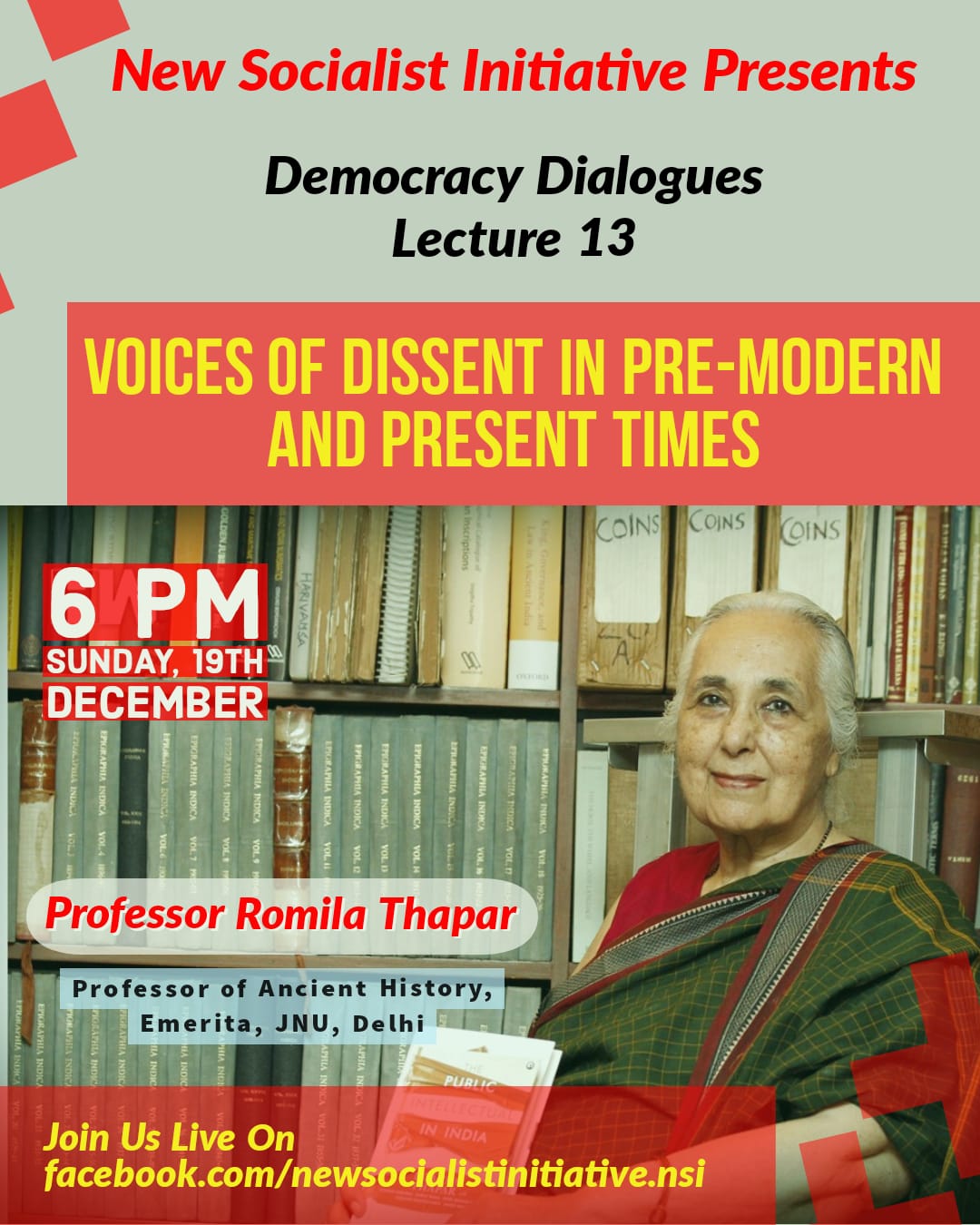
Prof Romila Thapar, great historian and public intellectual , will be delivering the 28 th Lecture in the Democracy Dialogues Series on Sunday 28 th January 2024 at 6 PM (IST).
Please reserve the time and date for the lecture. Details are given below
Democracy Dialogues – 28 th Lecture
Organised by
New Socialist Initiative (NSI)
Theme : Our History, Their History, Whose History?
Speaker : Professor Romila Thapar
Time : 6 PM (IST)
Sunday, 28 th January 2024
The lecture will be live on facebook.com/newsocialistinitiative.nsi.
The zoom invite will be shared closer to the date.
Abstract:
My purpose in this talk would be to examine the link between history and particular kinds of nationalism. I hope to show that nationalism can be a process, bringing together and uniting all the communities that inhabit a particular territory in support of a change in society or opposing a target common to all. This earlier form is what I would like to call a unitary, integrative nationalism that cut across communities and drew them together in a particular country to support a single purpose. This I would differentiate from the latter forms in some countries which identified with units of society or communities according to certain common features, such as a particular religion or language, or caste or ethnicity. I would call it segregated nationalism, where each community is segregated and treated as having a distinctly different identity and its own separate goal. History is brought in when the community that gives an identity to its nationalism insists on tracing its origins to a historical past. This pattern of integrated and segregated nationalisms would seem to apply to India of the twentieth century. There was the all-inclusive national movement whose participants were from every community; its objectives were to maintain the unity of the Indian people and overthrow colonial rule. The other nationalism, segregated nationalism, was seeded in the 1920s and assumed the existence of two nations – the Hindu and the Muslim – which, it was argued, go back to earlier times. Integrated nationalism succeeded in 1947 in bringing about independence, but its foundations needed strengthening, for we are now witnessing the strong presence of religious nationalism in the attempt to inaugurate a Hindu Rashtra in India.
– Romila Thapar
About the Speaker:
Internationally renowned scholar of Ancient History, Prof Thapar was elected General President of the Indian History Congress in 1983 and a Fellow of the British Academy in 1999. In 2008, she was awarded the prestigious Kluge Prize of the US Library of Congress which complements the Nobel, in honouring lifetime achievement in disciplines not covered by the latter.
Prof Thapar has been a visiting professor at Cornell University, the University of Pennysylvania, and the College de France in Paris and holds honorary doctorates from the University of Chicago, the Institut National des Langues et Civilisations Orientales in Paris, the University of Oxford, the University of Edinburgh (2004), the University of Calcutta and from the University of Hyderabad
Here is a select list of Prof Thapar’s publications
Ashoka and the Decline of the Mauryas, 1961 ( Oxford University Press) ; A History of India : Volume 1, 1966 ( Penguin) ; The Past and Prejudice, NBT ( 1975) ; Ancient Indian Social History : Some Interpretations, 1978 ( Orient Blackswan) ; From Lineages to State 1985 : Social Formations of the Mid-First Millenium B.C. in the Ganges Valley, 1985 ( Oxford University Press) ; Interpreting Early India, 1992 ( Oxford University Press) ; Sakuntala : Text, Reading, Historie, 2002 ( Anthem) . Somanatha : The Many Voices of History, Verso ( 2005) ; The Aryan : Recasting Constructs, Three Essays ( 2008) ; The Past As Present: Forging Contemporary Identities Through History, (2014) ;Voices of Dissent: An Essay, (2020); The Future in the Past: Essay ( 2023)
 KAFILA - COLLECTIVE EXPLORATIONS SINCE 2006