A confession of its own loss of legitimacy – the Modi government must resign

Farmers across the country have geared up to escalate their protests against the farm laws, as the government remains adamant in its commitment to its crony capitalists. The talks yesterday failed as three Union ministers part of the negotiations said it was not possible to commit to a rollback of the legislation without “consultations with higher authorities”.  

Who are these mysterious higher authorities whom they dare not name? Do they mean the Pradhan Sevak Himself, who is after all, within tweeting distance at all times, and could have deigned to talk to the farmers’ representatives; or do they mean his paymasters? 

Meanwhile 60 farmers have died at the Singhu Border protest site alone, according to doctors, to deafening silence from this utterly shameless government, that has tear-gassed and lathi charged its people, and forced them to brave the bitter cold and torrential rain in protest at these laws, which will wreak devastation on agriculture and on food security for all.

But the most revealing statement of all comes from the Union Agriculture Minister Narendra Singh Tomar, an explicit admission of the total loss of legitimacy of his government. Continue reading A confession of its own loss of legitimacy – the Modi government must resign

ONION CITY – Dilli hai jiska naam VII: Anisha Shekhar Mukherji

We thought of a series on Delhi that does not talk only of the narrow lanes of Shahjahanabad, the Mughalia, aka Mughlai delights and the lip-smacking Chaats of Chandni Chowk or the grand ruins of the seven Delhis and the wide open spaces and broad roads, but a series that also looks at the way Delhi has evolved. We wanted to explore the logic of the city and of the forces that have shaped the idea of the city itself.  It was this idea that made us approach people who have engaged with the city with love and care for decades and we requested them to write for Kafila.

This series is titled Dilli hai jiska naam and the links to the previous posts can be found at the end.

This is the seventh post in the series by Anisha Shekhar Mukherji

Onion City: Anisha Shekhar Mukherji
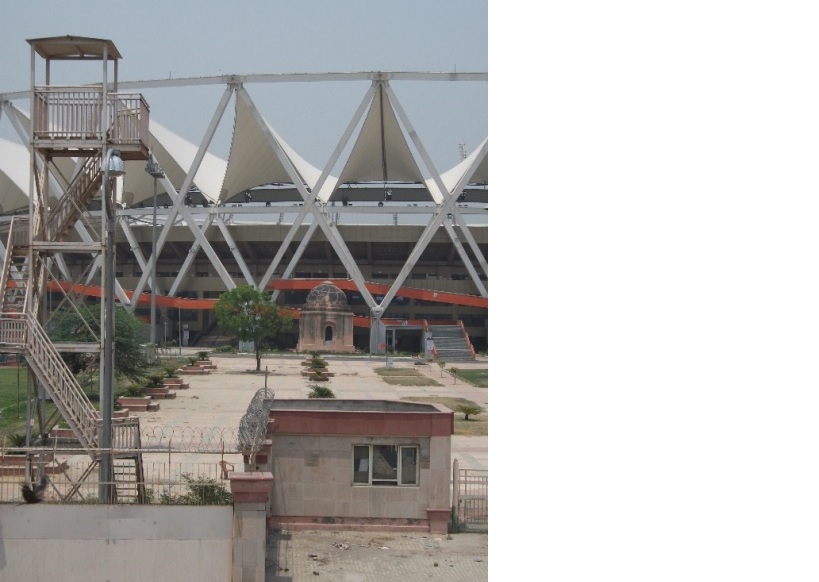
 Apparitions of different Delhis : A medieval structure engulfed by the expansion of Jawaharlal Nehru Stadium, 2010 (Photo: Snehanshu Mukherjee)

Delhi often reminds me of an onion. Imperfectly taken apart, many layered, veined, maimed. Its layers are not coherent or visibly bound. Scattered stray wisps forlornly curl at the edges in some corner, many centuries lie bunched together in another. Yet within them lie hidden vapours of many pasts, rising unbidden to sting you into an awareness of a different time.

Celebrated in tradition, song and history, the region of Delhi has been an urban centre almost continuously for more than 3000 years. The legendary epic Mahabharata[1] refers to Indraprastha—the capital of the kingdom of the five Pandavas, each embodying a virtue, and their beautiful wife, Draupadi—on whose site it is said, present-day Delhi sits. The Pandavas lost and won Indraprastha again. And that has been the fate of Delhi through the ages—to be lost and won successively by different rulers. Archaeological fragments and architectural remains of later dynasties, who built their cities here, may still be seen—from those of the Tomars in the eleventh century to the Mughals in the nineteenth century CE—vast palaces, intricate temples, looming gateways, arched bridges, domed mosques and tombs. In actuality each ruler demarcated a portion of land, within the larger area of what is now termed Delhi, as his city. So, effectively, the various cities of Delhi consisted of separate stakes of land with their own city walls, forts and supporting fabric. Sometime these cities encompassed and integrated the older ones. Sometimes they appropriated, ousted or ignored them. Continue reading ONION CITY – Dilli hai jiska naam VII: Anisha Shekhar Mukherji

मौजूदा किसान आन्दोलन पर वक्तव्य : रवि सिन्हा

Guest Post by Ravi Sinha

Image may contain: 1 person, beard

किसानों के इस आन्दोलन को उसके तात्कालिक उद्देश्यों और सम्भावनाओं मात्र के सन्दर्भ में देखें तो भी यह ऐतिहासिक है. अपनी अंतिम और सम्भावित सफलता से स्वतन्त्र इसकी उपलब्धियाँ अभी ही ऐतिहासिक महत्त्व की साबित हो चुकी हैं. लेकिन इस आन्दोलन के अर्थ और इसकी सम्भावनायें और भी बड़ी हैं. भारत की दुर्दशा के इस घोर अँधेरे में, जहाँ अधिनायकवादी फ़ासिस्ट शक्तियों के ख़िलाफ़ प्रतिरोध की सम्भावनााओं को एक के बाद एक कुचल दिया जाता रहा है, यह आन्दोलन एक मशाल बनकर सामने आया है. किसानों से शुरू होकर यह आन्दोलन सिर्फ़ किसानों का नहीं रह गया  है. पंजाब और हरियाणा के किसानों के द्वारा दिल्ली को घेरने से शुरू हुई यह मुहिम अब दिल्ली की सत्ता को घेरने वाली चौतरफ़ा मुहिम का रूप लेती जा रही है. हम किसानों के इस आन्दोलन को सर्वप्रथम इसलिए समर्थन देते हैं और उसमें इस लिये शामिल हैं कि उनकी माँगें जायज़ हैं और इस सरकार द्वारा ज़बरदस्ती लाये गये तीनों क़ानूनों को लेकर उनकी आशंकायें वास्तविक हैं. और हम इस आन्दोलन को इसलिये सलाम करते हैं और इससे प्रेरणा लेते हैं कि यह अँधेरे में रौशनी की मशाल बनकर सामने आया है.

 अगर हम आंदोलन की तात्कालिक माँगों और उद्देश्यों की विस्तृत चर्चा यहाँ नहीं करते हैं तो इसका अर्थ यह नहीं कि इनके जायज़ और ऐतिहासिक महत्त्व के होने में हमें कोई संदेह है. अब यह जगज़ाहिर है कि ये तीनों क़ानून उस शैतानी योजना का हिस्सा हैं जिसके तहत कृषि क्षेत्र को कारपोरेट पूँजी के प्रत्यक्ष आधिपत्य में ले जाने की तैयारी है. यह न केवल किसानों की रही-सही आर्थिक सुरक्षा को समाप्त करेगा, सरकार को उसकी जिम्मेदारी से मुक्त करेगा और न्यूनतम समर्थन मूल्य तथा राज्य-संचालित मंडियों की व्यवस्था को तोड़ देगा, बल्कि यह पूरे देश की आम जनता की खाद्य-सुरक्षा – जितनी भी है और जैसी भी है – को ख़तरे में डाल देगा. साथ ही ये क़ानून भारत के संघीय ढाँचे के विरुद्ध भी हैं, और केन्द्र द्वारा राज्यों के अधिकारों का अतिक्रमण हैं. यह सब आप सभी को मालूम है और इन कारणों से ही इस आंदोलन का सूत्रपात हुआ है.

Continue reading मौजूदा किसान आन्दोलन पर वक्तव्य : रवि सिन्हा
