

Tag Archives: Gopal Guru

The hopeless quest for a pure incorruptible knowledge – decoloniality and its discontents

[This post by Nivedita Menon is the fourth essay of the series in Kafila titled Decolonial Imaginations. Links to the previous essays are given at the end.

The terms ‘decolonization’ or ‘decolonial’ have become quite critical now, given that the impulse of justice lies at the core of these concepts. Neither postcolonial nor decolonial perspectives are compatible with right-wing ideologies but the fact that Hindutva ideologues in India and the rightwing globally are now trying to appropriate that language makes it seem to some that the very idea of the postcolonial or decolonial is suspect. We believe that this demonizing of decolonial theory from a position defensive of the European Enlightenment needs to be unpacked in the interests of a mutually productive debate. Kafila will be publishing a series of interventions on what the idea of the decolonial imagination involves, locating decolonial theory as speaking from the margins, drawing attention to identities which the orthodox Left subsumed under ‘class’ and which the rightwing in India seeks to assimilate into Brahminism. Additionally the orthodox left’s rejection of spiritual beliefs and inability to engage with them is also a factor that may have produced the space for right wing appropriations of a field marked “religion”. 

We hope that these interventions will clear the ground for productive conversations on the left rather than polarised and accusatory claims.]

Introduction

As Hindutva ideologues and the rightwing globally, appropriate the idea of “decolonising”, it seems to many opposed to these trends, that scholarship around decoloniality is itself the problem. Such arguments tie in with earlier ongoing attacks on postcolonial scholarship since the 1990s that virtually accuse it of directly contributing to the rise of the right. Decolonial scholarship is relatively a new arrival in the Anglophone world (since the 2000s), and ever since the rightwing started using that language, the same charges are laid at its door as well. Indeed, the implication (and sometimes outright allegation) is that decolonial/postcolonial scholars were secretly rightwing all along.

This charge I will address in a somewhat different way in the first section, by way of analogies with other bodies of knowledge.

The second section will address another related critique of decolonial thought, that it is “merely epistemic” and does not consider the materiality of structures of power

Finally we will ask the question – when Hindutva claims to be “decolonising”, what is it doing exactly? Continue reading The hopeless quest for a pure incorruptible knowledge – decoloniality and its discontents
Cartoon controversy – In conversation with Satyanarayana: Sharmila Rege

Guest post by SHARMILA REGE

Satyanarayana’s interview addresses the crucial issue of a sharp division between the dalit and the left/liberal viewpoint on the NCERT textbook cartoon controversy. Clearly, Satyanarayana’s foregrounding of this difference is not a denial of the differences between the positions taken by dalit intellectuals in this debate. Further, Satyanarayana is referring not just to responses by dalit academicians but to the presence of critical viewpoints in the larger dalit public sphere – the very perspective/viewpoints that Liberal/Left/feminists have in a sense not seriously engaged with, equating them to ‘manipulations by opportunistic dalit leadership’ or /and ‘always and already emotional iconisation of Ambedkar’.  In fact, despite   important differences between the arguments put forth by Satyanarayana, Gopal Guru, Anoop Kumar, Harish Wankhede, Raj Kumar and other dalit intellectuals; all of them interrogate these hasty conclusions about irrational or manoeuvred dalit publics. Gopal Guru  contends   that the controversy has created a field of power in which even the supporters of Ambedkar and Dalits have ended up reproducing the compounded insult  through two assumptions –that Ambedkar belongs to the dalits and that dalits are pathologically emotional and thus not capable of rational independent views.

Continue reading Cartoon controversy – In conversation with Satyanarayana: Sharmila Rege

Foregrounding Insult: Gopal Guru

Guest post by GOPAL GURU

Let me at the very beginning make it clear that I do not want to discuss insult in the context of the recent cartoon. Although I think that a progressive interpretation of that recent cartoon may not lead to the feeling of insult and hurt.

I would like to discuss here who should feel insulted and under what subjective conditions? Those who have inherited insult from the past, not invented it for the present, are the ones who should feel insulted. The past which continues to unfold in a series of social interactions necessarily insults, and gets reproduced through rigid and regressive assumptions.

The gut level or unmediated reaction finds quick expression because those who express it know that it would yield desired reaction from the dalit community which has graduated only in thick emotionalism. Those who offered this unmediated reaction exactly had the same background assumption that Ambedkar exclusively belongs to dalits and dalits have heavy emotional attachment to Babasaheb.

This assumption is insulting for two reasons: Continue reading Foregrounding Insult: Gopal Guru

Humiliation condemned to remain ‘Hurt’ – Notes from a talk by Gopal Guru: Parth Pratim Shil & Ankita Pandey

Guest post by PARTH PRATIM SHIL and ANKITA PANDEY

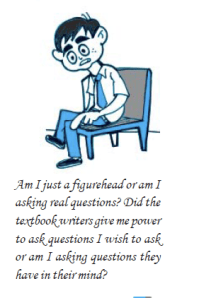
Unni [a cartoon character] asks:

“Am I just a figurehead or am I asking real questions? Did the textbook writers give me power to ask questions I wish to ask or am I asking questions they have in their mind?” [Page 85, Chapter 4: Executive, Indian Constitution at Work, for class XI]

This cartoon appears in the context of the discussion on the powers of the President of India in the political science textbook of NCERT. It seems this question has a function far wider than the limited task of revealing the institutional blueprint of Indian politics. It pushes the student to ask something very uncomfortable. Am I really the one asking the questions I ask? Or am I rehearsing questions that someone else has decided for me?

As teachers of political science, our constant effort is to understand the ways in which power operates. None of the themes of our syllabi can be taught without reference to the resistance, critique and offending positions taken by groups who challenge the status quo. Sanitizing the history of critique and resistance that is encapsulated in satirical modes of representation like cartoons, can only be at the cost of keeping the discipline of political science uprooted from its very object of study. In the recent cartoon controversy, however, the issues at stake are many more than a defence of critical pedagogy.

Continue reading Humiliation condemned to remain ‘Hurt’ – Notes from a talk by Gopal Guru: Parth Pratim Shil & Ankita Pandey