
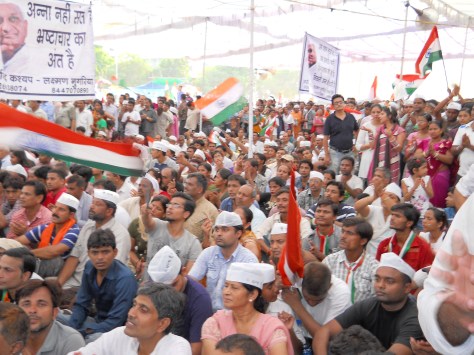
Partha Chatterjee’s post, following on Shuddha’s Hazare Khwahishein… is something of an eye-opener for me. I will not enter into a debate with him on his reading of Shuddha’s post as Shuddha and I have had our long online and offline exchanges and I have learnt immensely from these exchanges, even if a core of disagreement persists. I do think, however, that Partha is mistaken in thinking that this is the first time the question of corruption has been discussed on Kafila or elsewhere but since I am not interested in discussing that question here, I will leave that matter aside. I think I have said pretty much what I wanted to say on the movement and the myriad issues related to it and so I am no more interested in going over that territory all over again. Interested readers can see the Kafila archives if they so wish.
What has been an eye-opener for me is the way a certain other Partha Chatterjee has emerged, as soon as his theories were brought face to face with the hurly-burly of politics. The imprint of this other Partha is clearly evident in every word and sentence of this post, but most clearly in the concluding sentence where he claims that the indepdent Left has ‘its populist moment in Nandigram’. This sentence encapuslates the gist of our disagreements. It was this assessment that led Partha to write the essay, ‘Democracy and Economic Transformation‘ where, in some elliptical fashion, his own discomfort with popular politics found expression. That is when he extended the definition of ‘political society’ to say that it was the sphere of ‘management of ‘non-corporate capital’ (of course, by capital and government). That Partha links his discomfort over the Anna Hazare movement to his discomfort over Nandigram, is in my view, a sign of the fact that his idea of ‘political society’ lies in ruins, that it collapsed at the precise moment of its encounter with the popular.
Continue reading In the Ruins of Political Society – A Response to Partha Chatterjee
 KAFILA - COLLECTIVE EXPLORATIONS SINCE 2006