
 Guest post by SUSMITA DASGUPTA
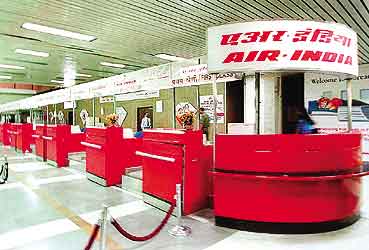
Many moons ago, when our sweet little dupleix in Dover Lane was enlarged into a three storey house to make space for a tenant, our first tenant was an Indian Airline pilot. Similarly, many modern condominiums in our locality were being rented out to pilots and air hostesses. This was a mark of Dover Lane having arrived as a respectable colony in Ballygunje from its rather modest middle class veneer. The airlines are always looked upon as a creamy layer of the middle class; offering prospects and possibilities that are matched only by the IT, bureaucracy and the army. It has the class of being high salaried, élan of professional excellence and the allure of a closed group cadre. In other words, it has the best of all worlds notwithstanding the attraction of international travel with sops like free tickets for dependent members of the family. The pilots, who are the core of this sector, are on strike in India’s only public sector in the aviation sector, namely Air India.
The pilots strike strands women, children, the elderly, the sick, the infirm and the rest to an uncertain halt. Air travel has picked up in India after the opening up of our skies to competition and cheap tickets that run without meals on board, expanding the market into ever increasing consumer base. Despite the rise in competition, the national carrier has grown only in importance over the years, plying in zones where the private airlines do not find it economically viable to travel. The importance of the public sector is precisely this; the large capital base makes the public sector actually extend its operations into areas where the private sector cannot delve as the former constantly subsidizes its operations with previously held monopoly profits. Contrary to common sense constructions that competition is detrimental to the government, it actually helps the public sector consolidate its profits and sometimes even steer them away from the private sector players. The company data from the CMIE clearly shows that the companies in the government sector do consistently better than the ones in the private sector, though the erstwhile sick companies that the government had taken over do worse than both of the above. Were the public sector companies to be removed from operations, private players would have done enormously better in terms of market shares and turnovers.
The scam that is forever a possibility in the Indian scenario is thus the decimation of the public sector. The CMDs are easy targets for bribing so that they like Trojan Horses destroy companies from within. Were the CMD to defy the Minister in such destruction, he is ferreted out as being corrupt with charges of misappropriation of funds leveled against him. The story of Krishnamurthy of SAIL is a case in the point. The other very suspicious category is the BSNL; a company, which in the smaller towns just refuses to operate. My experience with the BSNL is ridiculous; they never send bills on time, they never attend to complaints and should anyone study their website for registering online grievances, she would find that the site simply does not operate. In all these cases, they purposely drive customers away so that they move to Airtel, a company that seems to be just waiting in the wings. The case of Air India is no different from the above.
The intention of the government is to destroy its own airlines that will sky rocket the profits of the private players. There have already been murmurs about Jet heavily bribing the national carrier to hand over operations. Praful Patel’s steps at merging a loss making international carrier with a profit making national company without merger of pay scales and perks was purposely geared towards generating this level of employee resentment. The arrogance of the Minister and that of the CMD in resolving the issues shows the intention of the government very well. This is yet another scam no less than that of the 2G spectrum. Privatization arrives with ever burgeoning wads of dollars in the Swiss Banks.
Public sector employment is really about a security of employment rather than fanciful salaries. The private sector salaries are much lower than the public sector on the whole. The private sector may have one single individual at an astronomical salary but the next rung languishes at packets that barely sustain a dignified middle class life. No wonder so many families are now double income with neither the time nor the money to have children. No single institution but private capital has so systematically destroyed the stability of the social institution of the family. The public sector has been more equal in salaries, attracted always the creamiest layer of talents, and been better at R&D because retention of talent has been higher, accumulated expertise through security of employment. The life of private sector has been much lower, companies have barely survived beyond three decades, less than the life of Amitabh Bachchan, or Dharmendra on screen, retrenched workers, locked out, and never been able to move up the knowledge chain to become price makers in any segment of international trade. Vis-à-vis the public sector, the private sector has only to be resigned to normal profits. Only with the public sector gone, the private sector’s stocks will shine helping it to scrape off the shareholder’s money and then scoot. In sectors where the public sector is absent namely the real estate and entertainment, stocks have tumbled, creditors have lost, properties been attached. The aviation sector gets all set for such unholy gains only if Air India is out of its way.
At the level of the common man, such moves are deadly. People have EMIs to pay, children to send to school, old parents to take care of and insecurity of employment and income can play havoc with middle class calculations. Eastern India had been torn asunder by the manipulations of large private companies all through the decades of the 1960’s when people had factories locked out, provident funds stolen, crashing them out of middle class existence into poverty. The rest of India managed this with self employment and no wonder then the 1970’s and 1980’s saw the growth of self proprietary units largely called as the cottage, tiny and small scale units. The opening up of the economy to the unbridled play of private capital wiped out the niche for these self employed swelling the ranks of the jobless. It is then a scandal that the NSSO rounds on employment reports a steady decline in employment over its various rounds since 1972 till 2008 !! The existence of the public sector created some steadiness in rules of hiring and firing and in the absence of the same will leave the ever expanding population of job seekers and the already employed into a mayhem of madness of uncertainty, anxiety, depressions, divorces and suicides. Slowly, the middle class will disappear, leaving India widely divided into a minority of the very rich and a sea of the poor, looking like Africa, or Latin America, Bangladesh, or Pakistan, or Afghanistan or Zambia, or Ethiopia, or Greenland, or Dutch Surinam.
 KAFILA - COLLECTIVE EXPLORATIONS SINCE 2006
Agree fully! But i guess the media that is in the grasp of the Private sector interests will never expose this!
LikeLike
What’s with grouping ‘women’ with ‘the children, the elderly, the sick, the infirm’?
LikeLike
Women are usually grouped with children and senior citizens when stranded, or allowed inside sitting areas in public spaces, or in queues, or when getting down from crowded transport.
LikeLike
A really disappointing post on a usually sensible and thought through blog. Do you think that somehow the government disbursing salaries to public sector employees which are greater than what they would be in a free market, can somehow help the “common man” . The public sector employees are just a special interest group subsidized by the taxpayer’s money, namely the “private sector” money.
Have you done any research at all into what salaries people get in “private” and “public” sectors at comparable levels ?
Your argument is essentially one that has been made for 100s of years that somehow factories and modernization are bad because they “steal jobs” any introductory book on economics will show you how that is a logical fallacy
LikeLike
I am an active public sector employee for the past twenty years. This is my specialized area of research. Private sector dwells on poaching of the public sector brains, offerring one or two of the poached candidates pathetically high salaries and then dropping them off within three years flat. The skills with the private sector are poorer, salaries are unequal, turnover is high and focus on skill development low.
LikeLike
“This was a mark of Dover Lane having arrived as a respectable colony in Ballygunje from its rather modest middle class veneer.”
Dover Lane and “modest middle class”? Gimme a break!!
LikeLike
Dover Lane was modest in 1960’s. I belong to that era.
LikeLike
Kudos to Shivam to put this topic to public debate. The blatantly partisan neo liberal columnists of mainstream media wants to bin all these information infavour of the burgeoning corporates . Thanks
LikeLike
Obviously not well researched enough. Air India (as also BSNL) simply has a customer experience problem i.e. the collective experience of dealing with anything Air India (or BSNL) is pathetic, in comparison to expectation and/ or other options in the market. If users/ passengers are sort of forced to go with the next best private option, it would appear then that Air India/ BSNL were in fact first choices for several consumers, presumably because their relatively sober appearance betrays an acceptable tendency to stick to the basics and not indulge in expensive promotion and propaganda.
also the comment “The skills with the private sector are poorer, salaries are unequal, turnover is high and focus on skill development low” is not completely true. Turnover and salaries are simply outcomes of market dynamics, which the ‘secure’, even if disgruntled, government servant is immune to. All the training in the world is not good enough if it does not amount to getting the work done right.
Air India seriously does not need to hire the most expensive management consultants in the world and spend months on ‘route rationalization’. They need to attract more to hop on their bus. And that means every one of their ‘public sector’ employees has to wear their love for carrying passengers 30000ft into the sky, with a smile on their face.
A cultural problem. More than any other.
LikeLike
It would be helpful if Kafila imposed some mimimum standards of grammar and cogency on those whose article it posts. This is so atrociously written that is hard to discern the argument it seeks to make (assuming – to be charitable – that there is a cogent thought or two hidden in there). If not, please take the trouble to do some basic copy-editing – though in the case of something like this, that would amount to a full-scale rewrite.
Sentences like “This was a mark of Dover Lane having arrived as a respectable colony in Ballygunje from its rather modest middle class veneer” make no sense. Perhaps she meant “This was a mark of Dover Lane, with its rather modest middle-class origins, having acquired a veneer of respectability”?
Leaving aside the author’s apparent inability to reflect on things like what constitutes “middle class”ness, and whether such labels are used correctly, this betrays a basic inability to communicate clearly.
Even in an otherwise poorly written piece, “It has the class of being high salaried, élan of professional excellence and the allure of a closed group cadre” stands out for its utter meaninglessness. But that’s only until you get to ” In other words, it has the best of all worlds notwithstanding the attraction of international travel with sops like free tickets for dependent members of the family. ” Notwithstanding? Good Lord.
One final random example of the appalling level of writing: “The pilots strike strands women, children, the elderly, the sick, the infirm and the rest to an uncertain halt.” Err, how do you (transitively) strand to a halt? :)
Is this a joke?
LikeLike
Dear Sadat,
You might want to do a spellcheck+grammar check yourself?
:)
LikeLike
One of the worst articles ever on Kafila (and its standard is not too high in the first place)! I have no clue why Ms Dasgupta thinks it ok that my taxpayer’s money should go in paying the exorbitant salaries of incompetent, lazy employees of Air India. You want high salaries, you better work for it! You want to unionise and go on strike, you have a right as long as I am not paying your salary!
LikeLike
So, is it not better that such companies are sold off to private sector and the money accrues to the government rather than keep it in govt control and allow minister/cmd to make money at everyone else’s expense? Why should a govt run an airline these days? It should have been monetized a few years back rather than allow it to rot till date.
LikeLike
Not to mention the fact that in a private airline, it is the (rich) First & Business Class passengers that pay extra to subsidise the Economy class passenger. On Air India, it is the (poor) Taxpayers of India which subsidise the Politicians’ travel on First & Business Class!!!!!
LikeLike
well.. its just matter of time we will have private railways and few years after that the Indian railways shows a massive loss in its balance sheet… people wake up suddenly realising how their “tax money” is being wasted on a 150 yr old running company…
hmmm how bout privatising the defense force of India too.. lot of “tax money” spent there… bring in few private competitions, probably have a cheaper better defense…oh yes and the Indian police service too.. tax money is being wasted there too… why wait for a private company to enter and prove to the world how bad the govt of the largest democracy runs the show…
LikeLike