
Tag Archives: federalism

Professor Balveer Arora in Democracy Dialogues, 5 th January 2025, 6 PM (IST)

https://youtu.be/GM6KiF9zwII?si=hA3U2WAY_lh18jLF

Democracy Dialogues Series 35 / Organised by New Socialist Initiative

Theme : India’s Federal Democracy @ 75: Is it Secure?

Speaker : Prof Balveer Arora

Chairman, Centre for Multilevel Federalism and Former Professor of Political Science and Rector, JNU

Time and Date : Sunday, 5 th January, 2025 6 PM ( IST)

Live Streamed on : facebook.com/newsocialistinitiative.nsi

Abstract :As we celebrate the 75th year of the Constitution, it is important to remember that Indian federalism flowered late. In the initial years, the development of democracy overshadowed the federal provisions of the Constitution. Certain formulations of the Constitution and single-party dominance even cast doubts on its very existence.

Dismissed as quasi, much was made of the preference for the term Union to question even the federal intent of the framers of the Constitution. As India’s federal polity developed, it became clearer that federalism was not merely intended but also an integral part of the basic structure of the Constitution. It was further defined and refined with asymmetrical provisions to accommodate its burgeoning diversity.Is it being denied today?

The federal fact is central to the understanding of contemporary Indian politics. Federalism has imparted resilience to Indian democracy. Traditionally, the concept of federalism involved relationships between central governments and federated units. Defined in legal- constitutional terms as different power distributions between the central government vis-à-vis the states and local governments, they typically limited relationships to those between governments, notably between various actors in the executive branch. We seek to go beyond this framework to look at federalism as a democratic process.

The threats to the federal essence of the polity are many, majoritarianism being the foremost. Majoritarian democracy is incompatible with the federal principle, which is based on the recognition of the right to self-rule for all constituents of the federal polity. Is this under siege today by an integrationist vision that seeks unity through uniformity? How can federal democracy be protected and preserved under these conditions? Can it be made more secure?

About the Speaker : BALVEER ARORA is Chairman, Centre for Multilevel Federalism and Former Professor of Political Science and Rector, JNU. Earlier, he was a visiting fellow at the National Political Science Foundation, Paris and the Center for the Advanced Study of India, University of Pennsylvania, USA. He has edited / co edited many books : Here is a list of few of his publications :
– Transforming India: Social and Political Dynamics of Democracy
– Multiple Identities in a Single State: Indian Federalism in Comparative Perspective
– Party System in India: Emerging Trajectories ,
– Federalism in India: Origins and Development
– The Value of Comparative Federalism: The Legacy of Ronald L. Watts
– Federalism and Public Health in India: Dissonant Discourses

Functioning of Panchayati Raj Institutions in Bihar – Devolution or Delegation? Mayank Labh

Guest Post by  MAYANK LABH

The upcoming panchayat election in Bihar is a good occasion to examine the broader issues faced by the Panchayati Raj Institution (“PRIs”) in Bihar. According to media reports, the State Election Commission of Bihar has started to prepare for the upcoming panchayat election in Bihar, and the poll process would commence from the end of August.[1] Preceded by a 23-year gap as large-scale violence marred the 1978 panchayat elections, the panchayat elections in Bihar have been held on a mandated five-year interval since 2001. However, apart from conducting the panchayat elections, the National Democratic Alliance (“NDA”) government in Bihar has done little to further participatory democracy as the idea of local self-government remains illusory even after about 1,27,391 representatives get elected after every five years. Continue reading Functioning of Panchayati Raj Institutions in Bihar – Devolution or Delegation? Mayank Labh

Why Federalism Must Become the Fulcrum Of Politics In Coming Days

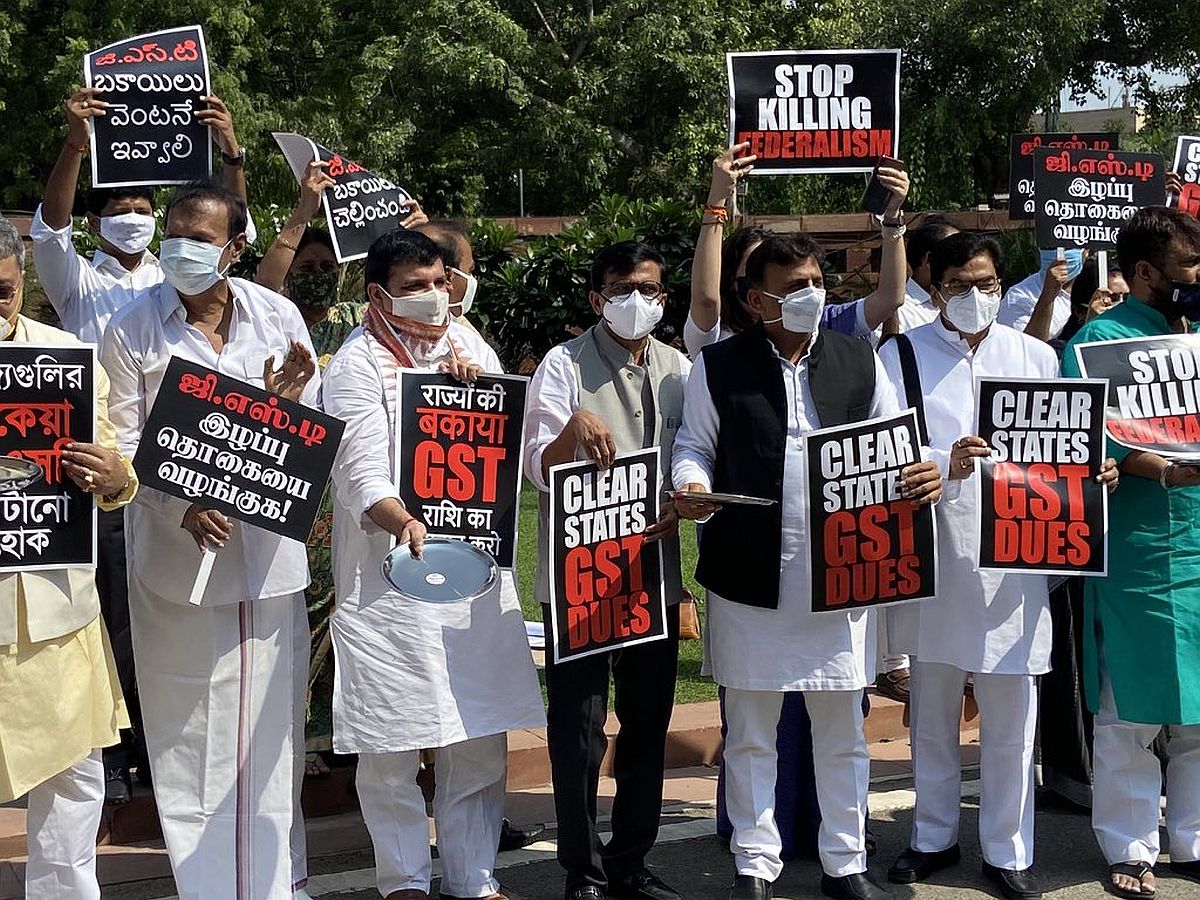
MPs demonstrtate in parliament for states' GST dues
MPs demonstrtate in parliament for states’ GST dues, 17 September 2020, Photo: Twitter/@priyankac19, courtesy The Statesman

A shorter version of this article appeared in Bangla earlier in Sahomon.

The question of federalism and Centre-State relations has been on many people’s minds lately, given that the Centre in the Modi dispensation has been hell bent on usurping the powers of the states while slyly thrusting all responsibility on to their shoulders. As a matter of fact, it was precisely during the outbreak of Covid19, when there should have been maximum cooperation between the Centre and the States, that the strains started showing in a glaring manner. Very early on, it became clear that the Centre was intent upon using the pandemic to usurp more and more powers, while riding roughshod not only on the rights of ordinary citizens but also of the States. In dealing with the pandemic, not only were the mandatory  consultations with the States not held, they were in fact simply handed over decisions. The most dramatic of all these, of course, was the completely bizarre manner in which the Lockdown was declared last year, at just four hours notice. The huge tragedy that followed was totally avoidable had there been prior consultations and had the Prime Minister, just for one moment, behaved like one. As a matter of fact, the record of this government over the past seven years has been pretty consistent in this regard at least. Continue reading Why Federalism Must Become the Fulcrum Of Politics In Coming Days

Post-Election Musings -Federalism to the Fore: Nakul Singh Sawhney

Guest post by NAKUL SINGH SAWHNEY

Some observations and takeaways from State Assembly elections in Kerala, Tamil Nadu, West Bengal, and Assam in May 2021 – from an original Facebook post. The observations are in the form of informal reflections but they point towards certain developments that might open up new, anticipated spaces for the struggle for a democratic India.

Federalism: The Election verdicts of May 2, 2021, from Tamil Nadu, West Bengal, and Kerala scream ‘federalism’. The election results are so vastly different in the State Assemblies and Lok Sabha. The election outcomes of Delhi, Maharashtra, Haryana, West Bengal, Kerala are important examples of this phenomenon.

India is a country that naturally lends itself to federalism and greater state autonomy. While the Congress, by and large, didn’t allow for it, the BJP is hell-bent on a deeply centralized structure and crushing any aspiration for regional autonomy. If progressive forces don’t take up the question of federalism and state autonomy, then it runs the risk of slipping into the hands of crude chauvinists and xenophobes like Shiv Sena of yesteryears or secessionists like Khalistanis.

Continue reading Post-Election Musings -Federalism to the Fore: Nakul Singh Sawhney

Save the left from left scholars

I have just returned from an atrocious talk delivered by a famous Nepal expert, David Seddon, who claims to belong to the ‘old British Marxist tradition of Eric Hobsbawm and E P Thompson’.

So this Mr Seddon is well known in Nepal for a book he wrote three decades back – Nepal in Crisis. More recently, he got along with a local activist to edit a book on the People’s War.

Now, Seddon sahib comes here. He tells a Nepali audience how he is worried about the rising violence and the ‘law and order’ problem. He links the violence with identity – “people feel they have a legitimate basis to pick arms and throw stones because they belong to a caste and ethnic group.” He tells the audience, many of whom have struggled for long to bring some change in the exclusionary Nepali state structure, that ‘identity politics is profoundly undemocratic and federalism is not necessary.” And here is the clincher, “When your constituent assembly members adopted a federal democratic republic, I am sure they were thinking only about the republic part. No one really thought about the federal part.” Continue reading Save the left from left scholars