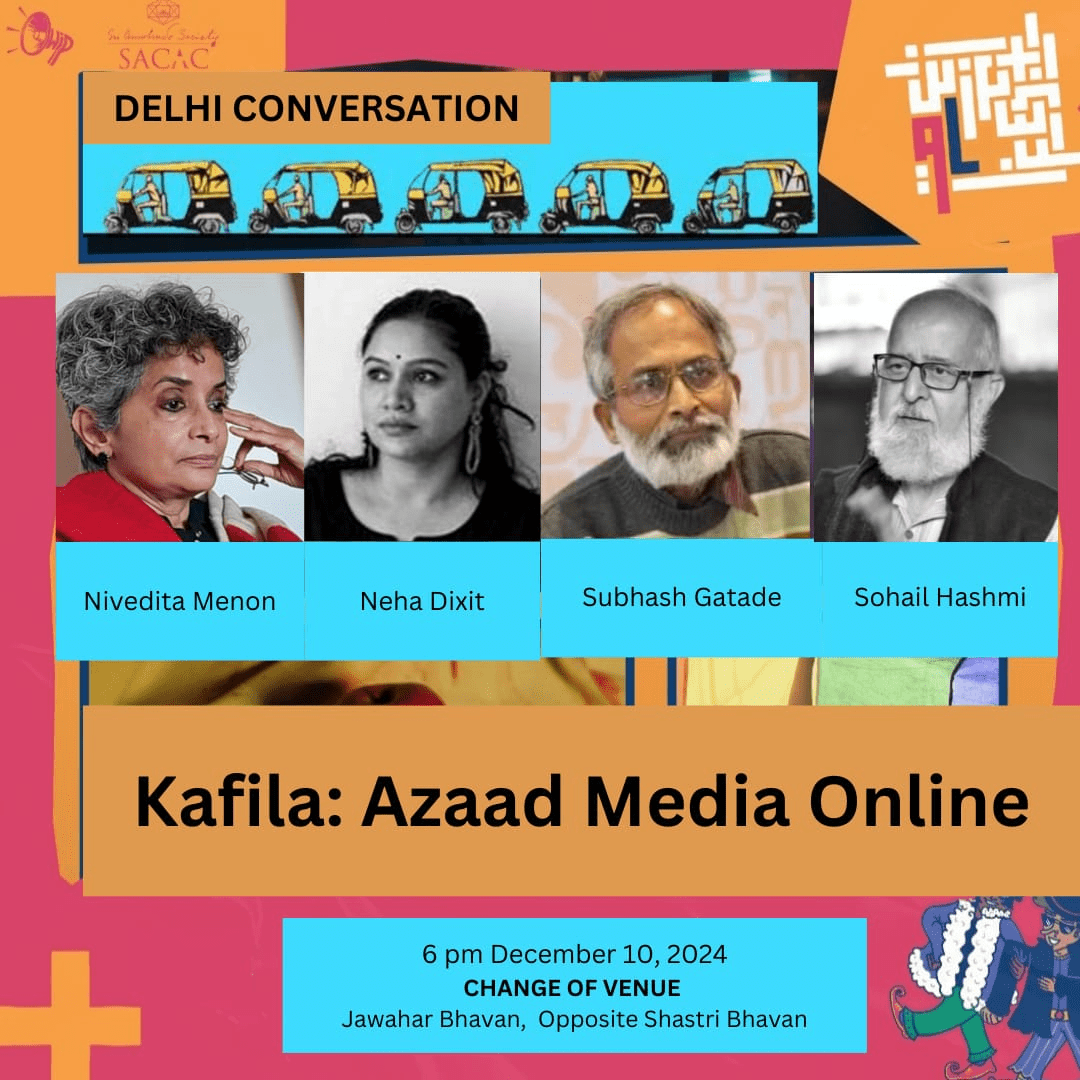
Presentation at the panel on Kafila held as part of the W.I.P alt.FEST held in Bangalore and Delhi in December 2024. The second post in the series can be read here and the third by J. Devika here.
They were different times.
Times when the space for debate and discussion had not shrunk as we it witness today, when stigmatisation of ‘others’ or ‘criminalisation of differences’ had not yet started; times when one had rarely heard about writers. rationalists or cultural workers coming under murderous attacks in this part of South Asia, just because they dared to speak the truth.
Perhaps it is better to begin from the beginnings.
One still remembers the very first meeting we had at CSDS, Delhi in Aditya’s room to discuss the idea of a blog and its launching. Apoorvanand was there, a young blogger Shivam Vij – was also present ( who became a ‘Guru’ of many of us ‘oldies’ for sometime, who were then taking baby steps in this virtual world of self publishing).
For me it was my first experience to be directly associated with a blog.
None of us had any premonition that we are in for interesting times and would be helping catalyse conversations on various issues of concern among a wide spectrum of writers, activists, scholars and concerned individuals.
All of us had our own teething troubles then, in fact initially I found it extremely difficult even to upload my posts on the blog and had to take the help of a close friend in the IT sector to do it.
What is worth underlining about Kafila
Looking back, one today feels mesmerised the way it could attract people of various shades to contribute for the blog . Thanks to the wide network of contacts of a few among us- the number of admins reached the figure of twenty two . What connected them was their unflinching opposition to communalism, capitalism, casteism, patriarchy etc and their yearning to enhance and enrich the intellectual atmosphere in their own way and promote a culture of discussion and debate in the rest of the society.
Nirbhaya movement and the India against Corruption campaign – popularly called as Anna Movement were the two high points when Kafila reached its peak. One can still recall Shuddho returning from a rally in Jantar Mantar and on his way back home, posting an article on the theme which used to gather scores of comments the next morning
It was a period when even the mainstream magazines, publications felt it necessary to pay attention to the debates happening there and gladly rerepublished pieces which had earlier appeared on Kafila or even referred to Kafila post. Another important facet of Kafila was that there were occasions when the views of Kafila admins themselves differed but what was remarkable that it did not create any bad blood or any rancour among us. We continued to remain friends / comrades as earlier.
Perhaps it also had its genesis in the long bonding which had emerged between many of us during various social political interventions in the capital since mid nineties. Campaigns for defence of rights of workers (Delhi Janwadi Adhikar Manch) or struggles against communalism (Aman Ekta Manch) or issue of caste (Durban Abhiyan) etc
Anna movement was the high point also because it clearly witnessed a clear division of opinion between us – few of us were completely opposed to the movement for its politics, who felt that it was a RSS inspired movement but others were equally vehement supporters of the movement, who felt that it provided a ray of hope in those times.
Another important point was the impact it could generate across a large sections of people.
It was the year 2014 ( elections were yet to be held) and one fine morning I got a call from an officer associated with a Eurozone country that he wanted to meet me. This gentleman – who was much familiar with Kafila – who had even read the morning article which had appeared in Kafila, felt that someone like me could provide him with necessary details and analysis of the unfolding situation and also the possibility of Modi’s coming to power.
What one observed that influence of Kafila was not restricted to only lefts and liberals, it was also read by the Rightwing.
A close relative of mine – who was then associated with a Hindutva Rightwing organisation but had started having doubts about their project – then had shared with me about the discussion he heard in the ‘family’ office.
He heard two of the seniors talking, ‘ we should learn from Kafila, look how they write and polemicise’

 KAFILA - COLLECTIVE EXPLORATIONS SINCE 2006