
Tag Archives: Hindu Code Bill

हिन्दुत्व के कल्पना-लोक में स्त्री और RSS के लिए उसके अतीत से कुछ सवाल

[मध्ययुग में पश्चिमी जगत में आधुनिकता के आगमन ने धर्म के वर्चस्व को जो चुनौती दी थी, भारत में अंग्रेजों के आगमन के बाद पैदा हुई परिस्थितियों और राजनीतिक आजादी ने यहां धर्म के प्रभाव को और अधिक सीमित कर दिया। रूढ़िवादी, प्रतिक्रियावादी ताकतों ने समय-समय पर इस बदलाव को बाधित करने की कोशिश की। संविधान निर्माण से लेकर स्त्रियों को अधिकार-संपन्न करने के लिए ‘हिन्‍दू कोड बिल’ को सूत्रबद्ध एवं लागू किए जाने का हिन्दुत्ववादी ताकतों ने जिस तरह से विरोध किया, ऐसी ही बाधाओं का ही परिणाम रहा कि डॉ. आंबेडकर को नेहरू के मंत्रिमंडल से इस्तीफा देना पड़ा। यह आलेख संविधान-निर्माण के दौरान स्पष्ट तौर पर उजागर हुए राष्ट्रीय स्वयंसेवक संघ के स्त्री-विरोधी विचारों एवं सक्रियताओं की पड़ताल करता है]

वह 1936 का साल था, जब राष्ट्रीय स्वयंसेवक संघ (RSS) के विचारों एवं कार्यों से प्रभावित होकर नागपुर निवासी लक्ष्मीबाई केलकर (1905-1978) ने संघ के संस्थापक सदस्य डॉ. केशव बलिराम हेडगेवार से मुलाकात की और संघ से जुड़ने की इच्छा जाहिर की थी। सुश्री केलकर- जिन्हें बाद में लोग मौसीजी नाम से पुकारने लगे थे- को यह कतई उम्मीद नहीं रही होगी कि संघ सुप्रीमो इस प्रस्ताव को ठुकरा देंगे और उन्हें सिर्फ स्त्रियों का संगठन बनाने की सलाह देंगे। ‘’राष्ट्र सेविका समिति’’ की स्थापना की यही कहानी बताई जाती है, जिसे आरएसएस का पहला आनुषंगिक संगठन भी कहा जा सकता है।

राष्ट्र सेविका समिति की जब स्थापना हुई, तब RSS का निर्माण हुए 11 साल का वक्फा गुजर चुका था। वह दौर औपनिवेशिक शासन के खिलाफ तथा सामाजिक उत्पीड़न से मुक्ति के लिए उठी हलचलों का था, जिसमें स्त्रियों ने बढ़-चढ़ कर हिस्सा लिया था। भारतीय राजनीतिक-सामाजिक जीवन में जबरदस्त सरगर्मियों के इस दौर में संघ संस्थापक महानुभावों में से किसी को भी यह खयाल तक नहीं आया था कि आबादी का आधा हिस्सा स्त्रियां उनके नक्शे से गायब हैं। वैसे, उन्हें इस बात का एहसास होता भी कैसे क्योंकि इन दोनों किस्म की हलचलों से उन्होंने दूरी बना कर रखी थी और अपने बेहद संकीर्ण व असमावेशी नजरिये के तहत संगठन बनाने में जुटे थे। धर्म आदि के आधार पर जिन्हें वह ‘अन्य’ समझते थे, उनको लेकर अपनी एकांगी सोच के प्रचार-प्रसार में सक्रिय थे। ( Read the full article here : :https://followupstories.com/politics/women-in-hindutva-ideological-realm-and-historical-blunder-of-rss/)
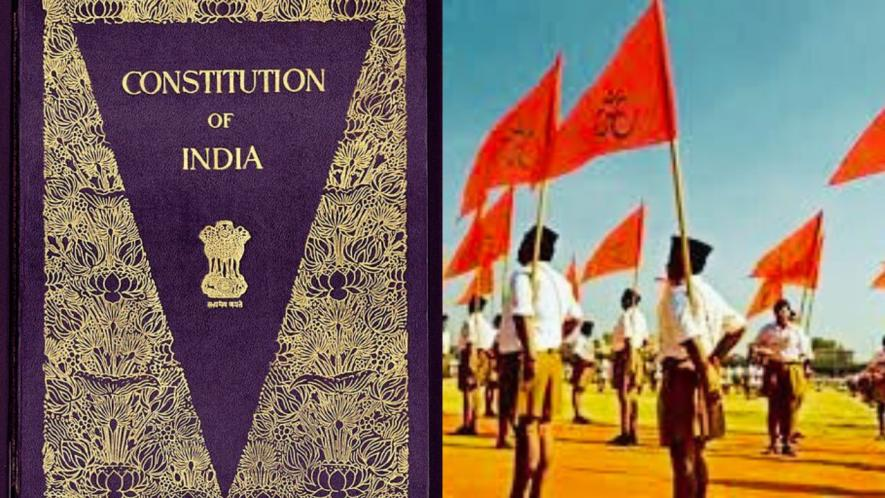
The Unending Discomfort of RSS With the Constitution

The Vajpayee government tried to change the Constitution, but lost in 2004. We must be vigilant, as a similar chorus is being raised again by Hindutva Supremacist forces.

..make India an independent sovereign republic and guarantee and secure for all the people of India social, economic and political justice; equality of status and  opportunities and equality before law; and fundamental freedoms—of speech,  expression, belief, faith, worship, vocation, association and action—subject to law and public morality;

and also ensure that

adequate safeguards shall be provided for minorities, backward and tribal areas, and depressed and other backward classes.

(Excerpts of Objectives Resolution in the Constituent Assembly, moved by Pandit Nehru on December 13, 1946 and adopted unanimously by the Constituent Assembly on January 22, 1947)

It was just another press conference in the national capital.

The only difference was that it was held at the house of a member of Parliament belonging to Bharatiya Janata Party (BJP), the main opposition party then…

This was on December 25, 1992. Less than three weeks before India had witnessed one of its deeply troubling, disturbing moment in its history where a mosque, which stood for more than 500 years, had been demolished by a horde of people who had gathered there from different parts of the Country, mobilised by the forces of Hindutva supremacism.

..Swami Muktanand and Vamdeo Maharaj, who were closely associated with the Ram Mandir movement (India Today, January 31, 1993) addressed the press meet.

This Constitution is anti Hindu‘ and needs to be rejected.”We have no faith in country’s laws‘ and ‘Sadhus are above the law of the land‘.’

..The press meet ended rather abruptly.

Journalists, who had gathered there to hear something about the movement, felt cheated that what unfolded there was an anti-climax.

Little did they have a premonition that the press meet was just an opening shot and more was coming. ( Read the full text here : https://www.newsclick.in/unending-discomfort-rss-constitution)

Women’s Rights are Hard Won — An Open Letter to the Chief Minister of Kerala : V Geetha

we are troubled that the state finds it hard to grant a woman the right to lead a life of her choice and to have custody over her child. These are hard won rights, and it has taken generations of struggle by women, many of whom are from your state, to secure both civil and legal acknowledgement for women’s rights to marriages of their choice, and for their right to motherhood, divorce, adoption and so on.

Continue reading Women’s Rights are Hard Won — An Open Letter to the Chief Minister of Kerala : V Geetha

Nehru, Ambedkar and Challenge of Majoritarianism

Image result for nehru ambedkar

( Photo courtesy : The hoot)

(To be published in the special issue of ‘Janata’)


The spectacle of what is called religion, or at any rate organised religion, in India and elsewhere, has filled me with horror and I have frequently condemned it and wished to make a clean sweep of it. Almost always it seemed to stand for blind belief and reaction, dogma and bigotry, superstition, exploitation and the preservation of vested interests.

– Toward Freedom: The Autobiography of Jawaharlal Nehru (1936), pp. 240–241.

If Hindu Raj does become a fact, it will no doubt, be the greatest calamity for this country. No matter what the Hindus say, Hinduism is a menace to liberty, equality and fraternity. On that account it is incompatible with democracy. Hindu Raj must be prevented at any cost.

– Ambedkar, ‘Pakistan or Partition of India’, p. 358.

Introduction

India’s slow ushering into a majoritarian democracy is a matter of concern for every such individual who still believes in pluralism, democracy, equality and a clear separation of religion and politics. The way people are being hounded for raising dissenting opinions, for eating food of their choice or entering into relationships of their own liking or celebrating festivals according to their own faith is unprecedented. The situation has reached such extremes that one can even be publicly lynched for belonging to one of the minority religions or for engaging in an activity which is considered to be ‘suspicious’ by the majority community.

No doubt there is no direct harm to the basic structure of the Constitution, its formal structure remains intact, de jure India does remain a democracy as well as a republic, but de facto democracy has slowly metamorphosed into majoritarianism and the sine qua non of a republic—that its citizens are supreme—is being watered down fast. It does not need underlining that this process has received tremendous boost with the ascent of Hindutva supremacist forces at the centrestage of Indian politics. Continue reading Nehru, Ambedkar and Challenge of Majoritarianism