
Tag Archives: Russia

South Asian Futures in a Tri-Polar World : Professor Pervez Hoodbhoy

Democracy Dialogues Series – Lecture 40
Organised by New Socialist Initiative

Theme :
South Asian Futures in a Tri-Polar World

Speaker :
Professor Pervez Hoodbhoy
Eminent Physicist, author, public intellectual

Time and Date :
6 PM (IST)
Sunday , 27 th July 2025

The lecture is also live streamed at facebook.com/newsocialistinitiative.nsi

Abstract:

The Cold War and the collapse of the Soviet Union are long behind us, and we’re now hurtling toward a tri-polar world dominated by America, Russia, and China. These three powers vy to shape global influence, often competing but sometimes colluding. As the saying goes, “When elephants fight, the grass gets trampled.” So, the central question for this lecture is: What path are the nations of South Asia—including Afghanistan and Iran—likely to take? What alternatives and tools do they possess to navigate this landscape? Most importantly, what vision of society and power should guide them toward a viable future?

Speaker :

Professor Pervez Hoodbhoy is a nuclear physicist, author, and a prominent activist who is particularly concerned with promotion of freedom of speech, secularism, scientific temper and education. He is the founder-director of The Black Hole in Islamabad and as the head of Mashal Books in Lahore, he leads a major translation effort to produce books in Urdu that promote modern thought, human rights, and emancipation of women.

Prof Hoodbhoy received his undergraduate and doctoral degrees from MIT and has taught  physics and mathematics at Forman Christian College-University in Lahore, at the Quaid-e-Azam University (QAU) in Islamabad and later at Lahore University of Management Sciences (LUMS).

He is a recipient of the Baker Award for Electronics and the Abdus Salam Prize for Mathematics. He was visiting professor at MIT, Carnegie Mellon University, and the University of Maryland. In 2003 he was awarded UNESCO’s Kalinga Prize for the popularization of science.

Here is a list of a few of his publications :

– Pakistan: Origins, Identity and Future, published by Routledge (London, New York), 2023.
– Confronting the Bomb – Pakistani and Indian Scientists Speak Out, (edited) Oxford University Press, 2013.
– Education and the State – Fifty Years of Pakistan, (edited) Oxford University Press, 1998.
– Islam & Science: Religious Orthodoxy and the Battle for Rationality, published by ZED Books, London, in 1991 with translations in Turkish, Malaysian, Indonesian, Arabic, Spanish, Sindhi, and Urdu.
– Proceedings of School on Fundamental Physics and Cosmology, co-edited with A. Ali, World Scientific, Singapore, 1991.
Statement on the Russian Invasion of Ukraine: Radical Socialist

We publish below a statement by Radical Socialist on the Russian invasion of Ukraine. The statement minces no words in condemning the aggression as well as NATO but refuses to make the NATO the justification for Russia’s yearning for the lost empire.

1. We condemn Russia as an imperialist aggressor using the dreams of an old imperial epoch to justify expansionism, and are deeply concerned at this precedent  that may later affect any other former Soviet republic.

2. As when the US invaded Iraq, we do not use the language of diplomacy, we do not seek UN intervention, but call for the immediate and unconditional withdrawal of the aggressors.

3. This demand does not date only to 2022. We demand the Russian withdraw from every inch of Ukrainian territory. That includes Crimea, and the provinces in Eastern Ukraine even as we recognise the justice of demands for greater cultural and political autonomy so that Ukraine becomes a more democratic and federal set-up. Crimea had its own Constitution in 1992 which gave it greater powers of self-governance with some powers delegated to Kiev. Unjustifiably, President Kuchma subsequently annulled this Constitution.

Continue reading Statement on the Russian Invasion of Ukraine: Radical Socialist

‘Revolution against Das Kapital’ and the ‘Lonely Hour of the Economy’

This is a modified version of the article that was published earlier in The Wire

(T)he economic dialectic is never active in the pure state; in History, these instances, the superstructures etc – are never seen to step respectfully aside when their work is done or, when the Time comes, as his pure phenomena, to scatter before His Majesty the Economy as he strides along the royal road of the Dialectic. From the first moment to the last, the lonely hour of the ‘last instance’ never comes. – Louis Althusser, For Marx, London: Verso 1979, p. 113

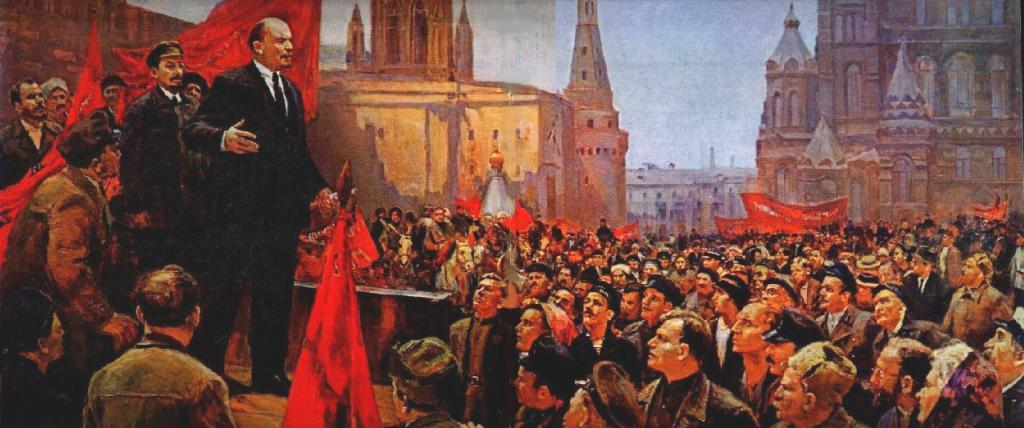
The event known to the world as the ‘October’ revolution in Russia – or simply as the ‘Russian revolution’ – took place on 7-8 November, a hundred years ago. But then why call it the October revolution? Thereby hangs a tale – the tale of modernity, myth-making and of a new imagination of Time.

The moment of revolution, image courtesy libcom.org

As a matter of fact, the Revolution occurred on 25-26 October, according to the Julian calendar (so called because it had been promulgated by Julius Caesar), which Russia, along with a large part of the Western world, followed at that time. It was only in January 1918 that the Soviet government decreed the shift to the Gregorian calendar. The reason was that Russia should join ‘all cultured nations in counting time’, as a decree cited by historian Mark Steinberg put it. Accordingly, the first anniversary of the revolution was celebrated on 7 November 1918 throughout the Soviet Union.

What is interesting here is not so much the shift but the reason assigned for it – joining other ‘cultured nations’ of the world, which in the language of the early twentieth century meant only one thing – the modern West, which had long been setting the norm for everything desirable. Ways of ‘counting time’ too had to be aligned with Europe, lest one be considered insufficiently modern. Spatially, the Czarist Russian empire straddled both Europe and Asia, which had already, in the new reckoning of Time, been cast as ‘advanced’ and ‘backward’ respectively. The desire to become modern and join the ‘cultured nations’ was to run through the history of the revolution and its consolidation into the new Stalinist state. This desire was to be manifested in its deep distrust of the peasantry and rural life on the one hand, and in the frenetic drive to ‘catch up’ with Western Europe. As Stalin would say, he wanted to accomplish in a couple of decades what Europe had in a few centuries, compressing time, as it were, into one dizzying experience for entire society. The continuing ‘past’ had to be annihilated.

Continue reading ‘Revolution against Das Kapital’ and the ‘Lonely Hour of the Economy’